
To your brain, a walnut and balsa wood sound like two different kinds of things. They are fundamentaly different. And that’s where people go wrong.
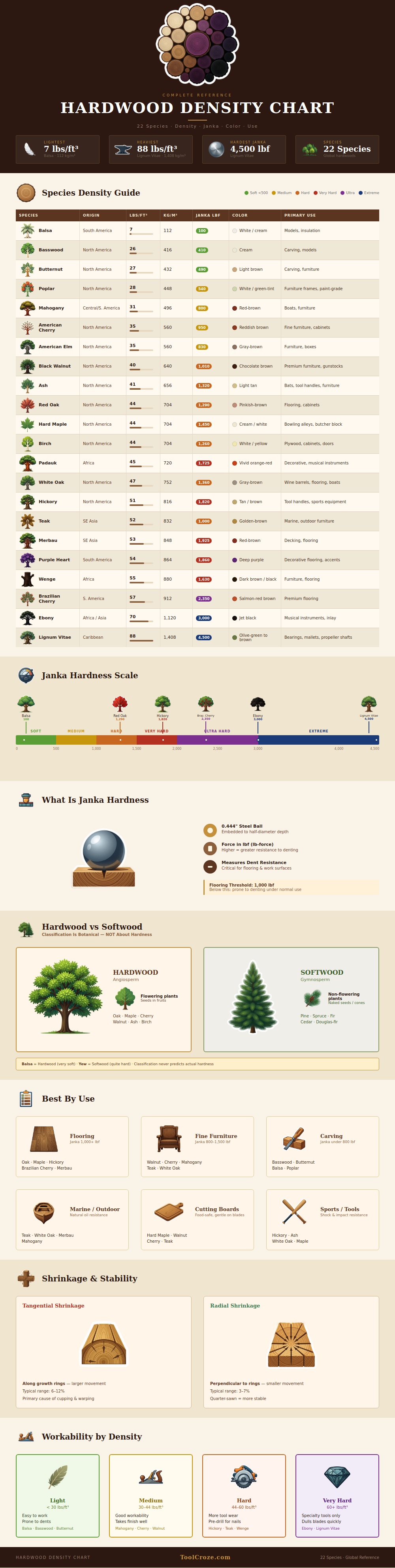
Walnut and balsa is both hardwoods. Hardwoods as in how the tree reproduces. It does not mean hard as in physically tough. The chart above illustrates the difference: balsa is seven pounds per cubic foot; ebony is seventy. They’re cousins; just look at their family tree. Yet in the workshop, they acts like strangers. Knowing this will keep you out of trouble.
Understanding Wood Density and Hardness
The most costly mistake a maker can make is buying the wrong piece of wood for the wrong project. How heavy is it? (That’s density.) (That’s hardness.) How does it resist wear? To perform the test, a steel ball push into the wood, measuring the force needed for penetration. If you’re making a dining table that gets used every day, you want something with high Janka numbers.
Above a thousand pounds sits hickory, followed closely by Brazilian cherry. These are great choice for floors that get used a lot: Drop your silverware and they’ll take the blow without a dent.
Basswood and butternut weigh less than five hundred pounds. Smooth as silk to sand, these species carve wonderfuly well. But look at them the wrong way, and they bruises. For every bit of workability, you sacrifice a little durability.
The origins of these materials should of been considered. Tropical climates produce many of the dense hardwoods used. Africa produces wenge. Southeast Asia produces teak. All of these wood developed where density was necessary for structural strength. If you’re sourcing locally on North American continent, you’ll probably be working with maple, oak or ash. These is all dependable woods that perform predictably. Generally they’re more readily found in standard lumberyard.
There are twenty-two different species on the chart from around the world. It paints a picture of what might await you if you choose to wait for special-order imports. On one hand, exotic woods gives your piece character. They also make supply chain more complex. Consider not only the price tag but environmental cost of this choice compared to visual reward.
As you begin assembling, think about what’s going into it. As a general rule, denser wood need heavier clamps. Because of its weight, it also tends to split if you screw without pre-drilling. Conversely, light wood is forgiving. It won’t splinter easily but will crush if clamped down too hard. Crushed wood creates weak joint.
The higher the density, the less workable the wood becomes. You want to be below 30 pounds per cubic foot, where things become easy. Wood moves with tools. Above 60 pounds per cubic foot, your saw blades gets dull fast. Use sharper blades. Be patient. More on this in infographic.
This isn’t all about strength. It’s about working with respect. The finishing touch is color. Color changes from the mahogany, which provides a nice rich reddish brown through age, to the padauk, which begins its life as a bright orange red but deepens into an even richer tone, and to the fact that some wood grow darker when exposed to light. That evolution brings another element of the anticipation to the process. You’re not simply constructing something, you’re cultivating a surface that will interact with the world and take on new characteristics.
The chart shows what each species was primarily used for. And they include everything from musical instruments to boats. That’s because some wood has grain structures and densities that resonate or hold up better to water. If you ignore them, you’ll be struggling against the wood instead of with it.
There’s a lot of science behind selecting wood. For instance, you should match properties to purpose. Need outdoor furnitures? Go with white oak or teak, both have natural oil resistance. Go with white oak or teak, both can absorbs natural oils. Want a smooth finish for a piano? Black walnut or ebony has the right acoustic quality and density.
The data points you in the right direction. Your own intuition closes the sale. Start with the numbers. Finish with the feel. Keep in mind, walnut and balsa is cousins, not enemies. Let that frame the way you approach each piece that comes across your bench.
