
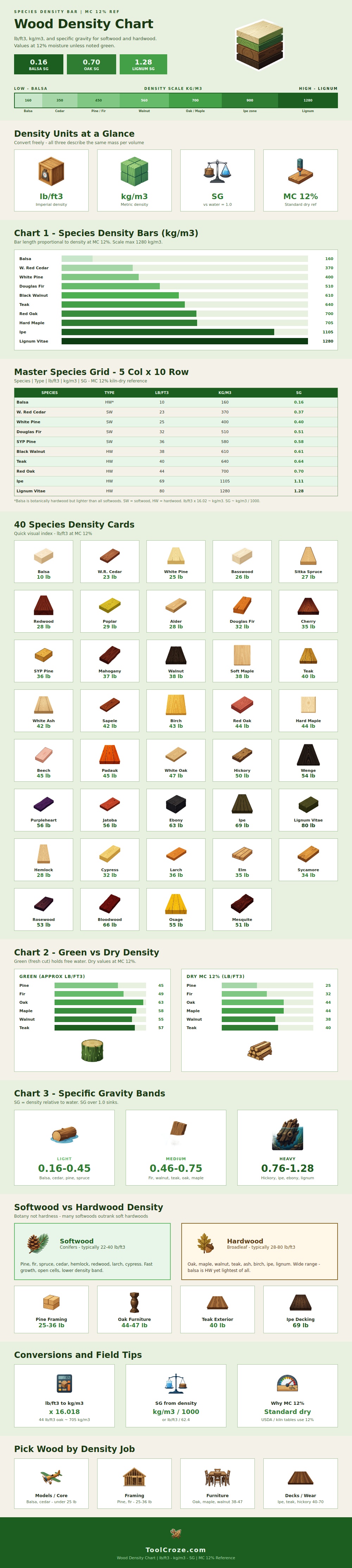
Pick up a chunk of balsa and then pick up an equivalent chunk of oak. They feels like two pieces of totally different material. One is as lightweight as air; you could toss it on a pond. The other is heavy as lead; it’s hard work trying to get the hammer head started. Why? It all boils down to density: How tightly are the wood cells packed in there?
Knowing this number shifts your perspective on any woodworking project whether building a fine model or putting up a house frame. The chart contrasts kilograms per cubic meter, pounds per cubic foot, and specific gravity. You’ll be able to judge a material easly with no guesswork.
Why Wood Density Matters
The botanical trap to avoid: Most folks think softwood is always lighter than hardwood. No. Conifers (softwood) grows fast. They have an open cellular structure. Broadleaf trees (hardwood) generally tend to be slower growing, packing more stuff into the space available. Balsa is technically a hardwood, but it’s an inefficient one at best.
In fact it is the lightest wood on this list and weighs just ten pounds per cubic foot. It carves like butter. It floats easy. On the opposite end of the range we find lignum vitae. This is a very dense tropical wood. It actualy sinks in water. It weighs eighty pounds per cubic foot. That’s the difference in the world of woodworking.
One variable that can ruin your project if neglected is moisture content. A lot of green wood has lots of free water in the cells. That means the wood is less stable and heavier. When that water evaporates out of the wood as it dries, it get lighter and lighter. The reference data shows twelve percent moisture content. That’s what most supply store lumber is kiln dried to. By making it all the same, it can all be compared on a fair basis.
You may purchase a board that doesn’t feel like you thought it would. It might just be drier or heavier, meaning it’s still retaining some moisture. Further drying will cause the wood to warp and shrink. Knowing the species isn’t quite enough; you have to check the moisture content too.
As far as density compared to water goes, we can think of this in terms of specific gravity, which is a handy shortcut. A specific gravity of one means something is the same weight as water. Anything with a higher specific gravity then that will sink. For example, lignum vitae has a specific gravity of 1.28. That’s what holds it down at the bottom of the pool.
Wood used commonly in construction, such as fir or pine, have a specific gravity much less than one. That’s why pine floats so readily. If you look at the chart, it groups them into categories by band. And it tells us that all of those woods used in furniture, with very few exceptions, tend toward a mid-range of specific gravities. Maple, oak is right there in the middle. They are just heavy enough to be substantial, but not so heavy that you need a forklift to get them around.
When selecting your wood, how dense it is matters; match your project to the density of the wood. Don’t put lightweight balsa into a table top, it’ll dent if you look at it wrong. And don’t put heavy ipe on a lightweight chair seat, it’ll be tiring to carry around.
A good mid-point for structural support is framing lumber (e.g. Southern yellow pine). Southern yellow pine is both dense and light. It is strong enough to carry a roof, yet light enough for two people to lug around. For exterior decking, where wear and weather is an issue, denser woods like ipe or teak make sense, since they’re harder-wearing. The woods in the higher density bands show up here. This makes sense because higher density means more durability, which is good for high traffic areas.
If you read metric specs and are accustomed to Imperial measurement, it can be a pain to convert the numbers. Fortunately, there’s an easy trick for converting pounds per cubic foot to kilograms per cubic meter. Just multiply the number of pounds per cubic foot by sixteen. You don’t have to remember all the conversions; just know the relationship so you can double check your guesses.
For example, say you’ve got some wood in one hand and you guess that it weighs about forty pounds per cubic foot. That means it’s probably six hundred kilograms per cubic meter. That mental math allows you to easily size up what something might weigh as you’re walking around comparing suppliers or looking at a stack of material at the lumber yard.
But density isn’t simply a number; it’s a promise from the wood. The word itself means “denseness.” It promises how it will act. It shows what load it will bear, how easily it will machine, and how long it will endure. How heavy does the wood feel in your hands? That’s the history of the tree growing into the piece you hold.
Lighter = soft = fast grower. Hard = slow = dense. It helps you understand and respect the material, making fewer mistakes when you allow the wood’s density to inform decisions. Want a gentle scroll or a strong work bench? What does it feel like in your hand? Let its weight tell you the story. And then start off with the proper density, and everything else should of fallen into place.
