
If youve ever been to an aisle of fittings trying to match the right connector to end of a pipe while clutching both in your hands, then you know what I mean: it’s a frustration shared by all who tinker in fields of hydraulics and industrial plumbing. From across the room, they might appear close enough to match, but a single millimeter difference in shape of those grooves can make all the difference between success and catastrophe. And so, what starts as memorization of a table is instead understanding regarding the pattern that holds our systems together and seals them tight against pressure.
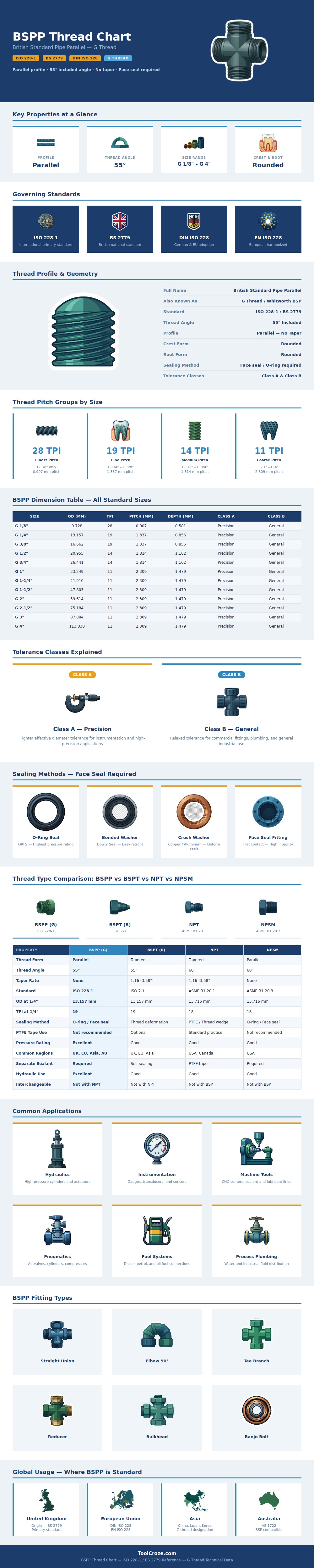
If you’re used to tapered threaded connections, you might find it unexpected, but G-thread (or, more precisely, the British Standard Pipe Parallel) is built to operate differently. There’s no expectation that threads alone can wedges tight and prevent leakage. Instead, it relies on the seal happening somewhere else. That’s why the infographic above emphasizes the parallel profile with constant diameter all along the length of the fitting, as well as the fifty-five degree included angle.
How G-Thread Fittings Work and Why They Are Different
When you tighten these fittings, you aren’t squeezing the threads together so they can sticks and form frictional seals. Instead, you’re tightening the threads against each other for strength. The actual sealing is done by a gasket, an O-ring, or perhaps a crushed washer between faces of the connector. It’s the separation of tasks that makes for high-pressure integrity.
The relevance: Tapered vs. Parallel threads is the most easily mangled combination on any new component. For example, you can’t jam a BSPP (parallel) fitting onto a BSPT (tapered) hole without stripping the threads well before your seal touches. This chart lays out which standard is being discussed (BS 2779, ISO 228-1 etc.) in clear terms so you don’t even attempt it.
But these standards aren’t meaningless bureaucracy. Instead, they identify the tolerance class, which is difference between a precision fit for instruments and a rugged fit for general water pipe work. Tighter tolerances are known as Class A, typically used when every fraction of a millimeter matter, like on instrumentation. Class B has looser tolerances and is better suited to tougher demands of general industrial plumbing. Just like choosing the correct pair of shoes for the situation, you pick the proper tolerance class based off how it will be used.
The reference guide covers everything from tiny G 1/8 inch fittings all the way up to gigantic G 4 inch connectors. As the gauge grows bigger, you’ll find that the number of threads per inch decline. While very fine threads are used on the small end (twenty-eight threads per inch is quite tight for such a tiny diameter), the large gauges tend towards more coarse threads (eleven is pretty rough for something as big as four inches).
This is not an accident. Small diameters can be adjusted and sealed with more fineness than larger ones. Larger diameters must withstand more torque and are therefore stronger when made with coarser threads. The chart above shows the compromise between strength and precision, and its results are expressed by change of pitch we’ve seen in the dimension table.
I suppose many of us thought “oh well, we have fifty-five degree threads so it’s compatible with American NPT fittings.” No. Not even close. NPT is designed as a tapered fitting using a sixty degree angle for sealing. This means it’s inherently incompatible with parallel designed fitting like the BSP system. Mixing typically leads to an unreliable, leaky connection that won’t hold up when put to use. You should of known this. The chart compares BSPP side-by-side with American standards and shows just how different their approach is even though they may appear similar at first glance.
They differ because of how they approach engineering. One uses the face seal, one the wedge of the thread. Learning all of this comes down to honoring the design intent. If it’s a parallel thread then get ready to prep the face seal. If you notice the crests are round and the roots aren’t, the stress won’t build up in one spot; now you’re good. And when it leaks out, you’ll know it’s because they’re there to hold the parts together but not to keep the fluid from coming out.
Make that mental switch and suddenly that chart isn’t a sea of random information anymore, but rather a quick reference guide. Stop making guesses, start making connections confidently. Next time you pick up a fitting, remember: it’s sealed at the face, not within the thread. That little change in thinking will save countless hours of troubleshooting and avoid having to clean all that hydraulic fluid off your hands.
The moddern ways can be tricky.
