Brick Laying Calculator
Estimate brick count by bond, courses, mortar, cut allowance, mason production, and daily staging quantities for a wall or veneer run.
Use a preset as a realistic starting point, then adjust wall size, brick module, bond, joint thickness, and crew output.
Full laying breakdown
Brick count by bond using this same wall
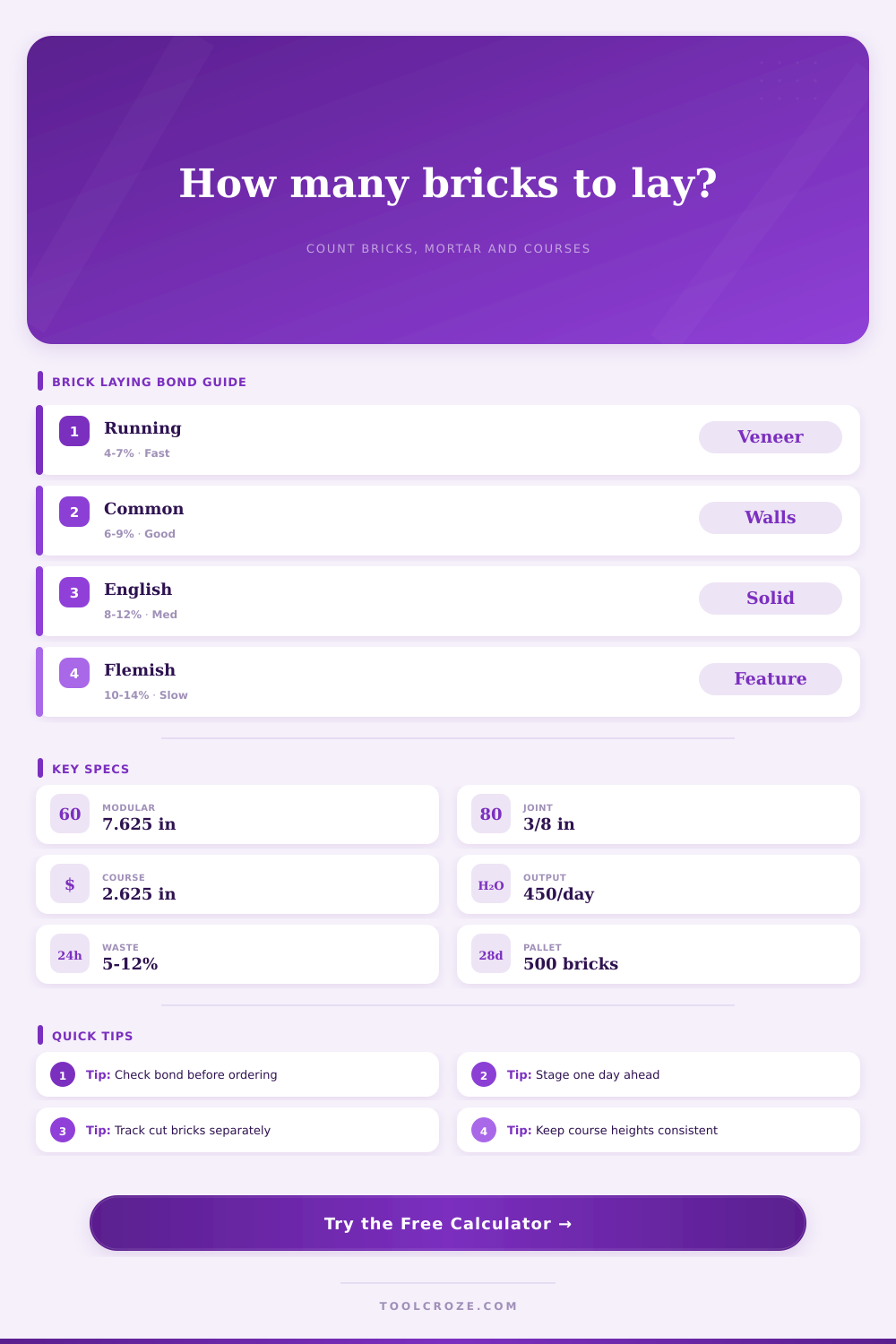
| Bond | Bricks | Cuts | Days |
|---|
| Brick | Actual size | With 3/8 in joint | Face bricks | Common use |
|---|---|---|---|---|
| US modular | 7.625 x 2.25 x 3.625 in | 8 x 2.625 in | 6.86 / sq ft | Veneer and walls |
| Queen | 7.625 x 2.75 x 2.75 in | 8 x 3.125 in | 5.76 / sq ft | Fast veneer courses |
| Utility | 11.625 x 3.625 x 3.625 in | 12 x 4 in | 3.00 / sq ft | Large wall areas |
| Engineer modular | 7.625 x 2.75 x 3.625 in | 8 x 3.125 in | 5.76 / sq ft | Stronger coursing |
| UK metric | 215 x 65 x 102.5 mm | 225 x 75 mm | 60 / sq m | Metric walls |
| AUS metric | 230 x 76 x 110 mm | 240 x 86 mm | 48 / sq m | Metric facade work |
| Bond / build | Brick factor | Cut allowance | Production factor | Best planning use |
|---|---|---|---|---|
| Running bond | 1.00 x face | 4% | 105% | Veneer, garden walls, long straight runs |
| Stack bond | 1.00 x face | 3% | 110% | Screen walls with reinforcement checks |
| Common bond | 1.02 x face | 6% | 96% | General solid wall layout |
| English bond | 1.04 x face | 8% | 85% | Structural solid brickwork |
| Flemish bond | 1.08 x face | 10% | 78% | Decorative face brickwork |
| Header bond | Header face | 12% | 72% | Curves, panels, and special bonds |
| Work type | Typical output | Course pace | Staging focus | Layout watch |
|---|---|---|---|---|
| Simple veneer | 450-650 bricks/day | Fast | Brick cubes close | Opening returns |
| Solid wall | 300-500 bricks/day | Medium | Mortar mixing space | Bond through wythes |
| Flemish face | 220-380 bricks/day | Slow | Cut brick rack | Header alignment |
| High scaffold | 200-360 bricks/day | Reduced | Lift quantities | Safe material loading |
| Repair infill | 120-260 bricks/day | Variable | Small sorted batches | Toothing and match |
| Joint target | Course effect | Mortar effect | Layout note |
|---|---|---|---|
| 1/4 in | More courses | Lower volume | Needs tight units |
| 3/8 in | Standard coursing | Standard volume | US modular baseline |
| 1/2 in | Fewer courses | Higher volume | Useful for uneven brick |
| 10 mm | Metric standard | Standard volume | 225 x 75 module on UK brick |
At some point in all your masonry projects, the mental math falls apart. There’s an empty foundation, and you’re picturing how it will look with a wall you haven’t built yet. Three-hundred bricks should of being enough, right? No, says the supply guy; five-hundred is closer.
Guessing stops when one or both sides figures out the course height, waste factor and bond pattern. That’s where the brick laying calculator comes in: it gets you thinking about the geometry of your job before you even order anything.
How to Use a Brick Calculator
The majority of folks forget the size of mortar joints, throwing off the final number. First decide what kind of bond pattern to make. It affects how something look, as well as its structure and the weight of materials used.
Because they have repeating patterns from course-to-course, running bonds allow for fast construction; the mason can get into a groove. By contrast, English and Flemish require headers to be laid every other layer. These headers is designed to interlock with stretchers, which requires a little more masonry (a shorter header cut in half) and different spacing between pieces.
The type of bond you select here determine the brick factor. Selecting a decorative bond without adjusting the multiplier will have you running out of bricks before reaching top of one corner.
Another factor that influences results is joint thickness. Three-eighth-inch is most common joint used by masons; it’s thick enough to hide variations among different-sized bricks, yet thin enough not to require too much mortar. Although thinner-looking joints are nicer on paper, they requires exacting leveling and cutting. Thick ones gobble up more mortar fast and produce more shrinkage cracks over time.
As you change the joint entry, this calculator reset the height of each course accordingly. With a normal joint, a modular brick measure around two and five-eighths inches tall. If you tweak its dimension by one-eighth inch, the overall course count for entire wall changes. Doesn’t sound like much, but you could add (or lose) an entire row of bricks.
Construction generates waste. Bricks aren’t all alike; walls don’t align exactly straight. Broken units are always found around window returns, jambs, and corners. For simple veneer projects, 5-10% is a good estimate for reasonable waste. Irregular locations or complex patterned wall increase it.
Rather than use a loose rule-of-thumb, you can specify your own estimate directly in the calculator. An extra fifty bricks in yard is preferable to halting operations until a hurried rush delivery arrives.
Like many materials, pace also matter for production. Under perfect circumstances, a good crew will lay four hundred to five hundred regular bricks per day. If wall rises higher, the need for scaffolding slows the process. Any complex cutting to create an intricate bond pattern also slow things down.
Based off daily production rates and crew size, the tool calculates a projected timeline that will help you stage materials properly. It doesn’t make sense to have a pile of three days’ worth of bricks somewhere, where they get damaged or go dusty. Stage only what you’ll need at workface for each day… Keep it organized and safe.
It turns imagination into inventory. It allows you to lay out various bond options side-by-side using the reference tables on the page. You can see the look-versus-speed trade-off at a glance. Once you get it, you know that waste, pattern complexity, and joint size all interact with each other. They do so in ways that make the numbers feel less like numbers and more like a physical version of the wall that’s going to be built.
Get this stuff figured out now and save yourself some headaches later. When you’re laying down the final brick, the count will match what was planned, different than just hoped for.