Concrete Block Mortar Calculator
Estimate CMU bed-joint and head-joint mortar from wall dimensions, block count, joint thickness, face-shell geometry, web layout, mortar yield, and waste allowance.
Mortar estimate
| Nominal CMU | Actual Size | Common Face Shell | Typical Web Count | Mortar Planning Note |
|---|---|---|---|---|
| 4x8x16 partition block | 3.625 x 7.625 x 15.625 in | 1.0 to 1.25 in | 1 to 2 webs | Low bed volume but head joints still add up on long runs |
| 6x8x16 wall block | 5.625 x 7.625 x 15.625 in | 1.125 to 1.375 in | 2 webs | Often used for partitions and light-duty walls |
| 8x8x16 standard CMU | 7.625 x 7.625 x 15.625 in | 1.25 to 1.5 in | 2 webs | Default choice for many structural walls and foundations |
| 10x8x16 heavy wall block | 9.625 x 7.625 x 15.625 in | 1.25 to 1.5 in | 2 to 3 webs | More bed contact area than 8 inch CMU |
| 12x8x16 heavy wall block | 11.625 x 7.625 x 15.625 in | 1.25 to 1.625 in | 2 to 3 webs | Use project submittals for exact shell and web geometry |
| Mortar Supply | Planning Yield | Approx. 8 Inch CMU Coverage | Best Use | Field Adjustment |
|---|---|---|---|---|
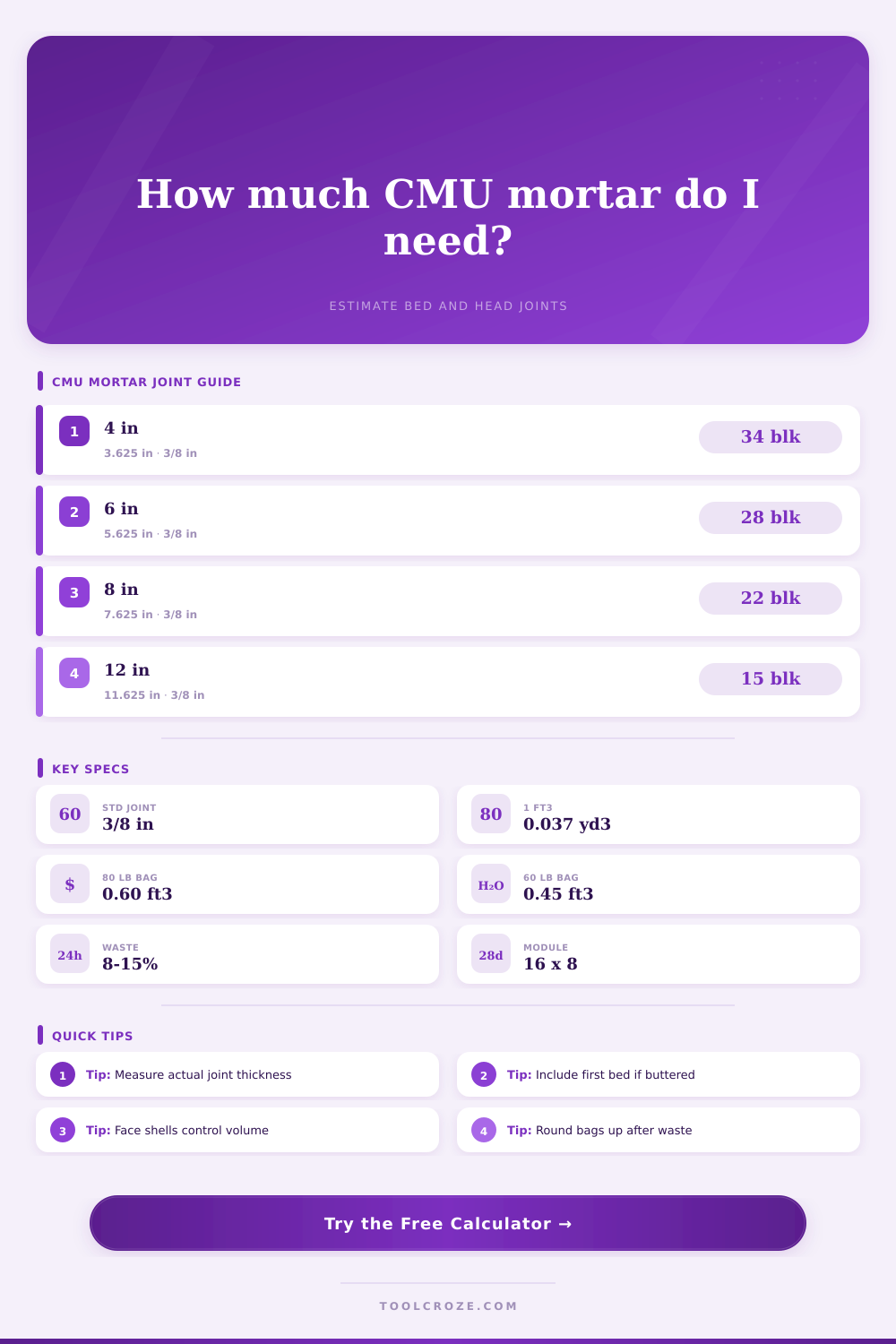
| 80 lb preblended masonry mortar | About 0.60 ft³ wet mortar | Roughly 20 to 24 blocks | Small walls, repairs, controlled batches | Verify bag label and mixing water |
| 60 lb preblended masonry mortar | About 0.45 ft³ wet mortar | Roughly 15 to 18 blocks | Patch work and lighter handling | Round up more aggressively for stop-start work |
| High-yield 80 lb mortar | About 0.70 to 0.72 ft³ | Roughly 24 to 28 blocks | Production work using a listed high-yield product | Do not assume this yield for standard bags |
| Site-batched Type N or Type S mortar | Use measured wet batch output | Depends on sand bulking and batching | Larger masonry work with mixer control | Enter the actual batch yield in ft³ |
| Joint Feature | Formula Basis | Common Input | Effect on Mortar | Check Before Ordering |
|---|---|---|---|---|
| Bed joint | Joint thickness x block length x bearing width | 3/8 in thick | Usually largest part of the estimate | Confirm face shells and web bearing area |
| Head joint | Joint thickness x block height x head bearing depth | One joint between adjacent blocks | Increases with long walls and many short blocks | Add returns, corners, and pilaster tie-ins |
| First bed joint | One horizontal bed under first course | Included when buttered on footing | Can add one full course of bed mortar | Exclude only if bottom course is not set in mortar |
| Waste allowance | Net wet volume x waste percent | 8 to 15 percent | Covers board loss and joint striking | Increase for rough CMU or novice laying |
| Thick joints | Linear with joint thickness | 1/2 in for salvage CMU | 1/2 in uses about 33 percent more than 3/8 in | Check layout because thick joints change modules |
Type N
General above-grade masonry mortar. Often chosen for non-loadbearing or moderate exposure CMU where high flexibility is useful.
Type S
Higher bond and compressive strength. Common for foundations, retaining-adjacent masonry, and exterior CMU walls requiring stronger mortar.
Type M
High compressive strength mortar for heavy loads or below-grade conditions when specified. It is not a default substitute for all CMU.
Type O
Lower strength mortar used mainly in limited restoration or interior applications. Use only where the project specification allows it.
| Wall Scenario | Recommended Mode | Waste Range | Geometry Priority | Reason |
|---|---|---|---|---|
| New straight CMU wall | Length and height | 8 to 12 percent | Block module and first bed | Courses and blocks per course can be rounded from dimensions |
| Repair using counted blocks | Known block count | 12 to 18 percent | Blocks per course and end joints | Patch work has proportionally more head joints and board loss |
| Architectural split-face CMU | Length and height | 12 to 18 percent | Actual face-shell depth | Nonstandard shells can change bed and head bearing area |
| Thick salvage block joints | Either mode | 15 to 22 percent | Joint thickness | Oversized joints increase volume and change the wall module |
| Metric plan with US CMU | Length and height | 10 to 15 percent | Unit conversion and module | The calculator converts metric inputs internally to inch-based CMU geometry |
The empty space between those blocks is what you’re really measuring. That’s why there isn’t just one formula for the number: it depends on block size. But if you know how to calculate that, then you can do your shopping before starting work. You won’t run out mid-project.
The vertical joints get overlooked by most builders. Why? Because they’re not as easy to see as all that long horizontal stuff: the beds. But it adds up fast if you has a lot of vertical joint; like in long walls.
Why This Calculator Saves Time and Money
By allowing you to describe your dimensions, this calculator takes care of the vertical stuff by breaking it down into head and bed. You can see how much is going where. If your head joint estimate seems high, maybe there are too many corner? The interface has return and end joint options. Those additional planes require more mortar than you realize. Add ’em right and you won’t run out before the final course.
Another surprise is the block thickness. Blocks aren’t solid bricks, they’re hollow concrete blocks. They don’t gets filled all the way through. Only the face shells (and maybe a couple internal webs) get filled. This is the part where you enter the thicknesses into the calculator. A typical block has an inch or more of shell on both sides. Alter this number and it make a big difference in the volume of the bed joints. For initial estimates, the default numbers work well. Inputting actual details makes the bag count even more accurate. It’s a little thing when entering data, but it means real money at the end of the day, either saving money or costing extra bags.
In the real world, there is no such thing as a perfect straight wall on the job. There’s mortar that drops off the trowel. You dig joints too far in. There’s a waste percentage field on the tool. Typically, that’s eight to fifteen percent. This covers the unavoidable waste. If you’re a novice mason, lean towards the high side of the scale. If you’ve got an experienced crew, bring it down. Failure to account for waste mean more mixing on a Saturday afternoon.
Your net volume gets multiplied by this number. Then it rounds UP (you don’t buy half a bag). It’s just as important to use the proper kind of mortar. For general above ground uses, Type N is flexible. Type S is stronger, such as for foundations. You’ll also see the option to specify what kind of mixture you’re using and how much it yields. An eighty-pound bag should produce roughly zero point six cubic feet, while a sixty-pound bag yield less. A lower number indicates that it contain less. Some are available in high-yield form, but these act different. By inputting the proper yield, the program will calculate the number of bags you need based off what you have available. Use the wrong yield value for regular bags and you will be coming up short. It is better to be safe then sorry, so check the package rather than assuming all are created equal.
Next are the reference tables which will give context around various block sizes. How does a 12-inch thick, heavy wall compare to a standard, eight-inch thick block? Why does a change in thickness matter on orders? The key here is it’s all about more web area on heavier blocks. More web means increased bed joint volume. This helps you see that increase. Don’t worry about remembering those numbers, simply be aware of their existence and look at them if you’re ordering non standard material.
Estimating mortar means finding a level of precision that is also practical. We’ll start with the baseline: use the calculator. Apply judgment based off site conditions. Measure your actual joint widths. Look at your block submittals. Plan for the messy reality of construction. The combination of realistic waste allowances and accurate geometry equals a math that makes a plan. You will finish the wall with mortar left over rather than digging through empty buckets. It should of been easier if you use the tool.