Drywall Texture Calculator
Estimate textureable area, mixed compound, dry material equivalent, hopper batches, spray passes, and working time for orange peel, knockdown, popcorn, swirl, brush, and trowel finishes.
| Texture | Mixed texture per 100 sq ft | Nozzle or tool | Air pressure | Typical passes |
|---|---|---|---|---|
| Fine orange peel | 0.85 to 1.00 gal | 4 mm to 5/32 in | 18 to 24 psi | 1 to 2 light passes |
| Medium orange peel | 1.05 to 1.30 gal | 5 mm to 3/16 in | 22 to 28 psi | 2 cross passes |
| Light knockdown | 1.25 to 1.55 gal | 5 mm to 6 mm | 20 to 30 psi | 2 passes plus knife |
| Medium knockdown | 1.50 to 1.85 gal | 6 mm to 1/4 in | 22 to 32 psi | 2 heavier passes |
| Heavy knockdown | 2.00 to 2.45 gal | 7 mm to 5/16 in | 24 to 35 psi | 2 to 3 passes |
| Acoustic popcorn | 2.40 to 2.90 gal | 8 mm to 3/8 in | 30 to 45 psi | 2 to 3 ceiling passes |
| Skip trowel | 0.95 to 1.25 gal | 10 to 12 in knife | Not sprayed | 1 trowel pass |
| Slap brush stomp | 1.35 to 1.70 gal | Texture brush | Not sprayed | Roll then stomp |
| Sand swirl | 1.10 to 1.45 gal | Brush or roller | Not sprayed | 1 swirl pass |
| Material base | Best texture use | Mix behavior | Calculation adjustment |
|---|---|---|---|
| All-purpose joint compound | Orange peel, knockdown, brush | Balanced body, common spray base | Use calculator base rate |
| Lightweight compound | Ceilings and wide areas | Lower weight, easier sanding | Wet weight about 9.7 lb/gal |
| Topping compound | Fine peel and smooth knockdown | Creamy mix, low shrink build | Reduce rate about 5% |
| Powder texture mix | Popcorn, acoustic, heavy texture | Strong build, batch sensitive | Increase waste for batch loss |
| Sand texture additive | Sand swirl and repair matches | Suspends grit in thinned mud | Use slower production rate |
| Surface condition | Absorption factor | Why it changes yield | Best calculator setting |
|---|---|---|---|
| Fresh primer, sealed joints | 0.96 | Low absorption and consistent suction | Primed |
| Existing painted drywall | 1.00 | Normal repaint or retexture field | Painted |
| New drywall, taped and sanded | 1.08 | Paper and joint bands drink mix unevenly | New drywall |
| Skim-coated repair field | 1.15 | Fresh mud surface holds more texture | Skim-coated |
| Mixed patch and old texture | 1.22 | Blend zones need feathered extra passes | Mixed patch |
| Porous ceiling board | 1.12 | Overhead spray loses more to build and suction | Porous ceiling |
| Application setup | Usable load | Transfer factor | Typical production | Use case |
|---|---|---|---|---|
| Small hopper gun | 1.25 to 1.75 gal | 0.90 | 25 to 38 sq ft/min | Repairs and small rooms |
| Pro hopper gun | 1.75 to 2.25 gal | 0.92 | 35 to 55 sq ft/min | Rooms and garages |
| Texture pump and gun | 3 to 5 gal pail | 0.94 | 60 to 120 sq ft/min | Large open areas |
| Hand trowel finish | Pan or hawk | 0.85 | 12 to 24 sq ft/min | Skip trowel and patches |
| Brush or roller texture | Tray load | 0.88 | 14 to 30 sq ft/min | Stomp and swirl finishes |
| Acoustic ceiling gun | 2 to 3 gal | 0.92 | 30 to 50 sq ft/min | Popcorn ceilings |
The right amount of material and consistency is key when it comes to drywall texture. Any kind of inconsistency show up when lights come on. It is tough to fix even if you have a keen eye for detail and steady hands. A match can be ruined by a change in water ratio or shortage of mix. It’s half art, half logistics.
Once you know what size room you’re working with and the type of finish you want, the calculator do all the conversion and coefficient guessing for you. Because the material doesn’t absorb equally on drywall, you have to consider condition of the surface. Old popcorn walls drink mix different than freshly taped/sanded or even painted drywall. New paper soaks up liquid fast and alter how the droplet sets and flattens. A batch treated like old paint behave differently on a new wall. It is too thick and crack as it dries. The tool adjust for how much material is absorbed. This allows you to purchase enough material to cover job instead of just square footage.
Why Use a Calculator for Drywall Texture
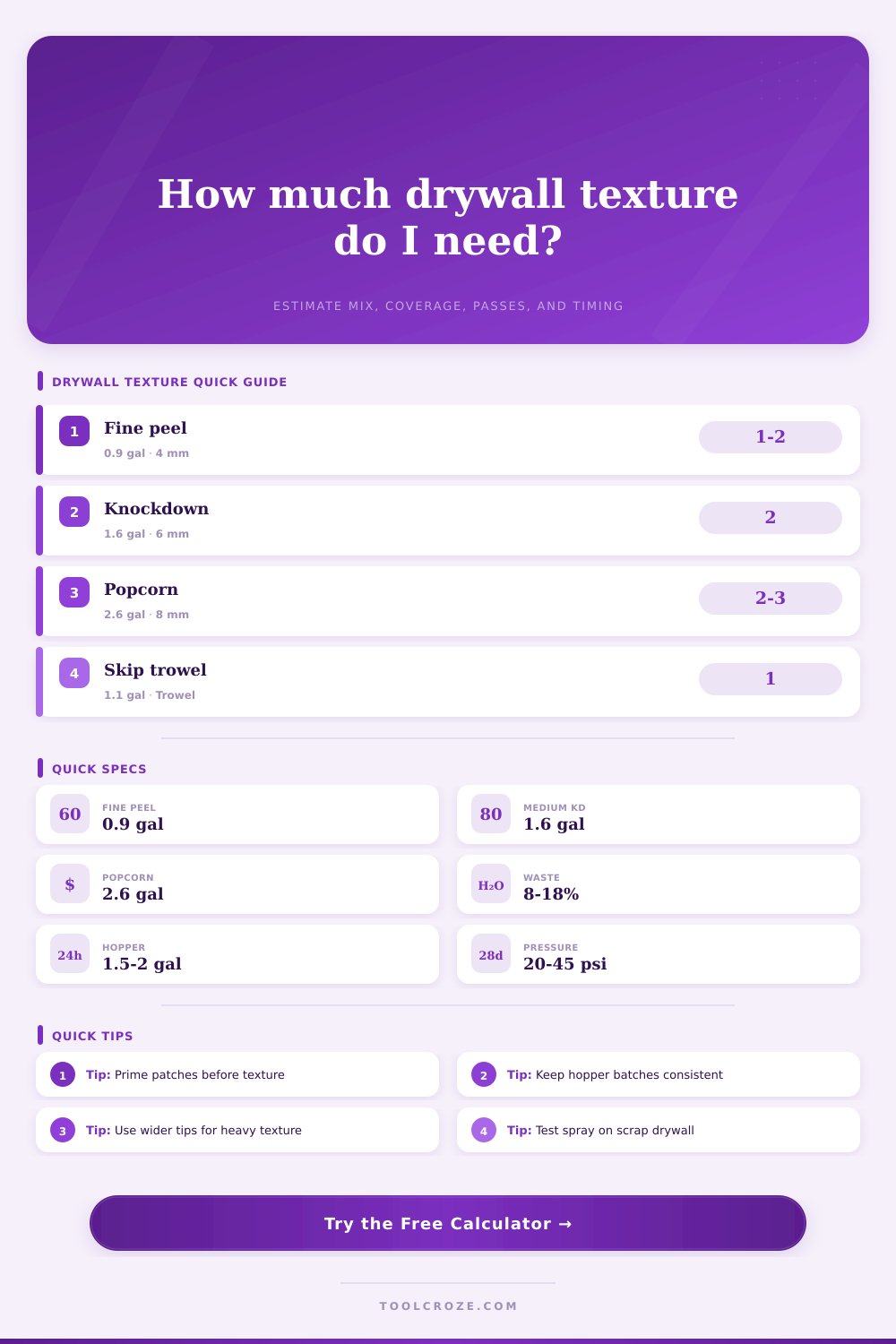
The amount of compound dispensed are also dependent upon the nozzle size as well as desired appearance. For example, a four millimeter tip will throw a light layer (orange peel) with minimal use of compound per sq ft. An eight millimeter tip spits out heavy popcorn or knock down texture that uses double material. Before choosing your desired style, be sure to understand what quantity of liquid you’re dealing with. This reference table show exactly how gauge size affects yield.
Water dilutes the compound for spraying and this is why most DIY projects go wrong. Add too much water and it will be a runny mess that won’t adhere well to ceilings or sag on vertical walls. Not enough water and it plugs up nozzle forcing you to tear down every so often. Ideally it’s a consistent stream that holds its round form long enough to get knocked down when necessary. The calculator calculate the recommended water range for any mix profile you choose; keeping each hopper batch actualy alike. If it’s consistent in bucket, then it’ll be consistent on wall.
Touch-ups, Another source of waste we’d rather avoid, but overspray and touch-ups can realy bite into your budget if they are ignored. More than you realize, it eats away at your final yield every time you feather an edge around a door or window. Having a realistic waste factor in will keep you from ending up with a half-full five gallon bucket mid-project. This would of require you to stop and mix up a new batch, which may dry at different speed. It is better to have a little more instead of running out.
Texture has a working window and timing is everything. You spray the material, let it dry for a set number of minutes, then flatten it with a knife for knockdown finishes. If you’ve got a big enough room and your crew works fast enough, that’s fine; you’ll be finished by the time the first wall dries. But if not, by the time you get to the last wall, the first one will have dried creating an obvious seam in the pattern.” The tool calculates how long you’ll take to complete all the walls using your total area and production rate. It warns you when you’ll run out of time to make transition smooth. This will require either a smaller batch or additional hands.
It’s invisible. Good texture blends in with architecture, so nobody notices it even exists. Bad texture draws attention: streaks, changes in thickness, mismatched patterns. If you get the material counts correct then you can worry less about running out of mud for the last corner and more about how fast your hands are moving to apply it. You go from a stressful renovation task to a manageable process where only variable is hand speed. Trust the inputs, and the math take care of itself.