Aggregate Calculator Tons
Estimate aggregate tonnage from compacted area, depth, material density, compaction, moisture, waste allowance, truck capacity, and delivery rounding.
Use centerline length for trenches or shoulder strips.
For a trench, enter the excavated bottom width.
Enter the finished compacted thickness after rolling or tamping.
Leave at the selected material density unless your supplier gives a tested bulk density.
Used only as a bag-equivalent check for very small projects.
Full aggregate tonnage breakdown
| Aggregate type | Typical tons/yd³ | Typical kg/m³ | Best fit |
|---|---|---|---|
| Crusher run / dense graded base | 1.50 to 1.60 | 1780 to 1900 | Driveways, pads, structural base |
| No. 57 washed stone | 1.30 to 1.40 | 1540 to 1660 | Drainage layers, clean stone backfill |
| Class 5 road base | 1.45 to 1.55 | 1720 to 1840 | Road shoulders and parking base |
| Concrete sand bedding | 1.25 to 1.35 | 1480 to 1600 | Paver bedding and pipe haunching |
| Recycled concrete aggregate | 1.40 to 1.50 | 1660 to 1780 | Bulk fill and road base where allowed |
| Project use | Common compacted depth | Aggregate behavior | Tonnage note |
|---|---|---|---|
| Walkway or patio base | 3 to 5 in | Moderate compaction | Small errors in depth change tonnage quickly. |
| Residential driveway base | 4 to 8 in | Dense compaction | Use crusher run, limestone, or Class 5. |
| Drainage trench | 6 to 18 in | Open voids | Washed stone weighs less per yard than dense base. |
| Shop or shed pad | 4 to 6 in | Flat compacted lift | Check edge overbuild and final grade trim. |
| Road shoulder repair | 4 to 12 in | Often irregular | Use higher waste for feathered edges. |
| Factor | Typical range | When to use | Calculation effect |
|---|---|---|---|
| Compaction shrink | 8% to 18% | Base stone placed loose then compacted | Raises loose order volume. |
| Waste and trim | 5% to 15% | Irregular edges, grade corrections, spillage | Raises final order tons. |
| Wet fines | 3% to 10% | Screenings, sand, or rainy stockpiles | Raises delivered weight estimate. |
| Truck capacity | 10 to 18 tons | Single axle, tandem, or tri-axle delivery | Rounds loads upward. |
| Lift limit | 3 to 6 in | Plate compactor or small roller work | Sets number of placement passes. |
| Material spec | Drainage | Compaction | Use caution |
|---|---|---|---|
| Dense graded aggregate | Moderate | Excellent | Needs moisture control for best density. |
| Washed open-graded stone | High | Fair | Does not lock like fines-rich base. |
| Crushed limestone | Moderate | Excellent | Fine dust can hold water near slabs. |
| Pea gravel | High | Low | Rolls under load unless restrained. |
| Recycled concrete aggregate | Moderate | Good | Confirm allowable contaminants and gradation. |
Everyone approaches a driveway project as though it’s a basic geometry exercise. Length plus width equals volume. You measure the rectangle, you choose a thickness, then you dial up the supplier and tell him how much gravel you need based off two numbers. And before long, the trucks is running over the property line or arriving short, and suddenly there’s nothing left in the budget.
Here’s the thing: A driveway isn’t about area. It is about everything that happens from the moment the aggregate arrives on your property until your last roller completes its final pass. Wet stuff is heavier. Stuff that has irregular edges waste aggregate. Stuff shrinks when compacted. All of this mean that instead of treating a driveway like a math problem, it becomes a practical puzzle of moving things around, something that adjusts for reality but does not depend on just calculated volume.
How to Order the Right Amount of Stone
After entering your measurements into the calculator above, all you need to think about are your inputs. The calculator do all the number crunching so you don’t have to try to guess at conversion factors and coefficients. And there’s one key thing to consider when filling out those boxes: Do you want packed depth or looser volume?
Because we buy our stone in tons, we think of it in terms of yards; how much of that stuff we’re going to fit in that space. Graded base material is pretty heavy, so it compacts down considerably when it gets rolled; these units aren’t equal. So if you’ve specified something like six inches as the finished thickness, it’ll add enough loose material to get that exact amount when compacted. It accounts for the extra loose material needed to achieve that specific compacted height. Hence a lot of DIY jobs turn out too short and squishy within a couple months of walking on them. You was ordering for what it looked like when complete, not what your pile originally measured.
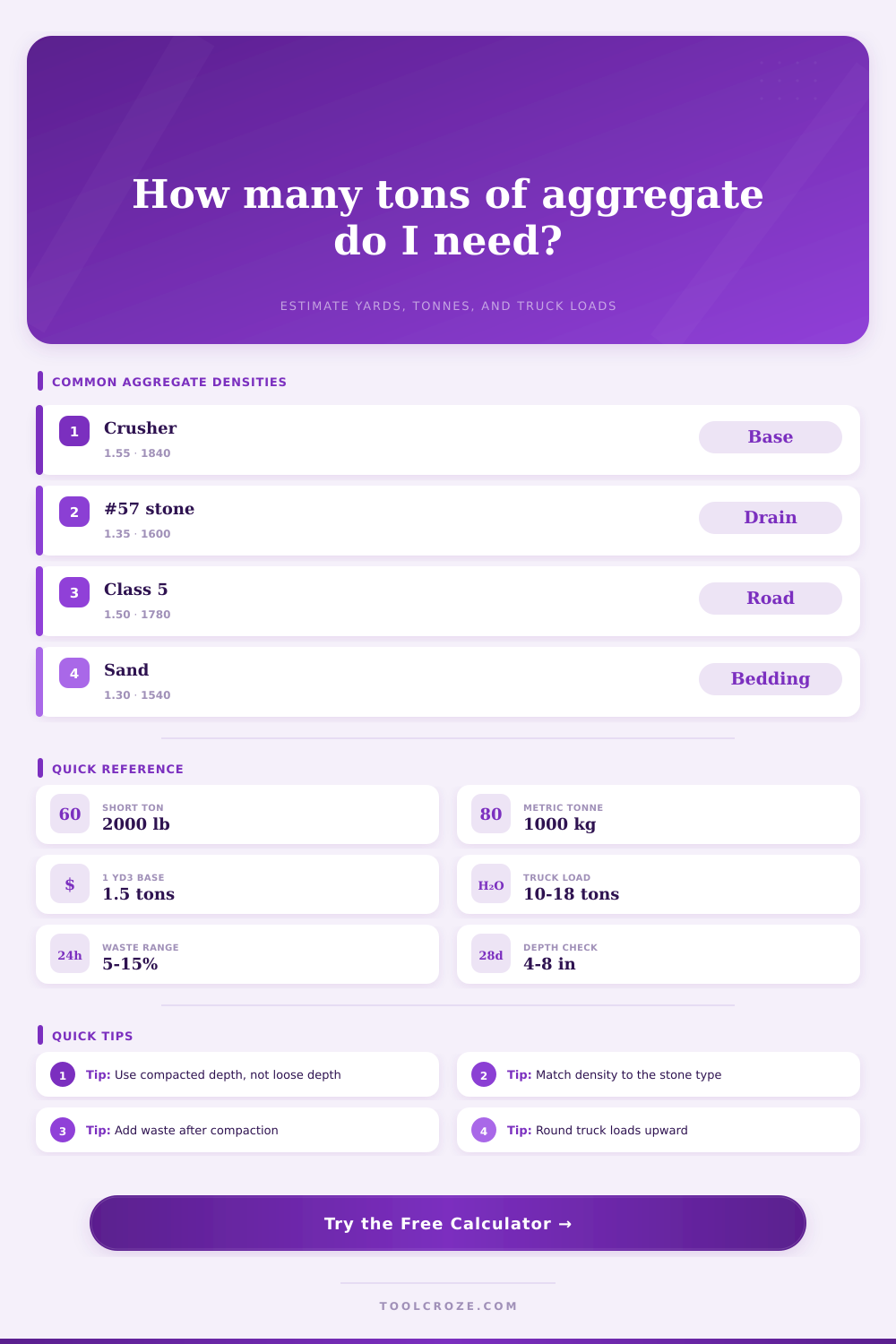
These are density presets. The size isn’t the only consideration: your choice of density is also critical. Not all stone are equal; it’s not all the same weight. Angular crusher run packs well, with fines that squeeze into each other when packed down tight. It forms a solid structure for supporting the heaviest loads. Washed number fifty-seven stone is more coarse, holds fewer fines, has bigger spaces between rocks, and weighs less by the yard, but works great as a drainage layer (where you want water to move through). If you pick the incorrect density setting in the estimator, you’ll order sufficient Tons of material to cover the space, but it may be too light or too sparse to work properly. To avoid this, use the chart on the page: material type determines weight needed.
Then there’s the factor of site conditions and waste. On paper, it may look like a perfectly rectangular patio, but in the ground? Not so much. One edge slopes downward into the lawn. In one corner, subgrade soil is soft and needs to be placed deeper. For those kinds of inevitable imperfections, the estimator lets you include a percentage buffer. For clean jobs, ten percent is typically good enough; if the boundary is irregular, or the underlying soil is bad, more, fifteen or even twenty percent; is justified. You can always put down extra stone and not use it, rather than pause mid-patio and await an additional delivery as the weather turns.
These calculations also account for moisture content. A truckload of wet stone hauled out of your mud-slick yard following a storm will weigh different than a load of dry stone hauled from a stockpile. With a damp pile of material, you may find yourself delivering fewer tons than expected. The tool will allow you to factor this into your calculation so that the tonnage estimated reflects what’s actualy being moved across the property line versus some imagined state of perfect dryness.
And lastly think about how it gets there: Tandem and tri-axle rigs can haul more rock than single axle trucks; many people’s driveways aren’t big enough for heavy equipment period; the estimator rounds up to full loads to prevent you from ordering an odd fraction that will not only be harder to deliver but may also end up costing you more money. You don’t want to overfill your site, but you also don’t want to make too many trips there. Get the logistics right and you get the tonnage right. It closes the loop between those numbers you see on the screen and what is under you when you step on the stone. It makes a solid foundation out of a chaotic pile of rocks. You should of planned better.