Brick Weight Calculator
Estimate single brick weight, total project load, pallet count, wet handling allowance, and wall or paving dead load from real brick dimensions, density, voids, and quantity method.
⚙Project Presets
📏Brick Specification And Quantity
Brick Weight Results
🧱Material And Brick Spec Comparison
📋Brick Weight Reference Tables
| Brick type | Nominal size | Typical dry weight | Common pallet count | Notes |
|---|---|---|---|---|
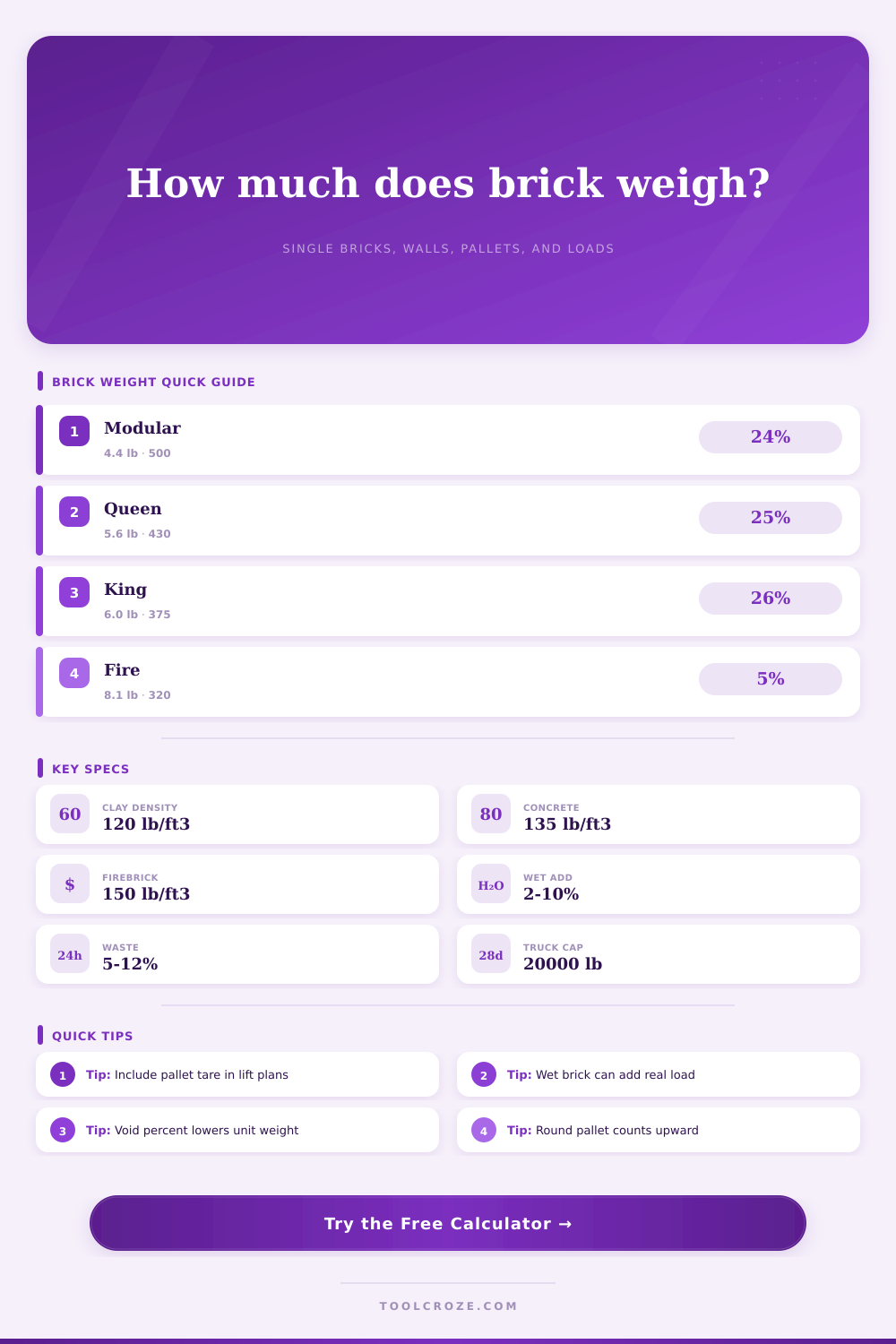
| Modular clay | 7.625 x 3.625 x 2.25 in | 4.0-4.8 lb | 480-525 | Most common veneer and wall unit |
| Queen clay | 7.625 x 2.75 x 2.75 in | 5.0-6.0 lb | 400-450 | Taller face, fewer units per wall area |
| King clay | 9.625 x 2.75 x 2.625 in | 5.5-6.8 lb | 350-400 | Longer face unit used on house fronts |
| Engineer brick | Varies by plant | 5.5-7.5 lb | 360-450 | Lower voids and higher density |
| Firebrick | 9 x 4.5 x 2.5 in | 7.5-8.8 lb | 300-350 | Dense refractory mass for heat lining |
| Concrete paver brick | 8 x 4 x 2.25 in | 6.0-7.0 lb | 450-540 | Usually low void or solid concrete |
| Material | Density range | Void effect | Absorption cue | Weight note |
|---|---|---|---|---|
| Common fired clay | 110-125 lb/ft³ | 18-30% cores | 6-12% | Weight changes strongly with perforation style |
| Dense engineering clay | 125-140 lb/ft³ | 5-18% cores | 3-7% | Heavier, harder, and lower absorption |
| Concrete masonry brick | 125-145 lb/ft³ | 0-15% voids | 5-10% | Often heavier than same-size clay units |
| Refractory firebrick | 140-160 lb/ft³ | 0-8% voids | 4-8% | Dense thermal mass drives high unit weight |
| Thin veneer brick | 115-130 lb/ft³ | 0-10% voids | 5-10% | Low total load because bed depth is thin |
| Load planning item | Rule of thumb | Check in calculator | Why it matters |
|---|---|---|---|
| Pallet tare | 40-70 lb each | Pallet tare input | Forklift and truck totals include wood pallet weight |
| Moisture allowance | 2-10% added weight | Absorption and condition | Outdoor storage can raise handling loads |
| Delivery grouping | Round pallets up | Bricks per pallet | Partial pallets still need safe staging area |
| Lift limit | Use rated capacity | Load limit input | Compares brick load to equipment or slab limit |
| Waste allowance | 5-12% typical | Waste input | Covers cutting, chipped corners, and attic stock |
| Assembly | Typical brick count | Approx dry load | Load expression | Planning note |
|---|---|---|---|---|
| Single wythe modular wall | 6.8 bricks/sq ft | 28-34 lb/sq ft | Face dead load | Add ties, mortar, and backup separately |
| Queen brick veneer | 5.8 bricks/sq ft | 30-36 lb/sq ft | Face dead load | Fewer units but similar wall weight |
| Double wythe clay wall | 13-14 bricks/sq ft | 60-75 lb/sq ft | Stacked mass wall | Foundation load check is important |
| Concrete paver field | 4.5 bricks/sq ft | 27-32 lb/sq ft | Surface load | Base aggregate load is separate |
| Thin veneer field | 6.8 pieces/sq ft | 5-8 lb/sq ft | Cladding load | Much lighter than full bed brick |
💡Weight Calculation Tips
The weight of a brick comes from its mass, yes. But that’s not all. There’s also the weight of the water it contains. There are the voids chipped away to reduce it’s center mass. There is the number of units crammed onto a lot. Do some math. Guess, if you must. Or just do it right now and spare yourself the structural headache later.
You enter the quantity and size of your bricks, and this calculator does the rest for you (it will spare you the task of doing the math yourself plus any errors due to factors). It’s tempting for most folks to assume all their bricks is roughly equal, but a solid concrete paver weigh much more than a standard modular clay unit (and even then, firebricks tend to be denser, so they’re heavier still). Void percentage and density, those two factor explain it all.
Why Brick Weight Matters
To save on weight and provide space for mortar keys to grab hold, fired clay bricks commonly feature a frog or core cut into them. That space make a huge difference. Twenty-four percent void reduction sounds like a bunch of abstract mumbo jumbo? Try removing 24 percent of a thousand units. All of that omitted material equate to hundreds of pounds of nothing for you to haul around and prop up.
Finally, there is the issue of moisture. This is where most estimates go awry. Sure, dry clay bricks out of a warehouse are one thing, but they’ll quickly pick up some moisture if you have them delivered and then the pallets gets rained on. And even a little moisture in the clay add weight. The tool allows you to account for how fast the unit absorbs moisture (and that a saturated brick can be somewhat heavier than a kiln-dry brick).
But that’s not all; you also want to know if you will have to plan for the extra time spent waiting outside before installation. If that is the case, you need to account for that additional wait time as well. Otherwise, you may find yourself with a hoist or crane running closer to its capacity then you realize.
There’s a lot of pallet logistics here as well. You aren’t just moving bricks; you are moving wood pallets too. Fifty pounds is not uncommon for a single pallet of wood, and if it takes several loads to fill a truck then the added weight from each pallet become significant. To show this in a nutshell, look at the reference table on the page where they break down the number of pallets based off brick size. Because there are fewer king-sized bricks per square foot, you end up with fewer units per pallet than with other types (i.e. This is the case for modular bricks, which affects your overall load profile slightly.
Getting the dead loads correct is vital for structural integrity. Joint thickness and bond pattern affect the number of bricks per unit area. This impact the overall wall weight calculation. Stack bonds use less mortar than running bonds and count bricks differently. This calculator allows you to enter the area and account for door and window openings with an option to adjust for both. Then total load including waste is provided.
Remember to add 5-10% for breakage, not because you’re optimistic but because you need it. Cutting bricks creates debris, and corners will chip during transport. Budgeting for this additional weight when doing your structural analysis or lifting plan ensures you won’t be over on assumed load capacity and short on actual material.
In short, brick is a straightforward material that shows complicated physical properties. When wet, it gains weight; when dry, it loses weight. If dropped, it will break. And when many are piled on top of each other, they become heavy, very heavy. To simply assume that brick is “one size fits all” and apply that assumption to its physical behaviors is an error in judgment that could of been easily seen long before occurring.
Don’t make the math harder than it needs to be: Know the actual unit weight. Allow for real-world moisture conditions. Acknowledge the pallet tare. It is better to be cautious about how much something weighs rather than how much it carries. This is where careful planning makes sure the lifting device remains intact and the structure stands tall.