
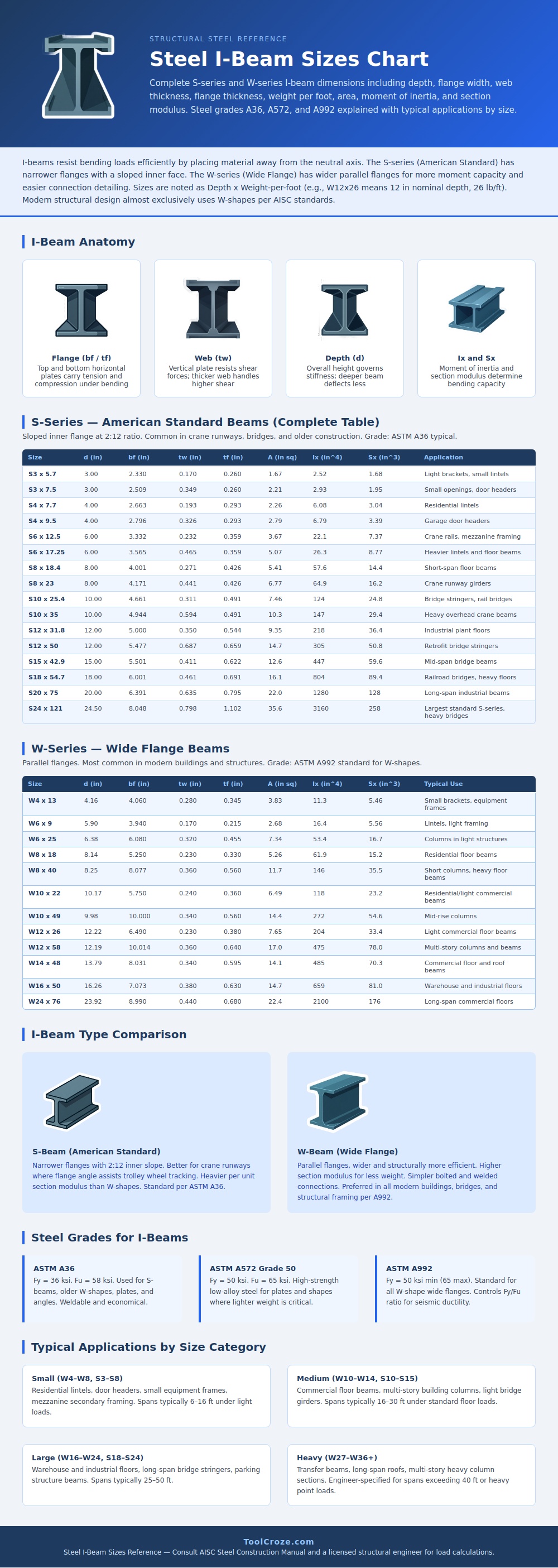
Steel is a material choice that’s really a geometry question. Why does an I-beam work? It’s not so much what type of steel are used but where all the steel goes. If it’s mostly concentrated in the top and bottom flanges then you gets lots of resistance to bending without having to pay for and carry extra weight. That distributes mass into resisting stress in the best places and leaves rest of structure thin enough to manage shear forces. The distribution makes shape look like an I.
In fact, there are two main families of beam shapes, as noted in the chart above; the W- and S-series. While their appearance can be fairly similar initially understanding the difference is important since each play a distinct role in structure. The American Standard, or S-shape, has an inner face that slope up on its flange. Although it is a leftover from previous rolling mill processes, this feature help crane wheels move easy across the rail. You’ll find these in industrial applications or perhaps old bridge work where such contact occur.
Why Shape Matters More Than Material
The W-shape (or wide flange) have parallel faces rather than a slope. This makes section more rigid for its weight and makes joining the members easy. By altering the distribution of material in the beam, a larger beam will carry more before deflecting (sagging). If you look at the moment of inertia numbers in the reference guide, you’ll see the variation are significant. Just by going from an eight inch section to a 12 inch section, you’re not only adding four inches of metal, but you’re increasing the lever arm resisting bending moments. The shape of the beam make it more effective at preventing deflection. Because of this, a W12 may be able to span further then a W8 of a comparable weight. It’s not about making the beam heavier; it’s about working with material smarterer.
Although these dimensions do not change based off the steel grade, this matters. As the reference points out, current standard for wide flanges is ASTM A992 which provide improved ductility (for use in seismic design) over previous A36 steel. If you’re retrofitting an existing structure, it’s possible that you will be using A36. While A36 is strong, it react differently when subjected to extreme stress. Knowing what material you’re using change how much safety margin you need in your connection designs. Just because two beams has the same nominal size on the label doesn’t mean you can treat them the same.
The same rules apply for shorter spans on smaller jobs… Like most residential work. For example, if you’re spanning a garage door with a header then a small S-shape or even a W8 would of been appropriate if span is short. Match the load to the section modulus. Many people will oversize their beams simply from fear: big must be better. That is wrong thinking that increase cost and complicates fabrication because larger members is limited by transport and handling. You want smallest member that satisfies the code. Larger member = what the warehouse had on hand.
Choosing the appropriet I-beam is all about understanding the load path and following its geometry. You’ll find the bare numbers in the reference table, now use them in the context of your building. From a small addition to a commercial floor system, it’s all about doing more with less. Like the I-beam was intended to do since day one, let shape do the work. Place the material where it matter most.
