
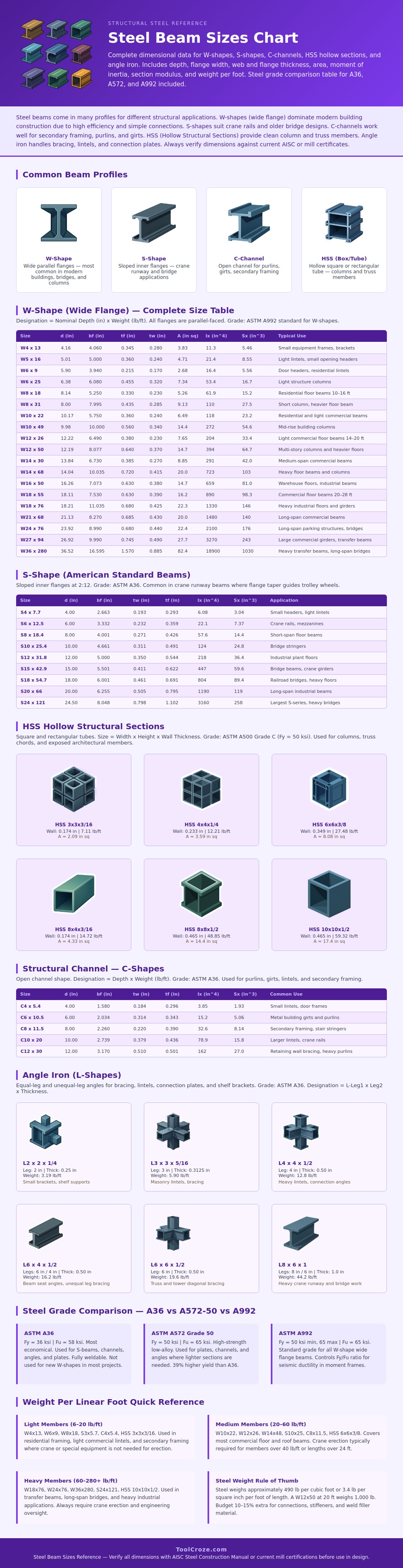
The chart is full of columns of abbreviations and numbers. It’s intimidating to most folks. Don’t worry about memorizing all those rows in the W-shape table. Learn the logic. Remember: steel beams are like puzzle pieces. They’re designed to support loads well, and this chart is the key to knowing which one to use for yours.
Today’s structures are built almost entirely out of W- beams (a.k.a. Wide flange) for their ease-of-use and high efficiency. So what does it mean when you see something like W12x50? The “W” refers to a wide flange shape; 12 is the nominal depth in inches, and the last number are the weight per foot. Seems easy enough until you learn that increasing only a handful of pounds per linear foot will dramatically increase the moment of inertia. As the chart explains, two beams with the same nominal depth (like a W12x50 vs. A W12x26) has a very different resistance to twisting and bending. That added mass is located far from the neutral axis, where dead weight turns into structural strength.
How to Read the Steel Beam Chart
Some jobs don’t use a wide flange beam. Some projects call for S-shaped beams due to certain industrial uses or older infrastructure. With those shapes, the inner flanges are actualy tapered (or sloped) to provide a path for wheels on a crane trolley down the rail. It seems weird next to current steel, but they do it for a reason. When retrofitting old factories or working with legacy bridge design, not taking into account this slope is going to cause fit problems down the road.
Along with angles and channels, these are all part of the profile chart that remind us that even though structural steel has changed, it hasn’t totally replaced its past. While structural tubes aren’t new to buildings (even though they’re increasingly popular), their appearance has been more due to aesthetic rather than engineering concerns. An HSS tube offer clean lines and strong resistance to twisting and buckling. Columns covered in fireproofing or drywall look overbuilt. The infographic shows different rectangle and square tubes. These examples demonstrate that you can change the wall thickness to keep roughly the same outside dimensions while changing the area or weight. This is a small but important detail if you have limited vertical space for headroom or want to meet certain aesthetic needs.
Another variable that tripped me up as a beginner was material grade, which can be very important in how it performs. For example, ASTM A36 steel is inexpensive and easy to weld, making it the workhorse of general construction. However, engineers typically specify ASTM A992 for wide flange beams in seismic zones, where it is needed. It has greater ductility than A36, so when an extreme event causes it to bend, it won’t snap. That difference shows up well in the comparison table, splitting out high- performance needs versus those for something more economical. Because of vastly different failure modes and yield strengths, you don’t just pick one or the other based off weight.
For example, the handy rule of thumb I like to use keeps me grounded with quick estimates because steel weighs about 3.4 pounds per square inch per foot. For example, how much does a 20′ W12x50 beam weigh? A quick mental calculation shows that 50 x 20 equals 1,000 lbs. It’s not exact science, but it allows you to estimate your load for crane planning and avoids ordering mistakes. Always allow for a buffer in connections and stiffeners, they add up fast on an invoice!
The decision of which beam to use isn’t necessarily which is the strongest, but rather which is most appropriate. That means a little lintel above a door is different than a huge transfer beam spanning an entry way in the lobby. Your judgment tells you which to choose; the chart presents the choices. Determine the load, then determine the span and follow the sizes until you find the profile that performs well enough without costing too much. It’s not rocket science, more a process of elimination where the numbers do the work for you and allow you to concentrate on the rest.
