
You are building something like fixing a shelf or a cabinet. Out comes your trusty pocket hole jig. A clean hole is drilled. A screw is driven home. The wood pulls tight. Or does it? No, instead the head rips out. Maybe even punches through in to the other side.
Why? Because you think of pocket holes as a one-size-fits-all solution. Pocket holes are an exact form of joinery. And there’s only one variable that will make the joint last. The variable is screw length. So that chart? Forget about the chart. Know your grips.
How to Use Pocket Holes Correctly
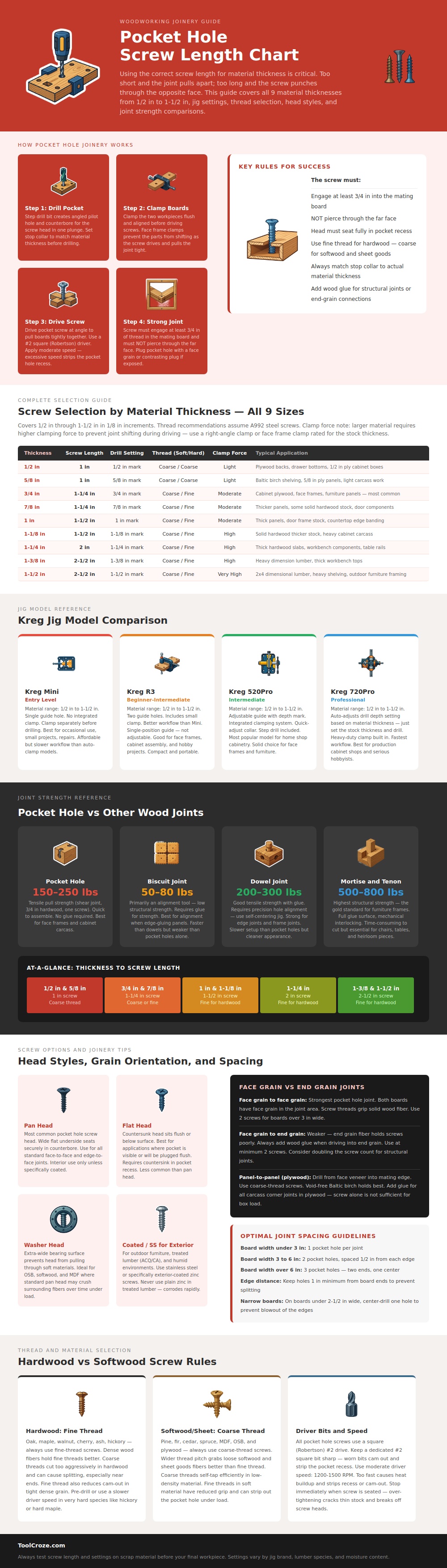
You need enough thread engagement with the mating board (the chart indicates exactly how much). But do not use so much that it pokes through opposite side. That’s the tricky part. Too little screw and there is no bite on structural wood; the screw rest in the pilot hole. Too large a screw and you’ve compromised the surface and decreased your holding power. A good rule of thumb is to have a minimum of three-quarters of an inch of thread engaged. People overlook this one all the time. They go to their junk drawer and pick up whatever screw happens to be handy.
Length is driven by material thickness. For cabinet work, standard stock is 3/4 inch. That require a typical screw of 1-1/4 inches. Because this is long enough to be strong without any risk of blowout. Longer screws is necessary for heavier materials. Two-by-fours and thicker hardwoods demand substantial thread purchase. When you use a short screw on thick stock, there’s no way it can handles the load. Over time, it just won’t have enough grip to do its job.
Equal importance is given to screw choice. Use a fine thread in hardwoods (oak, for example). Fine threaded screws makes a clean cut without tearing wood fibers. Use a coarse thread with softwoods and sheet goods. The coarser thread bites into the softer material. Don’t mix these threads and you’re going to have split wood and stripped hole.
Best joint is face grain to face grain. End grain joints take some attention. Most of the time, wood glue improve end grain connections. In tensile pull strength, they are as strong as any dowel joint. They are nowhere near more mechanically sound than a mortise and tenon. But they are easy and fast. It is great for complete cabinetry applications. It is also great for patching up something quicky.
Just be aware that there is a right way to make this joint. Use clamps to hold things together properly. Set the drill collar according to how thick the wood is you’re drilling into. Drill the hole at a moderate pace. Don’t strip out the recess. Measuring for screws is a woodworker’s best friend. It saves time and headaches by double checking your lengths. You won’t need any patchwork or taking things apart later.
When you see that flush surface and feel the solid connection, you know it’s correct. Ensuring you have enough thread engagement are what holds everything together.
