
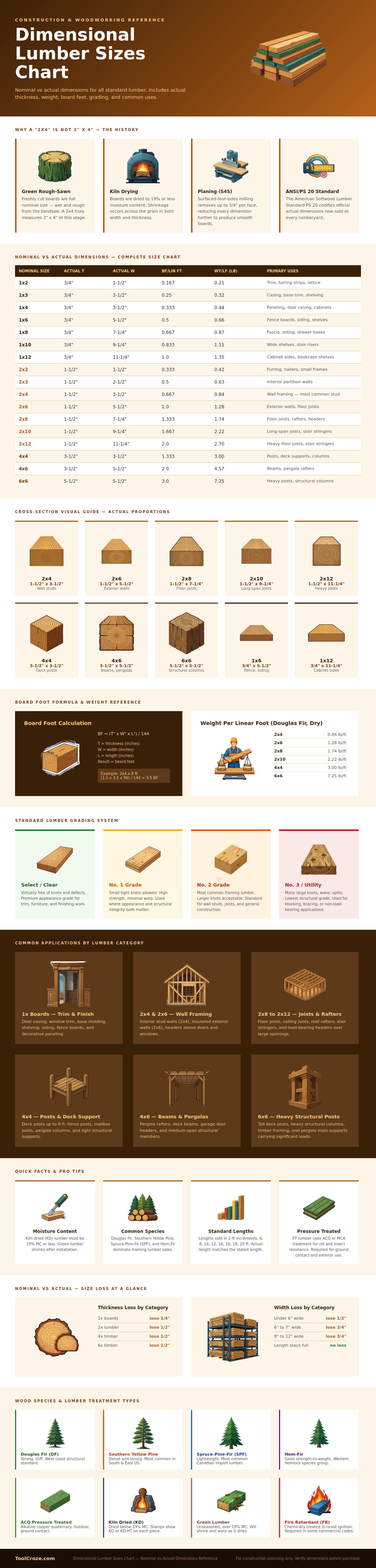
I know what you are thinking, I had a great plan, and walked in to big box store all confident that I could build my dream deck. I picked up some 2x4s because hey, those is two inches times four right? So I get home, use my trusty tape measure and the numbers don’t add up. Your wall frame are half an inch short, and then your door trim doesn’t fit the gap. What gives!?!
Well, the lumber teaches us a valuabel lesson; when wood dries, it shrink. Builders should of learn this lesson very early on. Here’s where things get confusing because we refer to this as nominal sizing. The word nominal mean something other than what it appears to be.
Why a 2×4 Is Not Really Two by Four
What do I mean? When the tree is freshly cut, it’s rough, thick and green. At that green stage, a 2×4 realy is two by four. No one want to construct a home with wet wood that could warp, rot in a few months’ time. Instead, the lumber industry dries the trees out. As moisture evaporates from the wood, the fibers will contracts. This leads to a second step called the planing process. Using machines, each piece is shaved down on all sides until surfaces becomes even and smooth. But with each stroke of the planer blade, some wood is removed. In the end, when you grasp that board, much of its width and thickness has dissapears.
Now it’s standardized (the graphic above shows how). And while that is good, it eliminates guessing what thickness a piece of wood might be, that also mean accepting that the name itself is fictional. What we call a 2×4 is an inch-and-a-half thick by three-and-a-half wide. A 4×4 post are 3.5 inches by 3.5 inches. Almost all sizes follow suit.
When shopping for lumber for construction projects, you’ll want to adjust mentally to working with the real numbers immediately. It will save you hours of headaches down the road. Notice how it breaks down based off both weight and size, and board footage. Why does this matter? More then you might think. Lighter woods such as a Spruce-Pine-Fir mix has less mass per linear foot of wood than heavier woods such as Douglas Fir or Southern Yellow Pine. So if you’re making a bookshelf that needs to span four feet without sagging, both the size and the species and grade of the wood matter.
No. 2 grade boards have some knots, so they aren’t quite as strong as say, a Select or Clear grade. But those knots realy don’t hurt their strength all that much in hidden framing within a wall. The right tool for the job. Not the most expensive tool. When purchasing your lumber, many beginning builder purchase pressure treated lumber for exterior use only. Although the ACQ is resistant to insect and rot damage, the lumber will be heavier and typicaly less stable dimensionally than similar kiln dried pine. Interior cabinetry or trim would better be served by clear grades with minimal knotting. The difference visually between Select smooth trim versus a knotty No. 3 are startling. The first should be on display, and the second should be in the mud. Knowing what the grading labels mean prevents you from paying too much for a premium look when you only need structural strength, and vice versa.
And then there’s that other thing: length. Typically lumber is measured in even feet, beginning with six feet and reaching a twenty-foot length. While thickness and width may decrease as it goes through the process, length doesn’t. An eight-foot piece of lumber realy IS eight feet long. It is give or take a fraction. And that’s what makes framing go so smoothly on the job site. Each stud is as you expect it to be and each joist spans exactly the distance called out for on building plans.
In conclusion: Wood is a live material and it behaves like one. It moves, it shrinks, it expands, and it absorbs moisture. When you accept that a 2×4 isn’t realy two inches by four inches, you are released from your battle against reality. From that point forward, you plan in real-world sizes and select grades according to load requirements and how they should looks. The next time you find yourself gripping a piece of dimensional lumber in the aisle, stop reading the sticker for a second and just feel how thick it is. Look at the width. And build with what’s there rather than wishing it were something else. This slight change in thinking transforms a jumbled heap of lumber into a solid collection of building blocks.
