
Have you ever walked into the lumber aisle feeling as though you’re holding a list written in alphabet soup? It look like alphabet soup to anyone who has never held a level. The two by fours is checked. Moisture contents are checked. Grades is checked. Board feet: check. Science experiments went wrong: check. This isn’t meant to make you feel intimidated by all the many choices waiting behind orange tag.
There is a logical order to purchasing lumber, if only we could bridge the gap between sign and hand-held product. The first thing that’s going to confuse you about 2×4 lumber is … well … the name. Two inches by four inches? It’s never that big, that’s what makes it so confusingly.
How to Buy Lumber Without Getting Confused
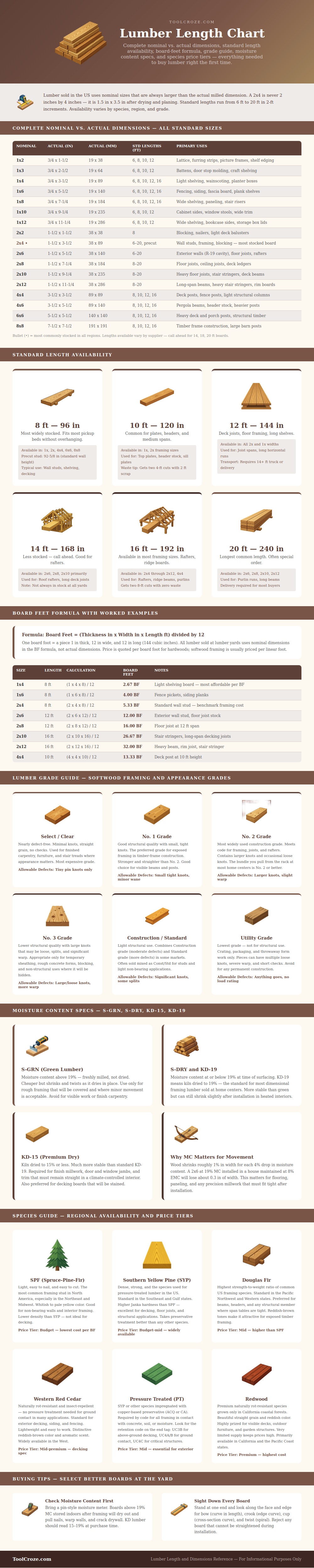
That measurement is for the raw green wood you buy; the rough stuff that needs to be planed and dried and squared up for sale. By then, a typical stud are actualy only an inch and a half by three and a half inches. Why the change? Because when they mill it, they shave off all irregularities and bark, then dry it out to get rid of all the water-weight. So all those “nominal” sizes in the chart above loses a large amount of their dimensions after they’re milled and dried down. And if you’re designing something based off the rough measurements, there’s no way your joints is going to fit. Design for the real size.
Most homeowners go nuts (or spend too much money) on length selection. The easiest size to buy are eight feet long. It fits in your truck bed without sticking out into traffic, and it’s the standard size cut at the lumberyard for framing interior walls. But the moment you start working with longer spans, things gets tricky.
If you’re by yourself, you need a bigger vehicle to carry 12-foot long material, or else make multiple trips back-and-forth. If you think “oh, let me just buy these 20-foot beams and I’ll be more efficient,” fine…but then those are heavy, and you’d better have some sort of equipment around to handle them safly. The reality is that most companies stockpile lots of shorter size; anything beyond 16 feet tends to be a special-order situation or something that comes on a delivery truck later.
There’s another wrinkle that seems arbitrary unless you’ve seen the wood up-close: grading. Clear and top grades are the most beautiful (almost no knots) and are great for anything you want to show off, like trim or furnitures. But construction grade contain plenty of knots and small warps. Again. This isn’t a defect in the traditional sense. It’s a trade-off. The knots makes the wood stronger in one direction and weaker in others, hence the reason engineers call out certain grades for load-bearing walls vs. These are non-structural blocks. So you’ll pay more if you want straighter, but again, sometimes we don’t need perfect for things that will be drywalled over anyhow.
Moisture content is the silent killer of all DIY. Green lumber may sound cheap, and it is, but green also means wet (with sap) and prepared to shrink in your home. And when it does? It pull on those nails and cracks that paint. Kiln-dried lumber is more expensive up front, but it would of save you headaches over time. This is because kiln-dried lumber is coded to tell you what percentage it has been dried down to. Knowing the difference between really dry and seemingly dry can make the difference between a wobbly mess months from now and a solid shelf.
And lastly, there is the species. For example: If it’s got to be strong (e.g., deck or floor joists), then use dense and strong Southern Yellow Pine. If it’s for interior framing and ease of nailing is more important than straight grain, then use spruce-pine-fir mixes. These mixes is common in interior framing because they’re lighter.
The point here is you don’t buy simply on the basis of available space in your truck bed; rather, you decide the right wood to use for what it has to accomplish in the building. These differences makes your visit to the yard less confusing and instead become a strategic shopping trip, through which you know to buy with intention, so each board goes exactly where it should go, no forcing the math to work out later.
