
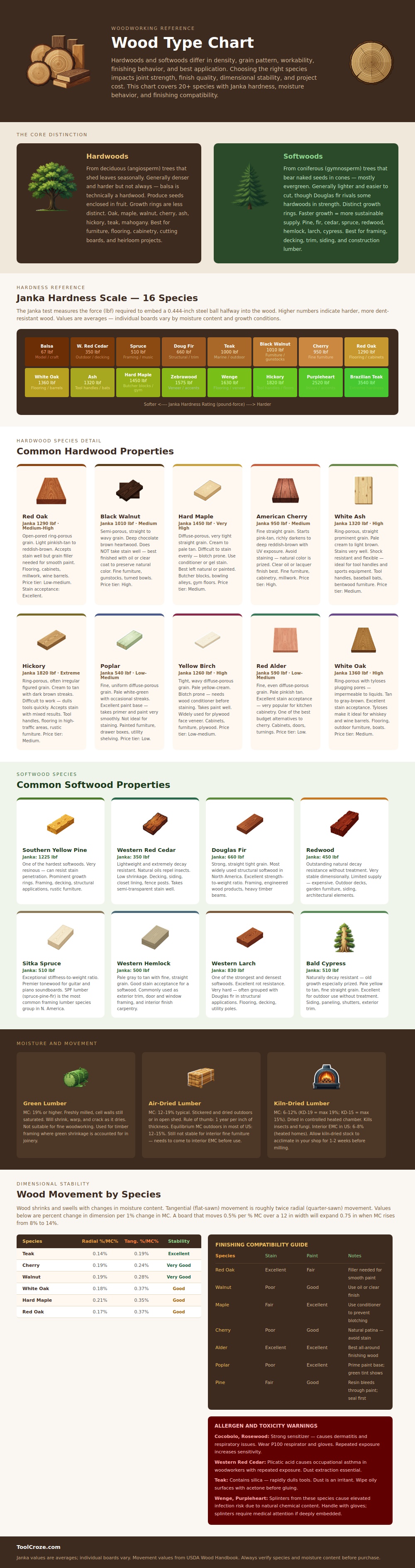
If you’ve been in lumber aisle looking at wood, I’m sure it’s because you aren’t trained and have no idea what you are looking at. Without knowing, the boards is all just brown sticks that are bound to break. Choosing the right type of wood can determine whether your project succeeds or fails. You don’t have to second guess which board will hold up well under pressure. The chart quickly shows the difference between harder hardwoods and softer coniferous woods.
So what’s the difference? Not just hard. Softwoods originate from needle and cone-bearing trees, while hardwoods come from leaves-loss variety… Deciduous trees. But here’s the thing: Softwood doesn’t mean wimpy (some, like Douglas fir, rival certain hardwoods in terms of strength). This means it is lighter and therefore easier to work with. This is helpful when building deck rails or framing a house, where being light and easy to install matters more than being super-scratch resistant.
How to Choose the Right Wood
For this reason, harder woods like walnut or maple tend to be used for furnitures. These types of trees grows more slowly, making them denser and costlier. However, they are far superior at lasting through day-to-day use without getting dented each time someone sets a coffee mug on the table. And the Janka scale makes this tangible for you. That’s because the Janka test is a measure of the force needed to embed a steel ball into wood, giving you a tangible sense of resistance. This gives you a feel for how resistant each wood are.
So on one end of the scale, balsa wood rates very poorly… Easy to carve, lightweight but hardly any resistance to a steel ball being driven into its heart. On the other end of the scale, hickory is rock solid. It is perfect for handles for tools that get beat up over time. If you’re looking at a piece of wood that has a higher rating, know it’ll be durable. If the rating is lower, know it will be workable. If your project calls for an inlay and the wood is purpleheart (extremely hard), don’t try to drive nails into it unless you plan on splitting out the surrounding wood.
Regardless of the quality of your joints, most failures occur due to moisture content. Humidity makes wood move; it expands when wet and shrinks as it dries out by releasing water vapor into the air. Too much moisture is bad; green lumber fresh from the mill shrink and warps badly as its moisture content drops. Kiln-drying gets the moisture level down to a safe range for indoor use.
As the chart shows, tangential movement is about double what’s called radial movement. That’s why quarter-sawn lumber is so highly valued in fine furniture. It stays flatter because grain runs more parallel to the board face rather than across it. Ignoring this leads to cupped shelves and cracked tabletops in a year.
Species vary wildly in their finishing behavior and that means they vary in their approach to paint and stain. For instance, red oak take stain really well (it has open pores) but wants a grain filler before paint for a smooth look. Walnut doesn’t take stain very well, since its natural color is rich enough (chocolate brown). Clear oils or lacquer are better choices. Maple can be a nightmare, blotchy if attempted without a pre-stain conditioner to help it even out. All this saves hours of frustration and sanding later. Without it, your finish might appear streaky because the wood soak up the dye unevenly across its tight grain.
The shop environment should of never been something you think about second. Any wood containing silica or other natural oils will be irritating to your skin and lungs. Some species like rosewood or cocobolo can even become strong sensitizers… I.e. Repeated exposure causes serious allergic reaction over time. If you’re using any of these exotic woods, make sure you wear a proper respirator. Even common western red cedar gives off dust that can cause occupational asthma for sensitive people. Not only do you have to worry about getting a splinter, but also what you’re breathing in while cutting.
Now armed with the baseline properties, it’s time to mix some science with intuition and choose wood. The data points comes from the chart; the rest comes from what you want the piece to do. A sturdy workbench must withstand impact, while an heirloom cabinet requires both beauty and stability. Match the material to the need and avoid expensive errors. Select the board that will handle the forces applied to it, then let nature do the rest of the work on its own terms.
