
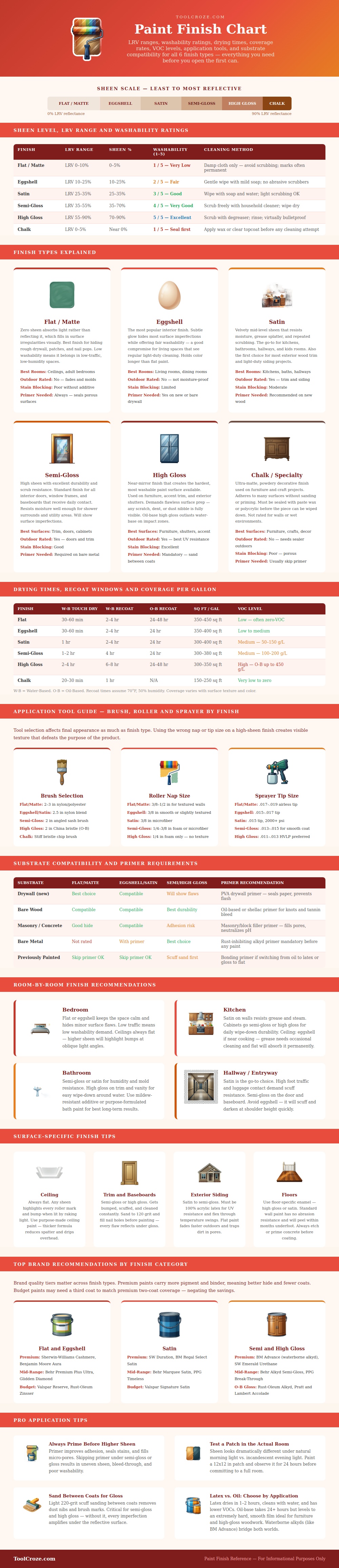
The Paint Finish Chart is your best friend. It happens all too often: You’re standing in the paint aisle clutching a can of paint that seems like it would be perfect for the job. Until you realize the can’s weight is filled with possibility…of it failing. It has the same color as your sofa? Check. The label says it’s durable? Check. How do I know it won’t stain when my toddler tries her hand at drawing? Or show any hint of the small drywall flaws in my wall? Enter the paint finish chart.
This graphic (above) shows you how every sheen perform when exposed to moisture, light, and cleaning products. Knowing which one is best for each situation turns guesswork into an educated choice. Gloss for a high-traffic hallways? Use flat paint for textured ceilings. No more do-overs, thanks to understanding the numbers.
Understanding Paint Finishes
Flat/matte paint is at the bottom of the ladder. Flat/ matte paint doesn’t reflect light but instead absorbs it, visually softening any imperfection on the surface (patch job, nail pop etc.). This is what you’ll see on ceilings and in adult bedroom. Surfaces you don’t expect anyone to grab hold of.
The trade off here is obvious. It has low washability. Stains set in really fast on matte paint and become permanent. You can try scrubbing them out, but that risks turning the spot into a shiny section that looks even worse then the stain itself.
Eggshell has a slight glimmer, just enough to hide most of your imperfections, yet it is still durable enough to be gently cleaned using some mild soap. It is the standard choice for dining and living spaces, offering more warmth but less practicality.
Satin finishes offers mid-level sheens. When we add in a satin finish, the conversation shifts completely as far as moisture resistance goes. It can stands up to repeated scrubbing and even grease splatter. This makes it the go-to option for rooms like hallways, bathrooms and kitchens where things gets touched every day. According to the chart, satin has good ratings for washability which makes it perfect for areas of regular use.
Moving up the sheen scale, semi-gloss offers excellent scrub resistance plus more shine. It’s what you’ll see on baseboards, window frames and interior doors, surfaces which are constantly being bumped around and cleaned. Surface prep is key here, since the higher sheen shows everything off and any dent or scratch will be glaringly obvious under semi-gloss. Sand and filling would of need to be done carefully before you apply your first coat.
At the top end of durability is high gloss with a near mirror finish which is pretty well resistant to staining. A high gloss finish highlights all brush marks and dust nibbles so it really does require a flawless surface. It provides the best UV protection for outdoor accent pieces and shutters but is not forgiving on walls.
Chalk paint is a specialty finish used mostly for crafts and furnitures. Chalk paint sticks to the surface without sanding but cannot be cleaned until sealed with either polycrylic or wax. Otherwise, the paint will remain porous and fragile.
Each of these finishes has very different coverage rates and drying time. High gloss (oil based) takes much longer to dry but yields harder film than water-based gloss. The tools you use is nearly as important as your choice of finish: A roller with too-thick a nap will create visible texture on a glossy wall; gloss goes on with foam rollers, and matte (or anything else) goes on thicker-nap rollers. Priming varies greatly: Sealing new drywall is essential to prevent flash, and bare wood must be covered with either shellac or oil-based primers to block tannin bleed-through. High-sheen finishes don’t cover well without primer. Which causes both bad adhesion and an uneven sheen.
Test a small patch before doing everything. The sheen appears different in morning light versus night-time incandescent bulbs. It’s not about painting walls so much as painting walls to protect them. Paint finishes should complement the function. Matching finishes to function means that when the paint finishes match how a space is used, they will last just as long as your furnitures does.
The next time you stand in the aisle, you’ll go from anxious to confident because you now know what sheen is going to solve your particular problem.
