
There comes a moment in every plumber’s and mechanic’s life where they’re tapping a hole for pipe fitting and suddenly have no idea what size drill bit to grab. If this sounds familiar, you’ve faced the Panic. Next thing you know, you’ve grabbed incorrect drill bit and destroyed your hole by trying to thread it.
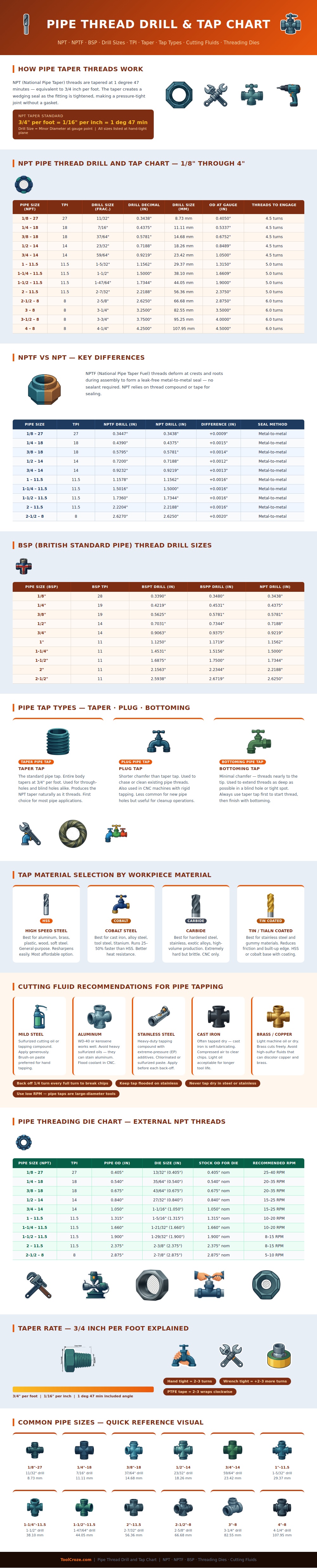
The truth is easier then you think. There is nothing magical or complicated about threading pipes. All you really need to do is understand that thread is meant to be tapered, and then find correct chart to use. The threads on National Pipe Taper thread has a three-quarter-inch slope per foot (see infographic above). That may sound abstract. But picture how those threads would comes together. When tightened down, that taper cause one surface to wedge into the other. And that forces metal together creating a seal without requiring a gasket. This mechanical process have worked for over 100 years. All you have to do is drill proper minor diameter and it works.
How to Choose the Right Drill Bit for Pipes
This chart (above) does a good job of breaking it down by size from one-eighth inch all the way up to four inches. What you’ll see is that smaller the pipe, the finer its thread. It’s sometimes as fine as twenty-seven threads per inch on that little baby one-eighth size pipe. The bigger the pipe grow, the coarser its thread becomes until at big three and a half inches we’re only dealing with an eight-thread-per-inch thread.
Why does that matter? Because it tells us how aggressively our tap has to goes about cutting that thread. If it’s a small hole with a fine thread, forcing it mean easy breakage. If it’s a big hole with a coarse thread, it cut right through, requiring more torque. Knowing what area you’re operating in lets you set your machine to match. It also let you stiffen your grip before you make contact with the metal.
NPT and NPTF: NPTF is the fuel version for high-pressure fuel and hydraulic systems; NPT is not. It is a small difference, but an important one. To make a long story short, NPT uses sealant like compound or tape to close up tiny spaces between threads. NPTF has a thread cut just a bit wider, which means they deform against one another as you tighten them down to form a metal-to-metal seal without use of a sealant. If you swap them incorrectly, you might get a leak or a stripped fitting. Small detail, but if it’s hazardous fluid or valuable machinery, it matters.
Your tap material choice is just as critical. For soft metals such as brass or aluminum that cut easy and run cool, high speed steel does the trick. For hardened alloy or stainless steel, however, you’ll require carbide or cobalt taps that can handle friction and heat. Because stainless steel gums up rapidly, a heavy-duty tapping compound containing extreme-pressure additives are required.
Also keep this rule in mind: back off. Backing off means turning the tap forward one full revolution and then back it off a quarter turn. The chips that build up in the flutes break free. Without clearing the chips, the tap will bind and snap. It happens fast and it’s very expensive. You should of known that.
A threading die is what you use to cut threads for external threads on pipe stock, in reverse fashion from a tap. Lube up, line it up square with the end of the pipe, and twist, taking care not to rush as this causes heat, bends tool, and destroys the thread profile. Again, low revs are optimal.
To take away any worry about the charts being guesswork, think of them like maps to where to start. No longer are you guessing; now you’re doing something proven to produce a tight-fitting joint each time. You shoulda recieved this info sooner. It makes things more comfortabley.
