
Sometimes you walk into a hardware store. You’re in the pipe aisle and there are all these same-sized pipes, same outside diameter but different internal diameters, and yet they costs a different amount of money. How do you know what’s black iron? What’s PVC? What’s copper? Those is all metal too! And that metal come in layers. Layers are known as schedule.
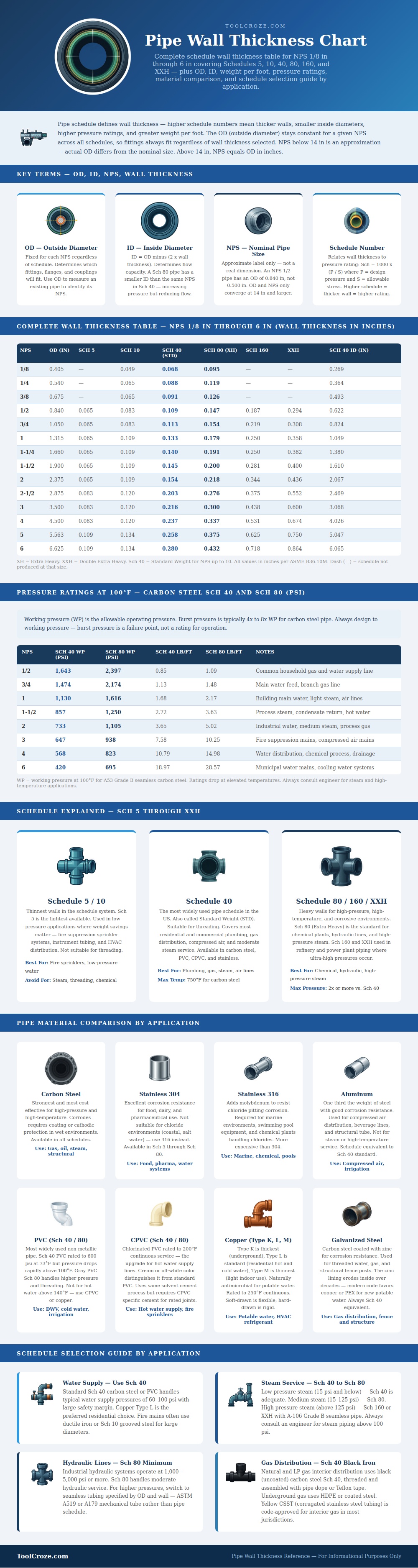
Here’s an explanation of the varying wall thicknesses by size (from one-eighth inch to as large as six inches) in the handy-dandy infographic above. From the super-skinny Schedule 5 to the beefy double extra heavy walls, it’s got it covered.
Why Pipe Wall Thickness Matters
So why learn this chart? Because it’s not really about remembering decimal points so much as it is learning about flow vs pressure. The key thing that catches rookie builders are that while the wall thickness varies, the outside diameter doesn’t change at all. Whether a half inch nominal pipe is schedule 80 or schedule 40, its outside diameter remain 0.84 inches. Because of this, a fitting will fit snugly onto your pipe regardless of the schedule number if both are nominally the same. No, you don’t need a bigger wrench with a thicker walled pipe. But within the pipe, there’s more material so there’s less internal pipe diameter. The thicker wall allow for greater pressure, but lower volume. You’ll just have to live with that.
Standard Weight (Schedule 40) is used for most plumbing in homes; it’s rated for up to 100 psi and has more than enough room for the average home water supply of about 60-100 psi. This schedule are the main tool for standard gas line distribution and water lines throughout house. However, get yourself to something like a high-pressure steam system or industrial application and Schedule 40 starts to fail you. As the chart indicates, moving from Schedule 40 to Schedule 80 give you about double the pressure rating. Go XXH or Schedule 160 for things like high pressure hydraulic lines, where the PSI reaches thousands of pounds.
All those extra inches of wall material weigh a lot. That can become important if you’re working overhead or running long length horizontally. Stainless steel 304 is excellent for resisting corrosion in food processing. However, it doesn’t stand up well to high-chloride environments like coastal regions. In those cases, you should of use stainless steel 316, which contains molybdenum. Carbon steel costs less and stands strong against force, but will rust unless protected from exposure to moisture.
PVC. Cheap, simple to work with; is commonly used for plumbing and drainage lines in cold water, but it quickly weakens at anything over 100 degrees Fahrenheit. For hot water service, therefore, you’d move to CPVC, which can withstand sustained heat up to 200 degrees. Putting hot water through regular PVC? It won’t matter how thick your schedules is: that’s a recipe for total failure.
What’s the pipe? Consider the constraints of your application, such as high temperatures. Is it high pressure? Are there corrosive chemicals? Or you might just want to move some water from point A to point B as cheap as possible. That’ll help you choose pipe based off the wall thickness chart. See how Schedule 80 is tough enough for a chemical plant but Schedule 5 save a lot of weight on a low-pressure sprinkler system?
Don’t always go for the cheapest thing out there, go for the one that fits the physical reality of your situation. The proper schedule means that your system will last, keeping the pressure safely in bounds and the fluid securely inside where it belongs. It gives you the confidence of engineering rather than guesswork when everything else appears to be a confusing collection of tubes made of moddern metal.
