
Chances are good that you’ve been in a hardware store and found yourself looking at a fitting for a pipe that wouldn’t go on the other end of that pipe. Both pieces say one-half inch and yet obviously don’t fit together. Is something wrong? Is there a manufacturing error? Nope. That’s simply how plumbing naming works.
The nominal size on a pipe are not its actual outer diameter. It never did. This difference between nominal size and actual diameter is the most important thing to know. You must understand it before purchasing a coupling or even making a cut. So what does it mean?
Why Pipe Sizes Do Not Match Their Labels
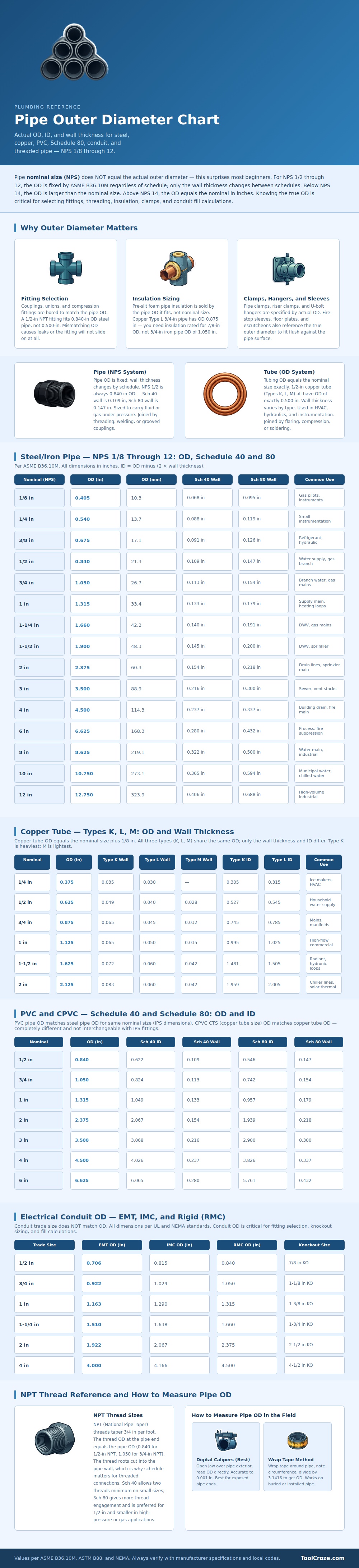
It means that the “outer diameter” doesn’t change no matter what wall thickness you have when buying steel or PVC pipe (see chart above). So even though there’s a difference between Schedule 80 and Schedule 40 for a given size pipe (e.g., a half-inch schedule 40 steel pipe), they both has the same outside diameter. Only the inside diameter and the pressure rating change, along with wall thickness.
Why is the outside kept the same? Because fittings has to fit! If you try to buy insulation based off the nominal size, you will either get no insulation at all or some loose foam. This is because the insulation is pre-slit to match its actual outer diameter, not its labeled nominal name. This creates mismatches that lead to leaks and more return trips to the store.
From one-eighth inch to twelve inches, IPS pipe adheres to this fixed outer diameter rule. They’re historical artifacts, so the numbers appears odd. An actual one-half inch pipe is zero-point-eight-four inches across. One-inch pipe? That’s one-point-three-one-five inches wide. Seems like an inefficient way to do things, but it lets plumbers and engineers replace one material with another without having to recalculate each point of connection.
If you have a retrofit project, you can replace steel with PVC or whatever so long as you stay within the same class of nominal sizes since all the fittings will be bored to match that outer diameter.
Novices can get confused by copper tubing, which works totally differently. Copper is sized using outer diameter (OD), and its actual size is close to its nominal size. Unlike steel pipe, a half-inch copper tube actualy measures closer to.625 inches. But within those same outer diameter sizes, you’ll find types K, L, and M of copper. All of these will be the same outer diameter but each will have varying wall thickness. Type K is thicker and used underground, whereas Type M is lighter weight and less expensive for use inside home. Because of this, you cannot simply go from one system, IPS, straight into copper tube. There are special adapters that spans that distance between the two systems.
There’s also electrical conduit, which doesn’t behave in a normal way. You’ll see a “one-half inch” EMT conduit listed but it’s actualy nearly 0.7 inches wide. Electrical conduit isn’t measured in inches; it’s called a trade size, and it’s a category rather than a measurement. When picking out knockouts for your panel boxes or doing calculations for filling ratios of your wire bundle, this makes all the difference in the world. You can’t trust that the label shows the real size. Threading a larger conduit into a hub is much more serious then finding your wires don’t fit into the box.
The only way to find out is in the field with some patient measuring of these pipes. Your best friends will be digital calipers that provide you with the exact outside diameter for ordering replacement parts. Without calipers, use a tape measure and wrap it around the pipe then divide the circumference by pi. It is an old trick but it still works. The point is to check the true measurement before buying anything.
These unseen parts form the base of the plumbing industry. A nominal size label is nothing more than a convenient way to talk about it. The real diameter actualy holds the water and moves it. Once you learn to trust the measuring and ignore the sticker, your fittings will begin performing as designed. No more wasted material returns and no more “it all fits but doesn’t fit” headaches. You should of known this sooner.
