
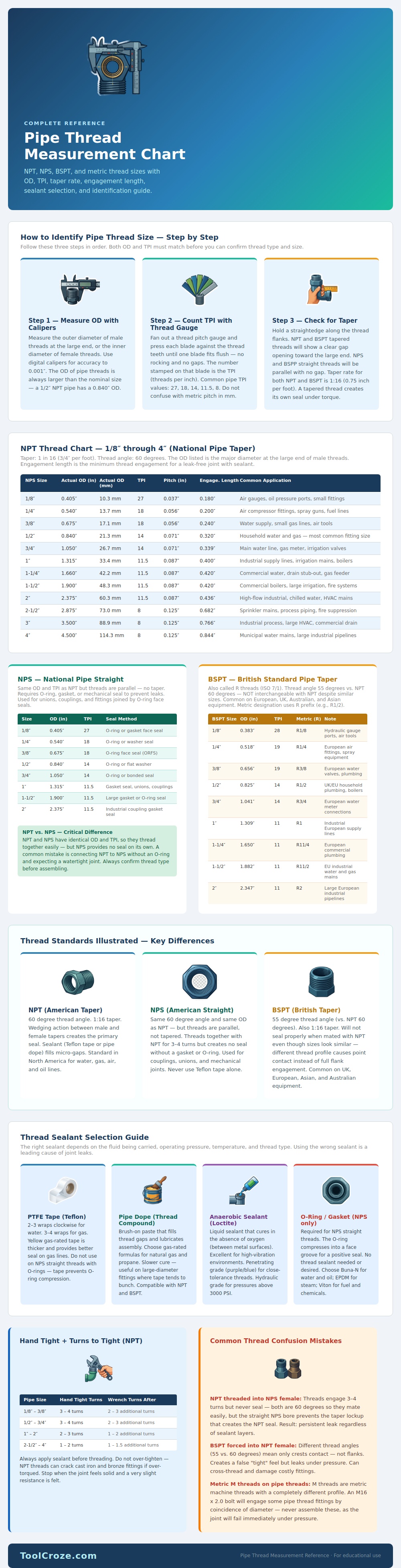
Follow these steps to identify a thread. Do you panic when you’re holding three of the same fitting while water sprays all around? Chances are it’s not your plumbing, but rather the various standards being used. Most commonly you’ll come across three types: NPT, NPS and BSPT standards. While they will generally be close in size, they all use totally different sealing methods.
To make things easier, we’ve put together an infographic that will help you identify these quickly and prevent double purchases of incorrect parts. We’ve broken it down into an easy-to-use, three-step process based off measurements (not guesses). You start by measuring the outside diameter using calipers. Nominal pipe sizes aren’t very helpful and throw people off at first. A “half-inch” pipe isn’t actualy half an inch in diameter.
How to Identify Pipe Threads
Then you run it through a gauge fan and count number of threads per inch until you get to one blade that will fit snugly without any rocking back and forth. Last step is to lay a straightedge across the threads to see if they are tapered. Is the space between the thread increasing as you move up to big end? Yes, you have a tapered thread such as BSPT or NPT. No; it’s parallel so you’ve got BSPP or NPS.
In North America, the residential market is dominated by the National Pipe Taper standard. Why? Because its thread angle is 60 degrees, and it has a taper rate of one-in-sixteen, which causes the joint to be mechanically wedged when tightened. To form the initial seal, there’s no substitute for pipe dope (or sometimes Teflon tape). The substance isn’t just filling voids: It also lubricates the threads to allow you to make critical metal-to-metal contact without stripping out your fitting.
As noted in the chart, threads-per-inch is lowest on the large lines (to four inches) but go way up again with smaller lines such as one-eighth inch. What does that mean? You can’t guess at torque based off how a fitting feels: A two-inch fitting feels far looser then a quarter-inch one… Just because of different thread pitch. Under-torque the fittings, and they will leak pressure right away. Cross-thread them and you’ve got problems too.
But then straight threads tell another story altogether. Although NPS has the same thread count and outer diameter as the tapered version, it isn’t shaped like a cone at all. No taper means no wedging action. So these can’t be sealed by tape alone, since nothing compresses against something else to form a barrier. Instead, these fittings needs a gasket or o-ring type face seal.
And this is where folks get confused and why it costs so much money: they’ll attempt to muscle an NPT male threaded piece into what appears to be an NPS female port because the two threads go together nicely for several turns. But they don’t. No matter how much sealer you use, the joint will still leak, because the shape just won’t cooperate for a tight enough pressure-seal joint. That is what most people does wrong.
If you’re using older systems or have equipment from abroad, there’s another wrinkle: British Standard Pipe Taper. Its 55 degree thread angle won’t mate with NPT. Although the one-in-sixteen taper is identical, the angles don’t meet well enough to form a proper seal. There are small channels between the flanks where fluid can leak out when pressurized. It appears close, but in reality it’s loose. And I mean loose like seal.
Knowing these differences turns what should of been a simple guess-and-test job into a simple mechanical process. Measure, then figure it out, then pick your sealant type. Is it something that needs anaerobic compounds (hydraulic systems) or thick yellow tape (high-pressure gas lines)? No more spray if you know your threads. Hours of cleanup later are saved by minutes of prep time early on. Have some calipers nearby and don’t forget that nominal size is not dimensional, just a name.
