
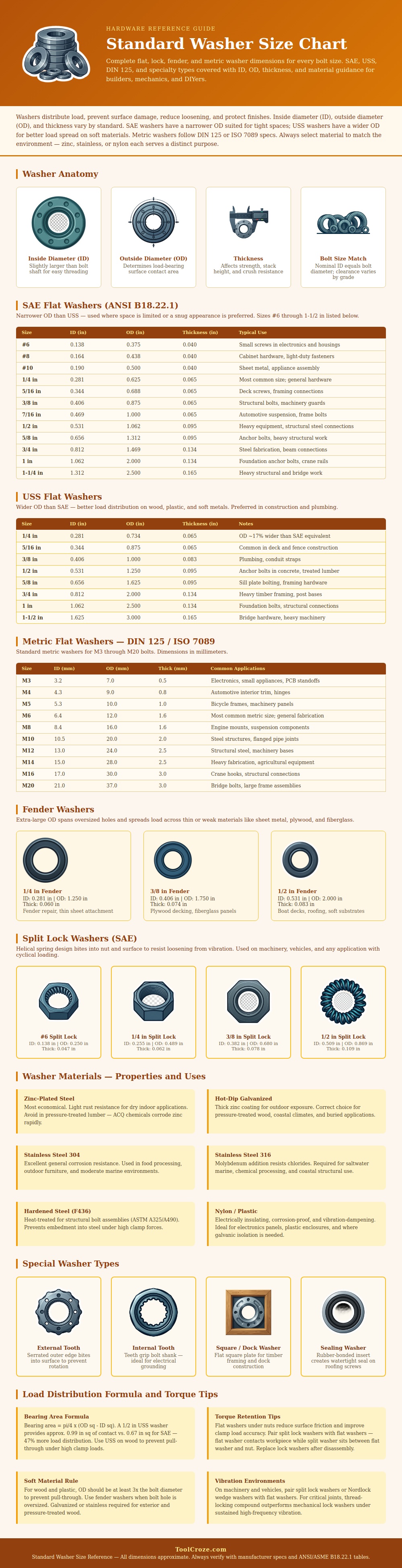
Ever find yourself standing at a workbench staring at a bunch of seemingly identical metal rings and wonder what makes some fasteners slip and others split wood? It’s not magic. It’s physics, it’s geometry pretending to be hardware. Picking the correct washer from chart above can be the difference between a joint that lasts decades versus one that falls apart within a week. If you don’t know how load distribution work, you’ll grab whatever flat circle is first and then you’re going to have issue.
It’s confusing if you’ve never seen a spec sheet, but the difference between USS and SAE washers are an important point made by the infographic. SAE washers is narrower, intended for use in tighter areas with limited clearance. USS washers is wider, with a broader bearing surface. That makes them more importent than you might realize.
How to Choose the Right Washer
If you’re bolting down something to soft material, such as drywall or pressure-treated lumber, the washer protect the material from being crushed by the tightening force of the nut. A narrow SAE washer sunk into soft wood will lose tension over time; a wider USS washer spreads out the force across a bigger area, maintaining a snug connection. It’s a tiny geometric tweak, but it change the mechanics of the joint.
These are bolt sizes and metric size. Metric sizing follows this pattern but with different numbers. In this case, it’s listing dimensions of standard DIN 125 washers sized from M3 through M20. Don’t worry about remembering all these numbers; what’s important is to see how they scale by thickness. While a small electronics-sized M3 washer is barely a fraction of a millimeter thick, an M20 washer used to construct a bridge are near half a centimeter thick. That way the washer doesn’t bend out from under load long before the bolt itself starts to give.
Lastly: The material is really important; that’s where so many jobs go wrong early on. If you’re bolting into dry indoor areas, zinc plated steel will do just fine. But if you place zinc anywhere near today’s pressure-treated wood that contains ACQ preservatives, corrosion occur rapidly. The chemicals in the wood consume the zinc coating, and you’ll have a loose bolt (and lots of rusted sludge) in months. When using them outdoors, especially near chemically treated lumber or salt water, use either stainless 316 or hot-dip galvanized steel. It doesn’t cost much more than the hassle of dealing with stripped bolts or rotted framing down the line.
And don’t forget about lock washers. Helical spring split lock washers bites into the surface and the nut to resist vibration. Basically, it’s tension that keeps them locked up, and boy are these things tough on soft surfaces. Typically you use a flat washer underneath so the lock washer grips mechanically, but the flat washer is protecting the plastic or wood. This is where the chart realy makes a difference. It highlights why there are all sorts of special washers, such as fender washers, which is designed to fill large gaps between nuts and bolts to hold sheet metal or fiberglass in place against pull-through.
A washer isn’t something that should of being treated as an afterthought. Even though it’s a bolt, it’s a load bearing piece. Building a deck or hanging a shelf? Match the width of the washer to the hardness of the material. Also, match the coating to where you’re going to hang it. It will save you hours of reworking later by checking the washers’ reference guide for a couple of seconds now. The right ring is all tight.
