
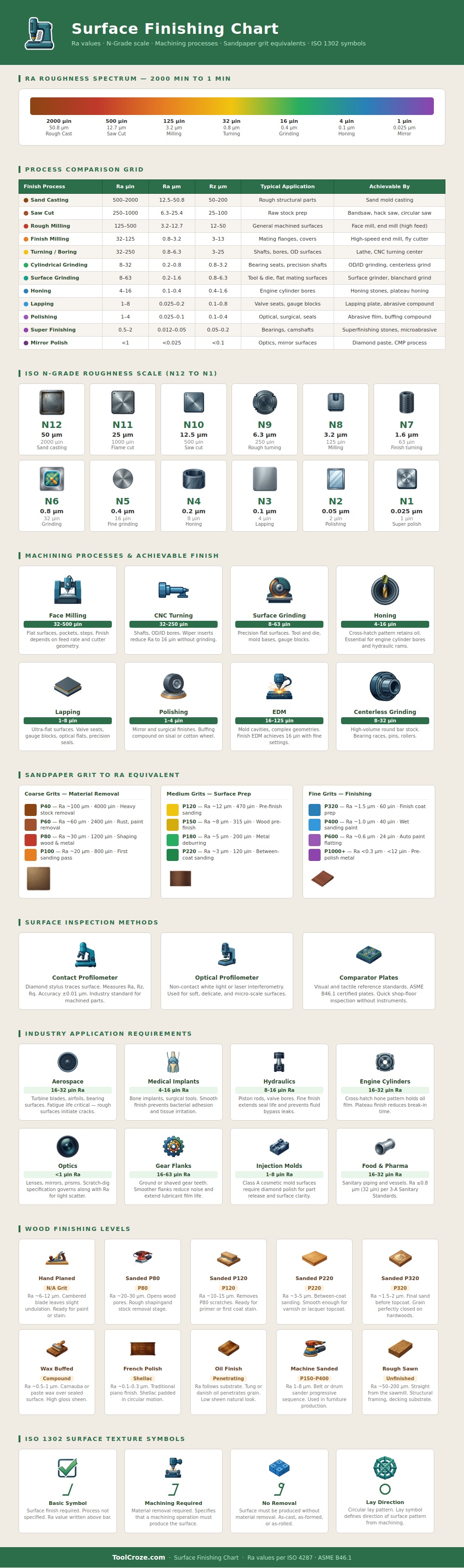
How rough or smooth do you want it? Surface finish are a functional parameter for machining. This one will help you decide the level of smoothness you want before starting machine operation, since it will be difficult if not impossible to correct after the fact. It will also help you understand what your machine shop might produce.
What does each process do? This is roughness average (Ra) chart. For example, most shafts don’t come out mirror finished from turning alone. They probably needs some form of smoothing via a hone or grind. Cylindrical grinding leave a much finer finish different than milling. For every step toward greater smoothness, there are added expenses in abrasives and tools. Why polish a bolt to optical grade? Over-specifying on the finish add unnecessary cost to the design.
How to Choose the Right Surface Finish
Rather than perfection with no purpose, apply the right manufacturing process to the part based off its intended use. Some applications, like a hydraulic piston rod, need a cross-hatch pattern so that they can holds oil yet not allow the pressure to leak. Too smooth a surface won’t hold any lubricant resulting in dry friction and ultimately failure; too rough, and it’ll wear out fast.
For things like hydraulic rams or engine cylinder surfaces, honing provide just the right kind of micro-structure… It’s rough looking under a microscope but enables movement without seizing up. For optical components, which demand sub-micron finishes to prevent light scatter, a tiny imperfection can becomes a visible distortion. A sub-micron finish prevents scattered light by stopping it at tiny irregularities.
The two examples illustrates that your surface finish is determined by manufacturing limitations, cost, and function. For every application you have to figure out how to strike this balance. Connecting engineering standards with workshop habits, this chart link Ra values with traditional grit sizes. Engineers use micrometer measurements whereas machinists is familiar with grit numbers from sandpaper.
Avoiding workarounds saves time and money because we know that a coarse grit will be too rough for mating parts. Use this bridge to translate technical decisions so other departments understands what you do. Justify any process in terms of both its physical effort and the need.
In every application, surface finishing affect wear and friction. Gears must have just the right texture to operate quietly. Medical implants require a smooth surface that resists bacteria. Pick the smoothest finish you could of afford that also serves your function. Super-finishing stones don’t work well on rough castings any more than a chainsaw does for fine joinery. Make your decision based off the data rather than guessing.
