
Building a house isn’t just about standing up big hunks of wood and calling it framed. These days, manufactured I-joists is used instead of solid lumber, so how do you know when your boards goes too far? Do they sag? Knowing this helps you determine if floor will feel solid or bounce like a trampoline.
Strength does matter, but even more so does deflection: the amount that a beam deflects (or sags) with load on it. The homeowner doesn’t typically see when something fails due to strength, but he’ll sure feel the bounce.
Why Engineered Joists Make Floors Feel Solid
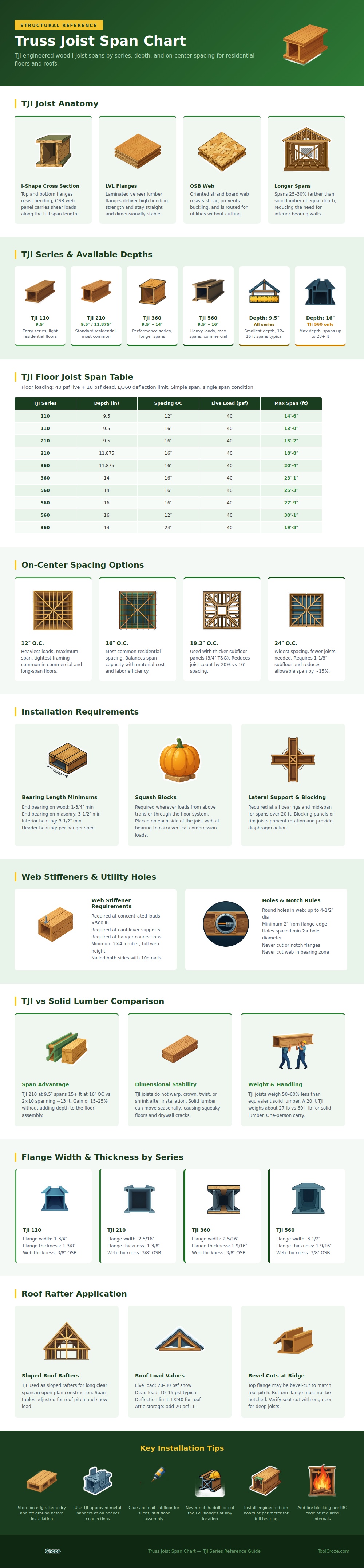
As you’ll notice in the chart above, material series and depth do make a huge difference based off the maximum distance a given joist type can span for any given spacing. For instance, if you’re looking at a light duty residential application, the TJI 110 series joist won’t go as far than the beefier TJI 560 will go with heavier loads. You can see from the infographic, going up a couple inches in depth from a nine and a half inch joist to a sixteen inch deep joist really makes an impact on maximum span length.
What that means is, you can have more feet of free floor plan (without interior support walls) because of that added depth. This make it possible to build open-concept homes that traditional lumber can’t support without requiring much more ceiling height.
Think about the anatomy of these beam. They aren’t solid blocks of wood, either. These beams is made from an oriented strand board web sandwiched between two laminated veneer lumber flanges. The web resist shear loads and the flanges resist the bending forces. Because of this composite design, engineered joists weigh considerably less than their solid lumber equivalents, but will also span farther.
A 20 foot TJI will probably only weigh about twenty seven pounds, so a single person can easily carry it around. Compare that to a solid two-ten of equal strength which may well be weighing in at sixty pounds or more. That’s a weight difference that affects how you work on the jobsite because you don’t tire as quickly and can move around quicker. Small things, sure, but when you’re lugging several hundred of them up the stairs it adds up.
The other thing that throws off the whole equation is spacing. Sixteen inches on center is common in most houses built by residential builders. These homes are reasonably priced but not too wasteful to build. Twenty four inch spacing mean fewer joists, so less material. But look at the chart; at this larger spacing your maximum span gets reduced about fifteen percent. To fill the space you’d have to make the subfloor thicker as well. Twelve inch spacing will give you the sturdiest floor, but it takes more labor and materials. It’s commonly used in commercial buildings or homes with a very high live load. Typically, it’s a question of budget vs. Degree of desired stiffness of floor.
Where projects get derailed is in the installation details. One thing to remember: don’t cut or notch your engineered wood. Ever. Unlike regular lumber, that’s not how it works. You lose the bending strength of all those laminated layer, which renders the whole beam compromised. On the other hand, routing utilities through the web won’t harm anything. Just avoid cutting into the flanges and you’re good to drill out round holes as large as four and a half inches across. That’s one of the greatest benefits of this system, plumbers love it!
Just be sure to add a little block (stiffener) where there are concentrated loads or where a hanger connect. Failing to do so could of cause problems down the road which will cost you big time.
You must balance span, series strength, and depth when selecting the right joist span. For general residential use, the visual guide is a good start. Local code take priority though as do exact load requirements. Storing the beams dry is important as is getting your bearing lengths correct on masonry and other walls. Respect the engineering and house will reward you with steadiness.
A stable floor makes a building feel like a home. Not only can it hold our weight, but it can make us feel secure at our very base. You should of seen how much difference depth makes. It is actualy naturaly more luxuruis to have a solid floor.
