
If you’re cutting wood with a power saw, I know you’ve been there: wrong angle on your drawing, panic time! Cut the wood, check the square…still doesn’t close up the frame right? That’s typicaly an issue of not grasping the behavior of angles on flat paper vs. Angles in 3D space.
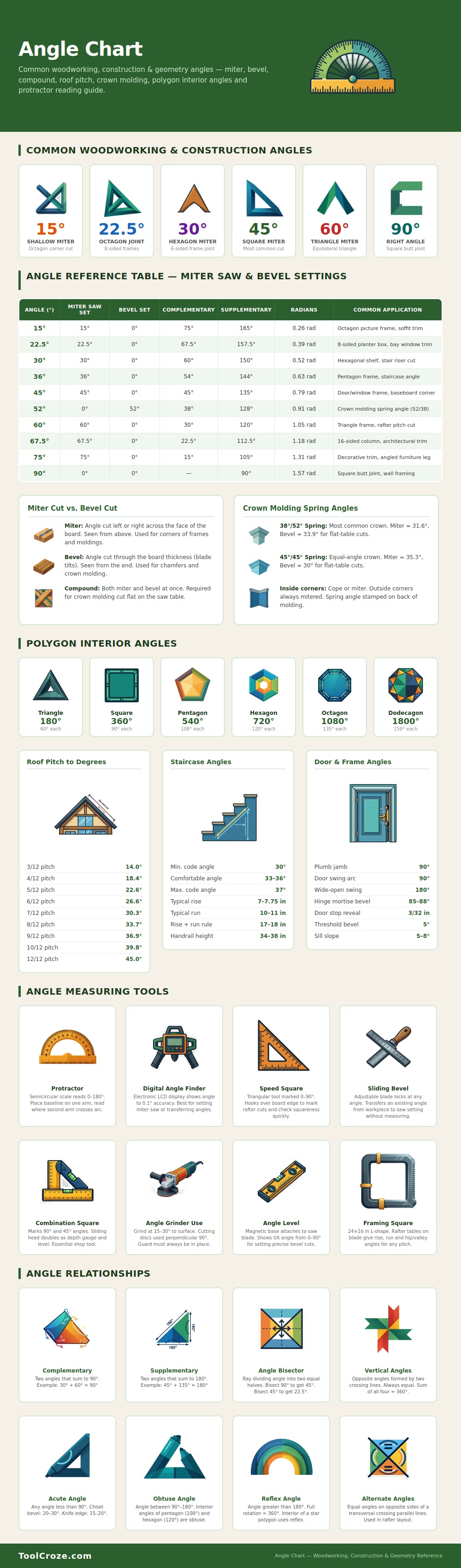
Miter cuts aren’t the same as bevel cuts. Both require the blade to be angled. However, most people new to using trim consider them interchangeable which wastes lots of money quickly. The chart clearly divide the two.
A Simple Guide to Woodworking Angles
For crown molding, there’s no way around it. You’ll either need equal angles on your stock or you can’t just pull out your saw and set it to forty-five degrees. As the infographic points out, most molding is typically thirty-eight degrees and fifty-two degrees on the back (or spring) angle. To cut it flat on the table you have to adjust the blade tilt and left-right turn at the same time. We call this a compound cut.
The number on the dial doesn’t match actual angle of the joint once it is in the wall, so it feels confusing. But if you don’t want to haul out some trigonometric tables while standing by spinning blade, the guide will tell you what to set it to so you can save time and preserve your sanity.
These angular relationships also control shed, such as how roofs drain water and structures stands upright. The table of references provides the rise-over-run ratios (from 3:12 to 12:12) translated into their degrees equivalents. Why does this matter? Roofing material manufacturers’ specs say things like “this kind of shingles cannot be used at less than X number of degrees,” which is why they use degrees instead of rise-over-run.
Code says your stairways have to add up to between seventeen and eighteen inches in the rise plus the run, for comfortablely climbing. It’s not random mathematics, but biomechanics. Your body has a natural length of stride, and stepping off that makes going up stairs harder. So the chart will help you see where code minimums align with what feels more better to walk on.
With polygon frames, however, there’s some tricky math involved. Theory and practice meet in frustrating ways; a hexagon have an interior angle of 60-degrees, but your miter saw doesn’t measure interior angles. To get hexagonal shelf joint, you need to cut on a thirty degree angle from square. The infographic spells it all out, from triangles to dodecagons, so you won’t have to do the math in your head each time.
Knowing why is just as important than knowing what. Why do we cut off extra? The leftover edges can align with the desired vertex. Guesswork will leave you with a collapsed looking picture frame instead of a nice even one.
Finally, precision isn’t about fancy gadgets but rather solid references. Whether you use an aged speed square or a digital finder, it doesn’t matter as long as you get that angle from the paper onto the material correct. This chart will be your center point for those conversions and take the guessing out of matching joints where every inch matter.
Your frames hold tighter, your cuts are cleaner and when you quit fiddling with the math and give geometry its due, that sweet click of the frame coming together isn’t magic, just right angles working exactly how they’re supposed to.
