
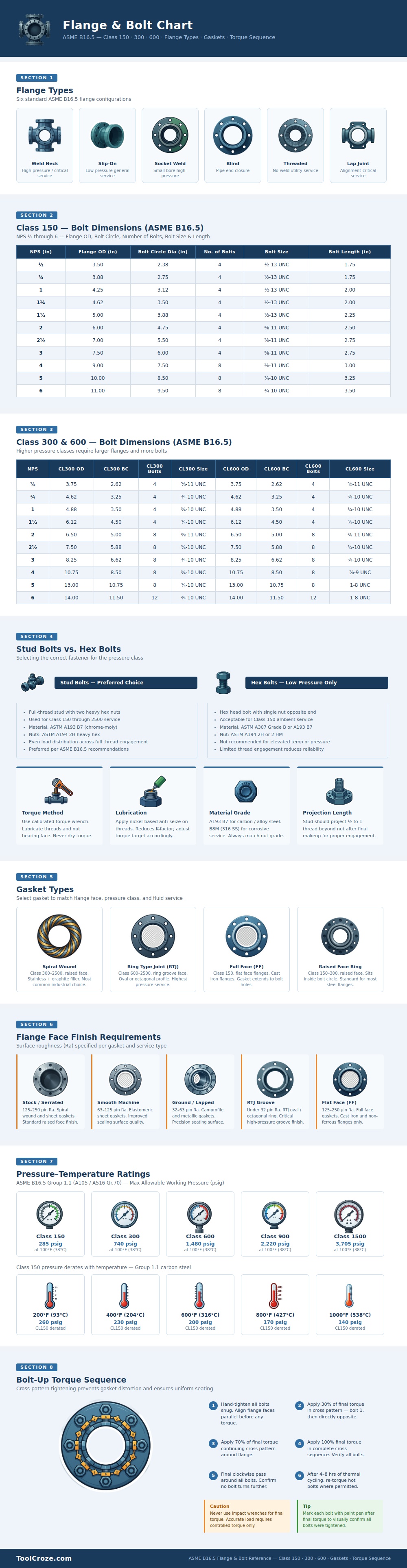
When building a piping system, you may inadvertantly select an incorrect gasket for a flange face. It’s easy to do: you just grab something without checking the material compatibility or pressure class. Brute force isn’t the same thing as precision. One joint lasts decades; another leak under steam.
Standardized by ASME B16.5, the bolt count and surface roughness is standardized so what was once potentially dangerous becomes routine assembly. As you step up to Class 300 from Class 150, chart illustrates how flange dimensions change. You’ll notice the increase in bolt size (the weight of the bolt) along with the increase in number of bolts as pressure rating increase. That change is mathematicaly based off engineering and it makes sure the sealing surface can resist internal forces but won’t blow apart.
How to Build a Safe Pipe System
Flange connections should be thought of as dynamic seals instead of simply two piece of metal sandwiching each other. They need to withstand changes in pressure, vibration and thermal expansion; this is why slip-on vs weld neck flanges becomes a consideration. A slip on flange is not structurally rigid and is therefore appropriate only for utility type applications with lower pressures.
In contrast, the weld neck design use a butt-weld joint that transfers loads to the pipe. This eliminates need for the bolted connection to hold up under the stress. Slip-on flanges used in higher stress environments will give you trouble as the bolting holds too much of it. The chart points out six common configurations to help you select the joint type for use before pulling out your wrench.
Where things go wrong or where people shortcut is in fastener selection. Industrial uses requires stud bolts that offer full thread engagement with an even distribution of loads. These let you torque down two nuts together keeping the load centrally located on the face of the flange. Hex bolts are what appear convenient for normal service at low pressures but have minimal thread engagement. Hex bolts also becomes problematic as temperature increases.
Match your stud material to your nut grade. For instance, if your studs are ASTM A193 B7 studs then your nut should be A194 2H. Mixing grades will compromise integrity of the joint and may create issues related to galvanic corrosion. Again, not a big deal except when system is hot and under pressure.
Seals: The infographic outlines five main types of gaskets The heart of the seal isn’t an accessory, it is the gasket itself. The infographic details five primary types of seals. These include Ring-Type Joints for high pressure groove services and spiral wound rings for raised faces and more. You cannot use a flat face gasket on a raised face flange.
Flanges also have requirement for surface finish to match gasket needs. Roughness ranges includes 125-250 micro-inches for spiral wound gaskets. Precision machining under 32 micro-inches prevents micro-leaks in RTJ grooves. Failure is immediate or slow weeping, which destroys plant floor air quality.
The last step in the assembly process is the torque sequence. First tighten by hand, then seat parts evenly by torquing them in a cross pattern. Final tightening should of not be done with an impact wrench. You have no idea what load the wrench will deliver so you lose control of it. Use thirty percent of desired torque, then move up to seventy percent, followed by one-hundred percent while checking each bolt.
To make sure you’ve covered all the bases, try marking each bolt with paint after torquing them. Because materials will set differently and expand differently over time, re-torque might be required following temperature changes. With this procedure, you’ll know that your connection won’t fail on day one or year ten, keeping pressure where it needs to be.
