
Replacing a tire isn’t merely about jacking up the vehicle and cranking on lug nuts until they’re tight. Why? It is a delicate act of precision engineering, not a brawn contest. Clamping a wheel against a hub can cause a rim to warp a rotor and strip threads of studs. The goal is applying sufficient force to retain the wheel in place while cornering without stretching a stud past its yield point. Torque specs guides you toward that sweet spot between safety and danger.
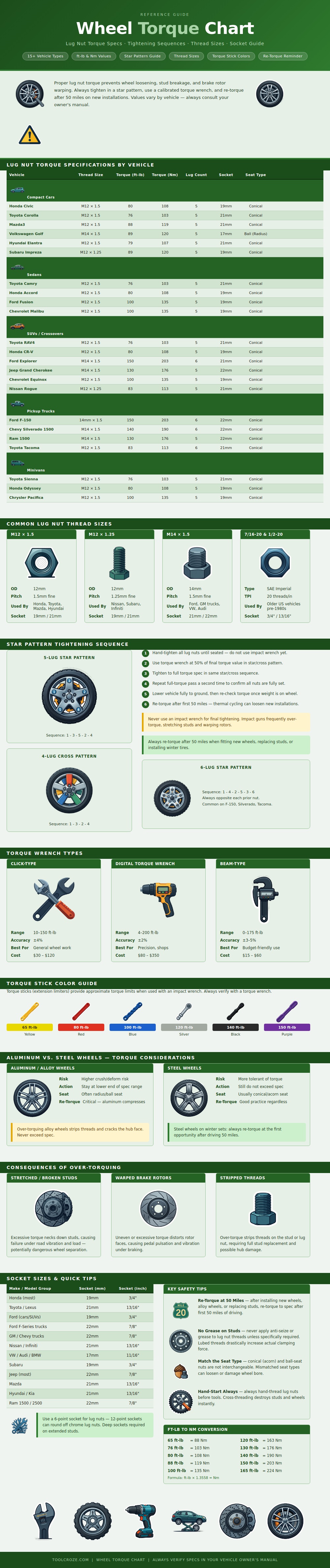
This is from the reference guide: Each vehicle has its own requirements. It’s nice to know what they are instead of having to guess each time you get your wrench out.” As an example, look how various cars differ in terms of torque (foot pounds). Those smaller compact such as the Toyota Corolla or Honda Civic typically fall somewhere in the low seventies to eighties. That might sound mild compared too say, a Chevy Silverado or Ford F-150, which both needs roughly one-hundred-and-fifty foot-pounds.
Why Tightening Wheel Nuts Correctly Matters
But it isn’t just random. Those larger pickups carry more weight. They endures greater stress on their wheel assemblies. Therefore, the manufacturer specifies tighter clamping to make up for this increased stress. They also use heavier rims made of steel, while those smaller car tend to use aluminum alloy rims. Aluminum is very unforgiving compared than heavy steel rims because it compresses somewhat with load and heat. Stick to lower end of spec range on the chart if using the lighter alloys. It is easy to push them too hard and rip the hub face off the wheel or strip all the way through the threads.
Knowing how tight to tighten is important but so too is having the proper tool. Final tightening with a regular old impact wrench will do more harm than good. It applies its force randomly, probably stretching the stud and distorting the rotor without ever letting you know. For the final tightening, opt instead for either a digital or a click-type torque wrench.
This guide points out color-coded torque sticks as another shortcut for garages. Red equals eighty foot-pounds and blue equals one hundred. This limits the torque applied in situations where speed is most important but precision isn’t quite needed. They’re not as accurate as handheld wrench but can be handy if you’re in a pinch. For your own garage, reach for the clicker since it provides a physical feel that even an air gun cannot. When that handle snaps under your thumb, you know exactly when to release tension.
How hard do you snug ‘em? That’s important, but so is how they’re tightened in sequence. A common mistake is going in circles. Doing so squashes the wheel into an oval shape making one side tighter than the other. The trick is to work in a star-like fashion, starting at one nut then moving straight across to the one opposite it. Continue working your way around like this until every nut are tight. Cross-patterning like this makes sure there is even clamping force on all of the studs and helps the wheel seat properly onto the hub surface.
Begin by tightening each nut by hand first to be sure none is being cross threaded (which will destroy the stud right away). Next torque down each nut incrementally and end with the final full value. Don’t think that’s all there is once you mount the wheels. Metal has memory; as it cools down and then gets hot again while you drive, it will settle into place again. And so will your lug nuts. But they can actualy loosen up a bit. The thermal cycle of acceleration and stopping causes the lug nuts to tighten and loosen just a bit over time. That’s why you should of always re-torque after driving them 50 miles or so to catch anything that might be loose before it starts becoming unsafe.
Every car is different, but always refer to your owner’s manual to find the correct number. It will change depending on how big an engine your car has and what it was designed to do. Get it right and your wheels won’t go anywhere. Your brakes work like they’re supposed to. And your wallet doesn’t take a beating at the mechanic later.
