
Don’t know your gauge? You’ll have problems if you don’t know your gauge, like I did during my first custom kitchen project. It is usually not because of lousy craftsmanship or design but rather a lack of understanding about how gauge work.
For example: A fabricator quoted you based off carbon steel standards when you actualy needed stainless steel. By the time the material shows up at the door and you use calipers to check its thickness, it turn out the sheet is much too thin. In fact, it seems flimsy when pressed between two adult-sized sofa. And that’s when you learn that numbers mean nothing except within the context of whatever standard they’re generated by.
Everything You Need to Know About Stainless Steel
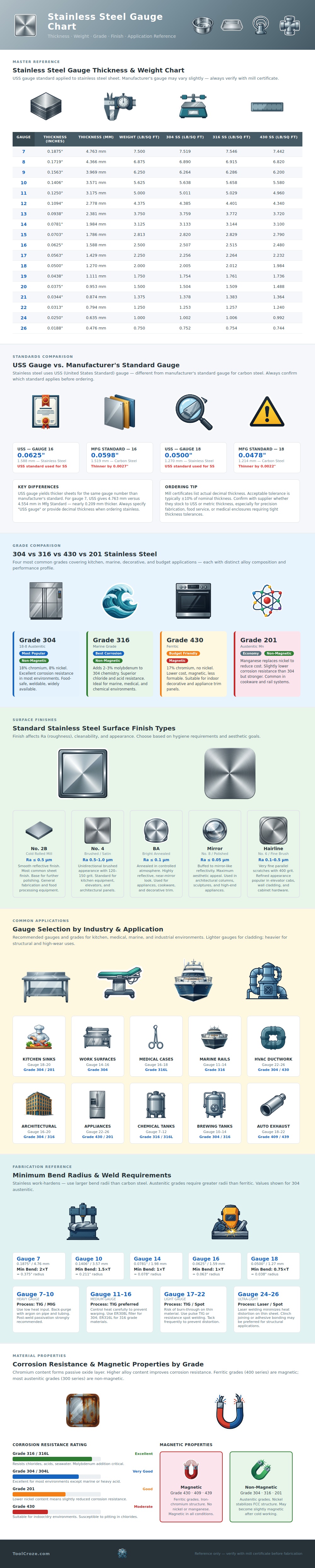
Here’s the breakdown of the USS gauge system in stainless steel. This gauge give you heavier sheets than the manufacturer’s standard which is usually applied to carbon steel. So if you call up and say “I want a 16 gauge stainless steel sheet” without specifying the USS standard, be warned that the answer may actualy be a sheet that’s almost three thousandths of an inch less thick then what you ordered.
That’s nothing structurally. But in food service applications where durability and cleanliness are important, it’s a recipe for disaster. The key to stainless steel is understanding how the thicknesses work. To that end, United States has created a standard gauge system so everything is uniform, but there is another wrinkle: Metallurgy.
There’s no such thing as “stainless steel.” There’s a whole family of alloys that each have their own properties for use in specific applications. For the most part, grade 304 (commonly referred to as 18-8 because of its nickel and chrome composition) is the workhorse. It’s strong, weldable, non magnetic and resists corrosion from the vast majority of elements you’ll run into outside or in a commercial kitchen.
And then there’s grade 316, which mixes in a little molybdenum. That give it more resistance to acids and chlorides, making it marine-grade, i.e., ideal for a coastal application where it won’t be pitted and rusted by those elements like 304 would in a matter of months. Skipping the additional expense of 316 if you’re making something for a chemical processing plant or coastal environment is penny-wise pound foolish. You’ll pay much more down the road in terms of repair bills.
At the other end of the spectrum is Grade 430. Because it does not contain any nickel, it is ferritic (meaning it’s magnetic). That means it’s easier on the wallet but can corrode a little faster if exposed to rough cleaning solutions or moisture. It is great for use inside of appliances as trim or decorative paneling that won’t be subject to high amounts of wear.
As the infographic points out, you’ll notice that even though they have the same gauge number, they will have a different weight in pounds per square foot. For example, a 16 gauge sheet of 316 will be slightly heavier than 409 of the same size…because the density of their alloys is different. It is not a big deal but it is something to take into account when shipping large fabrication jobs or determining the load bearing capabilities.
The other important factor in what you’re going to end up with is surface finish. You’ve got your basic No. 2B is fairly reflective but also smooth. It is great for food processing equipment or just about any kind of fabrication where ease of cleaning is a must. If you prefer something closer to satin (you know, like in new cabinets or elevators), then go with a No. 4. Go with a No. 4 brushed finish. And if you really need to impress someone, there’s always the mirror polish of a No. A No. 8 finish is good for decorative trim or high-end architectural elements, but it will mark easily and show fingerprints like crazy. Even the best-welded item can be visually ruined by incorrect choice here.
The chart breaks down the finishes along with their relative roughness so you can quickly see how to balance appearance against hygienic needs. The other fabrication consideration is the gauge itself. Welding thick sheet requires a lot more force to bend than thin sheet and also requires care when heating to weld to keep from warping the material. Thin sheet, by comparison, can be welded with spot welding and laser welding techniques but will burn through easily if you aren’t careful. In addition, thicker sheet has more room for error in the bend radius before cracking, as shown in the reference guide above.
The bending process require more force, but also a larger radius. Again, tool selection isn’t all that’s important. It’s knowing what the metal can physically withstand.
All this adds up to one thing: Working with stainless steel is all about matching the material to the mission. Use thin-gauge sheet for a bookshelf in your home not a structural support beam; use marine grade for the beam, but definitely not for the bookshelf. Before fabrication starts always check your mill certificate. What’s on paper is a promise, what is in your hands is real.
Once you get to know the finish options, alloy compositions, and gauge standards you stop guessing and start engineering. When you build with confidence, good projects becomes great projects. You could of been certain that something built today will look solid both on the day you cut the first sheet and decades later.
