
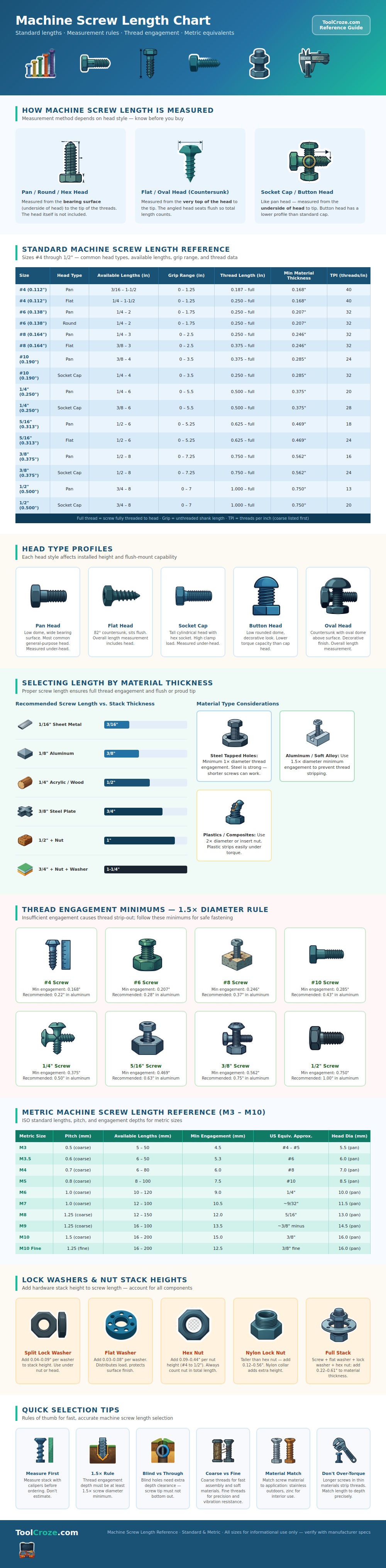
Learn more about screws. Knowing what a screw does when driven into whatever it’s holding in place matter for both strength and usability. Is it possible to drive the screw without damaging or actualy stripping the thread? Did you know that way a screw is measured makes all the difference? The answer is no to both questions if you don’t realize one basic truth about which part of the screw are being measured. Most people think that every screw is measured from top of head right to the point.
FALSE. Round heads and pan heads starts their measurements at bottom of the head. So the rounded part on top doesn’t factor into total. Flat heads has another story since they rest flush against surface. Their angled countersunk head is hidden beneath so we measure their entire profile (top to bottom).
How to Choose the Right Screw Length
When purchasing hardware, this means that a flat head isn’t the same length than you’d expect based off its pan head cousin. In fact, the thickness of the head itself is what you’ll be missing. It is a small detail but it provides an expensive lesson when buying screws.
That gives us our chart, which shows relationship between standard length and thread engagement and grip range (above). It covers everything from tiny number four screw to the half-inch heavy hitters. See where the longer lengths are possible with each size? For example, that little number six screw doesn’t go more than two inches. A half-inch pan head might extend to eight inches. Makes sense: bigger diameters requires thicker shafts, or they’ll bend when torqued. Once you’re trying to tighten something physics enters the equation and you don’t get to order whatever length you want in every diameter.
Grip range indicates how long the shank is before it’s engaged with threads. This is for when you want a smooth section to feed through a hole without the threads biting into it too soon. You also has to consider what kind of materials you’re working with. Different materials requires different amounts of engagement based on their diameter. Going against this rule means stripping out holes before you know it. Because steel is tough as nails, you can typically get away with engaging a hole once to a depth of at least the diameter of screw.
Aluminum has a different story. To keep screws engaged to aluminum, at least 1.5 times the diameter need to be buried in material. Otherwise, there’s a good chance they’ll come loose over time.
What about plastics? Even more respect are needed. A proper insert nut or twice the diameter is often necessary for plastics. The material itself simply doesn’t bite into steel threads well enough to secure a screw for long periods of time. Screwing something onto an aluminum bracket with a screw that barely engages won’t last long under any type of vibration. There’s a reason we do it; it’s not a matter of getting used to it.
Also remember to include nuts and washers when calculating how high your stack will be. Hex nuts adds a lot of bulk, as do nylon lock nuts. Washers add a couple thousandths of an inch. But if you’re going through a plate where there’s another nut on the other side, then you has to account for entire nut and whatever washers you use PLUS the thickness of whatever it’s going through. Often folks just measure out the material and neglect the stack of nuts and washers. Then the screw goes part way up the nut’s threads. There’s absolutely zero clamping force.
If you’ve been relying on approximations for metric conversions, beware! Sure, five-sixteenths inch sounds like an M8 screw. But they don’t always interchange cleanly in a threaded hole because of pitch differences. If you haven’t verified compatibility, stick to the hardware’s system. To avoid wasting trips to the hardware store (and some frustrated evenings staring at loose joints), take a chance and measure the stack before ordering.
It is less about memorizing tables and more about visualizing how parts fit together. The key to choosing the correct screw length isn’t so much remembering tables, but rather visualizing how everything fits together. Visualize the screw as a bridge: It requires solid footing on either end. If the screw is too short, it will slide out. Too long and it pokes through when it doesn’t belong. Once you get the length right, your project remain tight. Get it wrong and you’re simply playing with moddern metal paperclips. You should of checked first.
