
So, you’re half-way into creating your engine and then you remember that the fuel line isn’t going to quite make it to the regulator. So you pick up a fitting, snug it down, turn the key and see fluid seeping out off the connection before you’ve even started the truck. It is every mechanic’s nightmare to underestimate how precise these high pressure system can be.
And it’s never as simple as purchasing superior components. It’s mastering the geometry of the connection. Performance build don’t leak due to bad hoses, but rather improper torque on the flare seat and/or mismatching threads. That’s where the Army Navy standard comes into play.
Why AN Fittings Do Not Leak
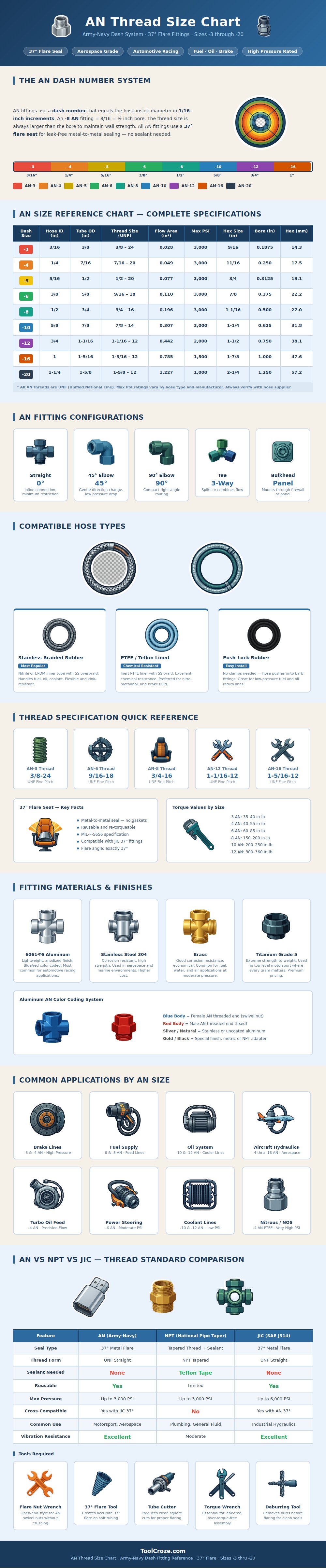
It is designed to establish a universal way to describe the amount and transfer of fluids with less emphasis on convenience and more on being reliable. As you can see from the chart above, there is actualy order to the numbers, and the dash number isn’t just a random series of digits. An “eight” size fitting isn’t going to take eight pounds of pressure. It has an inner diameter equal to eight sixteenths of an inch. The chart shows how the size relate to the flow capacity immediately.
This means you don’t have to do any mental math when purchasing a component. It’s largely a mental exercise. If you get inside your head that the dash number equals the size of the bore in sixteenths, choosing the correct hose won’t be a guessing game anymore, but second nature.
These fittings has a unique flare angle of thirty seven degrees. While this doesn’t seem like much, it’s what makes them different than your normal plumbing connection. Because of the flare angle, the metal-to-metal seal provides security instead of relying on the threads. So you’re thinking I’ll just tighten it some more. Nope. All those threads holds the two pieces in place. Meanwhile, the conical part of the face pushes up on the mating piece to seal off the flow.
Because the seal doesn’t depend on sealant or deformed threads, you can take the parts apart, clean them, and reuse them repeatedly while still being sure they will stay sealed. With tapered pipe threads relying on sealants and deformation, you don’t get that.
A big part of where those fittings go depends on what they are made from. For race cars aluminum is the norm. It has a very good strength to weight ratio and also allows for anodized finishings which make them easy to identify. When corrosion resistance is required, such as in marine applications or when using brake fluid that will break down other metals over time, stainless steel take over. Brass works nicely for less demanding water or air line at a lower pressure where durability isn’t needed quite so much and cost becomes more important. Pick your material based on what it needs to last in and what it will be carrying.
Tightening is torque related and we don’t pay attention to it… until it’s too late. Stripping out threads in aluminum fittings happen immediately if over torqued. Under tightening leads to slow seepage that wastes fluids and creates safety hazards. A range exists for each size where proper sealing occurs without damaging the hardware. This allows you not to guess at how hard to tighten with the wrench. It turns the heavy work of assembly into a precise operation.
One common mistake is confusing the same-looking thread standards. For example, both AN fittings and NPT threads appear very similar at first glance. However, they are not interchangeable. If you try to mate them together, you’ll have a leaking and therefore dangerous connection that compromises the integrity of your whole system. Before proceeding with the assembly, always double-check the angle of the flare. It only takes five seconds and saves hours of troubleshooting down the road.
These specs make sense of a seemingly random assortment of tubes and hoses. They allow you to move the liquids necessary to operate your rig. Once you know what each part is and how it connects to everything else, you won’t struggle with the equipment. You will work together with it.
Next time you grab that flare nut, recall that the seal is not on the thread but rather on the face. That little detail could of been the difference between a leaky mess and a well sealed system that always seems to leave you one step short of complete.
