
Ever try tightening a pipe fitting only to have water leak out anyway? You crank on the wrench a little more, hoping brute force will close up the gap between the fitting and the pipe. Then you find youve cracked the fitting or stripped its threads. If you’ve done any plumbing, you probably know what I’m talking about.
Your lack of strength isn’t typically the issue. The problem is usualy confusion about national pipe threads. People think if it’s tight then it’s safe… And that’s a very dangerous assumption.
Why NPT Threads Leak and How to Fix Them
NPT threads are standard threads, and while they’re tapered, they don’t form a seal when compressed together between two pieces of metal. They are not designed for that. They require help, specifically, something to fill in the tiny spaces between the root and crest of the thread. That substance forms the barrier against pressure.
That’s why the joint must be sealed with pipe dope, or PTFE (Teflon) tape. If it isn’t, even the tightest joint imaginable will simply act as a high-dollar sieve.
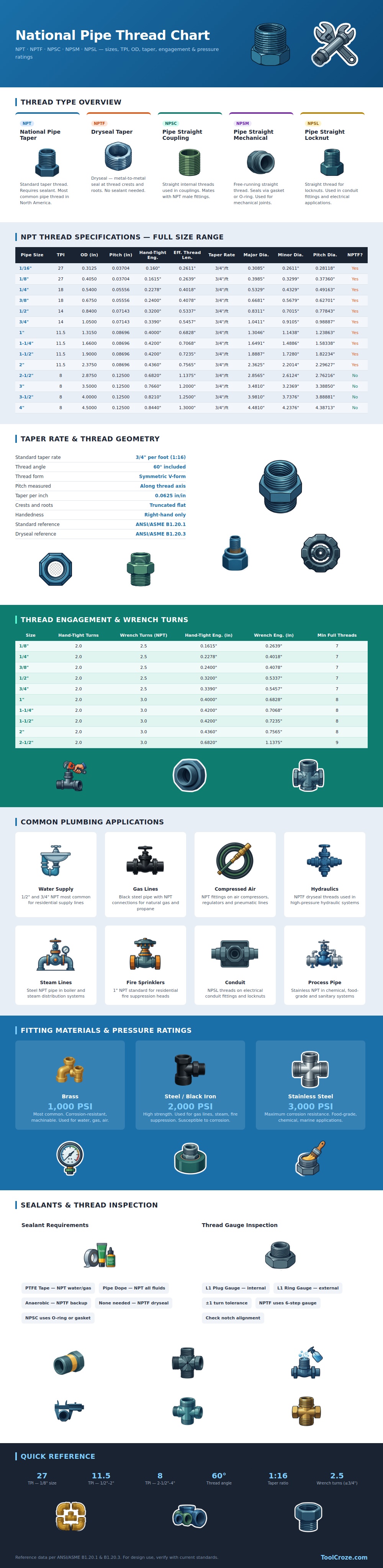
Knowing about the geometry is far more important than memorizing a number. As you can see from the chart above, it show exactly what happens between those threads. It also makes clear why hand-tight turns and engagement length are important for forming a solid connection.
The other thing is that if you examine the threads on them, you’ll see that they has a uniform taper rate: three-quarters of an inch every foot. So when the male end rotates into the female end, the threads wedge against each other in a 1 to 16 ratio.
But here’s where the secret comes in, how much do you rotate? If you turn it too far, the threads warp; if you turn it too little, there is too much space for any sealer to fill. On smaller threads (like three-quarter- or half-inch) you usually don’t want to go past two-and-a-half wrench turns beyond hand tight. Sounds fussy, but after some experience, it just sorta feels right.
Crack is never good. Solid resistance is the goal.
Finally, consider whether NPT is necessary at all. If it’s a high-pressure hydraulic system, or maybe some kind of fuel application, then leak free means no leaks. This is where NPTF, or dryseal threads, come into play. Dryseal threads has tighter tolerances and are cut deeper, such that they create a metal-to-metal seal without any paste or tape. It’s a mechanical perfection that regular pipe threads don’t aim for.
If you use regular NPT fittings in a system built around dryseal compatibility, then there will be gaps too large for a mechanical seal and that can result in catastrophic failure under pressure. Save yourself the expensive mistake by knowing what standard your equipment runs on before you ever grab for the wrench.
The equation gets more complicated with material choice. For something like general water supply lines in which the temperature doesn’t get crazy hot, brass is perfect: corrosion resistant and forgiving. If you’re dealing with steam systems or perhaps gas lines, steel provide the brute strength needed; however, because it will eventually rust, it requires some respect.
At the top tier are food- or chemical-grade applications in which potential for contamination is greater then the potential for pressure failure. Here stainless steel is best, capable of supporting up to three thousand PSI compared to the approximately one thousand for brass. This isn’t only why you might consider buying one or the other, but also where you’d consider putting it.
You’ll find all this information in the infographic below.
Last but certainly not least, think about how you confirm your efforts. Thread gauges are not just for factory quality control. If a die is off-centered when it rolls through, they’ll let you know. Likewise, if you’ve tightened things too much too many times and the threads have been eaten away, that’s going to show up on a thread gauge as well. Use a go/no-go gauge and you might avoid hours of head scratching down the road.
Sure, it’s one of those things we don’t always think about in the heat of the moment. However, it makes everything precise. This keeps systems running smoothly and out of water.
The next time you’re confronted with a leaky joint, don’t just try to crank it harder. Take a moment to inspect your sealant, tally your turns and appreciate the shape. A well-constructed joint depends on knowing precisely when to stop, not on how hard it is to turn. It should of been easier if you knew this earlier.
