
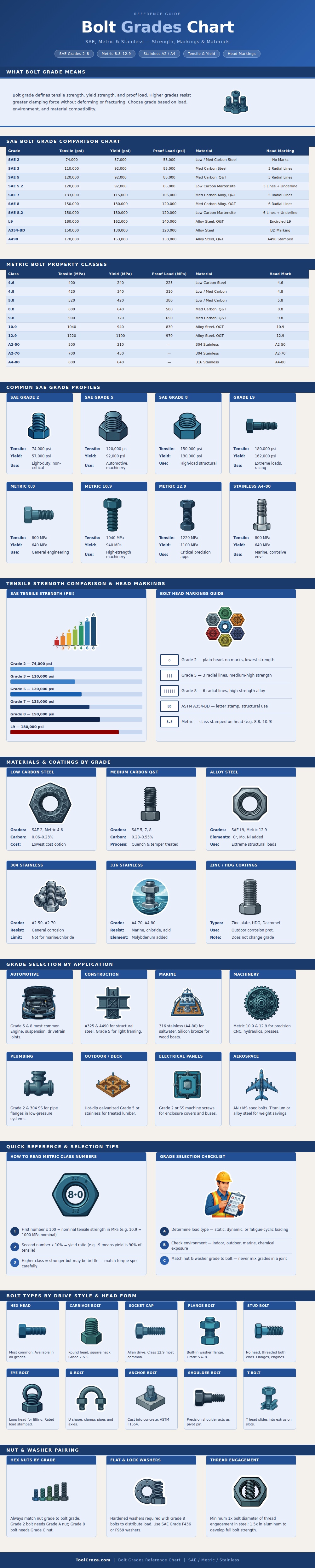
Bolts are bolts…at least that’s what many folks think. They have heads, they have threads, they have nuts with threads that spin on them, so they’re all the same. Wrong. The grade stamped on the head denotes how much abuse that particular chunk of metal can withstand before stretching or snapping into some permanent new shape.
This make the difference between holding an engine block in place under high loads without vibrating free after driving down a rough road a few miles. This isn’t about getting the strongest bolt possible. It’s not even about getting the correct size bolt for a particular use. This is about getting the right bolt for the job. Too strong, and you’ve over-engineered the connection. Too weak, and you’ve used something that won’t hold up against the forces put on it.
How to Choose the Right Bolt
But as the chart above shows, there is an order of performance according to SAE grades, which are broken out based off both yield strength and tensile strength. So, for instance, if you find an unmarked bolt in your head with no markings whatsoever, it’s probably an SAE Grade 2, just plain carbon steel. It is great for mounting a light duty cover or hanging a license plate bracket if vibration isn’t much of a concern, but it is not strong enough to keep your wheels attached to your vehicle.
To do that you’d need something like an SAE Grade 5 or 8, marked by those radial lines etched into the head. If you see three lines, it’s a medium carbon steel that has been quenched and tempered to be slightly tougher. Six lines mean it is an alloy steel grade meant for high-stress parts like suspension components. Once you know what to look for, the visual cue makes it easy, you don’t have to guess at which bolt might be good enough for the job.
That’s not quite how metric bolts work. In fact, they do tell you more about how the material will behave. The first number times 100 is the nominal tensile strength in megapascals. Second number is the ratio of yield strength to tensile strength. For instance, a class 10.9 bolt (tensile ~1040 MPa), has a yield strength of approximately nine-tenths of that value. That’s why you’ll find them all over the place in high-performance automotive builds and precision engineering: they can absorbs tremendous force without permanent deformation.
But there is usually a trade-off between strength and stretchiness. A stronger bolt won’t stretch out as much when overloaded. Instead of giving you warning that something’s wrong, it may snap unexpected and lose its clamping force in an instant. While this might hold better in the beginning, it is a bit more brittle.
As important as mechanical properties are, the material choices is important too. For corrosion resistance, stainless steels like A2 and A4 are difficult to beat, particularly outdoors where moisture and salt are present (e.g., on marine applications). Of course, stainless typically has less yield strength than alloy steel of equal diameter. You can’t replace an A4-80 stainless bolt with a grade 8 bolt in your high load structural application and get away with it.
More importantly, the material limits must be considered. Hot-dip galvanized or even zinc plated carbon steel bolts will resist rust, but that doesn’t make the bolt any stronger than before. It merely prevents the metal from becoming orange in the dead of winter after a couple years of road salt use.
Finally, don’t overlook the importance of how much thread is actualy engaged on the mating material; no matter how strong your bolt is, if it isn’t threaded far enough into the material it won’t hold. This is especially true with soft materials such as wood or aluminum, where you require much greater thread depth in order to create maximum strength, and may be able to get away without using a locking nut (nylon insert lock nut or hardened washer) for retaining clamp load due to vibration. This small detail ensures a joint holds long after it should have, which avoids potential safety risks later.
Match the grade of bolt to the grade of nut, the last thing you want is for one to crush the other more quicker before reaching the desired breaking point. When choosing the right fastener for an application, knowing how your assembly will be loaded determines which grade of high-strength material you can use with more confidence regarding strength (static load) versus fatigue life (dynamic environment). This means paying close attention to yield strengths rather than tensile strengths.
Respect the numbers behind those seemingly innocent radial lines or class designations and look to see what head markings are before reaching for the shiniest bolt on the rack. It isn’t rocket science but it is physics, and knowing how to get it right helps keep things together when they need to stay together.
