
White PVC or gray pipe: That’s what you’re standing in front of. A wall, a leak, and two pipes that seem alike. It doesn’t matter, right? The hardware store clerk doesn’t care which one you buy because they look the same to him. Get whatever you want; that’s why there are two different types, says hardware store clerk.
But one might not even last long enough for you to paint drywall, whereas the other lasts 50 years…on the inside of your wall. How could this be? It is not magic. Just a little knowledge about geometry and chemistry of plastic pipe will save you some serious cash, and embarrassment, from unseen plumbing mishaps.
How to Choose the Right Plastic Pipe
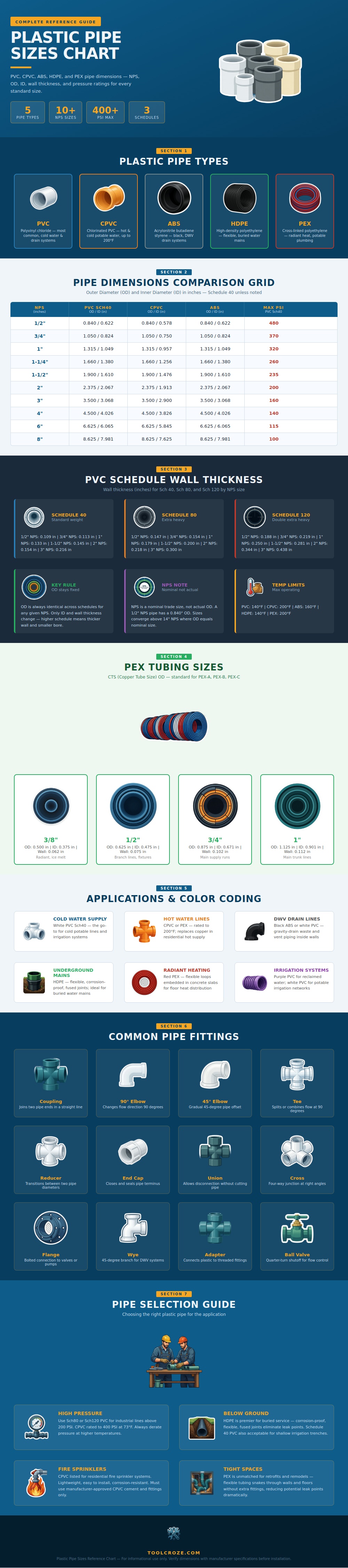
Understanding the plastic pipe size charts will help you make informed choices ahead of time (before buying) by distinguishing between actual dimensions and material types. Cold water and drain systems are PVC (the white stuff). It’s cheap, rigid, and connects using solvent cement which melt the plastic together. CPVC has chlorine added so it can stand more heat, up to two hundred degrees Fahrenheit.
CPVC is popular among homeowners as an alternative to copper because it’s cheaper and easier to install in residential plumbing. Drain waste and vent line systems are ABS (black pipe). ABS resists impact well, but it doesn’t do well in sunlight. That’s why you hide it from daylight.
Underground water mains is overwhelmingly HDPE, because it’s very durable against ground movement, and fuses leak free. PEX is a flexible option that’s good for long runs through walls and floors with minimal fittings. PEX can be run long distances through walls and under floor with minimal fittings. Fewer fitting mean fewer opportunities for leaks to start.
Actual outer diameters don’t correspond to nominal pipe sizes. For example, a half inch PVC will actualy be about.84 inches in outer diameter. Why? Because they got started making iron pipes and that’s how they sized it. So for any given nominal size, the inner bore vary depending on wall thickness; the outer dimensions are always constant.
Standard weights is called “Schedule 40“, and heavy wall (and thus lower volume) weights is called “Schedule 80“. So which do you use? Well, that depends on your pressure requirements. For very high industrial pressures, you want higher schedules; for gravity fed drain lines, you only want standard schedules. So the thick walls create less volume but you have to figure out what the tradeoffs are in each project.
Copper tube sizes is standardized by their outer diameter with varying inner diameters based on wall thickness (i.e., PEX tubing). The inner bore determines flow rate. Over a long run of tubing, the faucet will feel less pressure if the walls are thicker (smaller inside diameter) than what the faucet demands. Match size of your pipe to the demand of the fixtures.
Main trunks serving several bathrooms requires a larger bore to maintain volume; smaller branch lines to sinks can be narrower. Fittings is where amateurs screw up. If you don’t use good fittings, or put them on backwards, even perfect pipe will be junk.
There are 45 and 90 degree elbows. The 45’s let water slide through with minimal resistance. The 90’s cause turbulence that decreases the flow efficiency. There is tees to divide flow. Reducers gradually reduce diameter. Plumbing is quieter when you use a reducer rather than cut pipe. It smooths the transition so there is no noise or cavitation.
Material selection is driven by application and environmental factors. For buried lines, use something resistant to corrosion and flexible (HDPE). Want to fit into tight spaces? Need to bend it but don’t want a joint? (PEX) High pressure? You should of used thicker walled tubing (Schedule 80/120 PVC).
Why would you ever have to remember all those sizes? No, you understand how material limits, wall thickness, and the resulting inside flow capacity works together. Pipe is a pressurized vessel with shape limitations. Once you view the pipe in this way, what’s the right tool for the job becomes obvious. It is not the one that just happens to look the same on the shelf. This translates to saving money, time, and drywall.
