Square Footage to Acreage Calculator
Convert square feet, dimensions, parcels, setbacks, usable area, acres, hectares, and equivalent lot shapes with a full land-area breakdown.
⚡Real Land Size Presets
📐Area Inputs
Full Calculation Breakdown
🧭Calculated Land Spec Grid
📊Square Footage to Acreage Reference
| Square feet | Acres | Hectares | Equivalent square side |
|---|---|---|---|
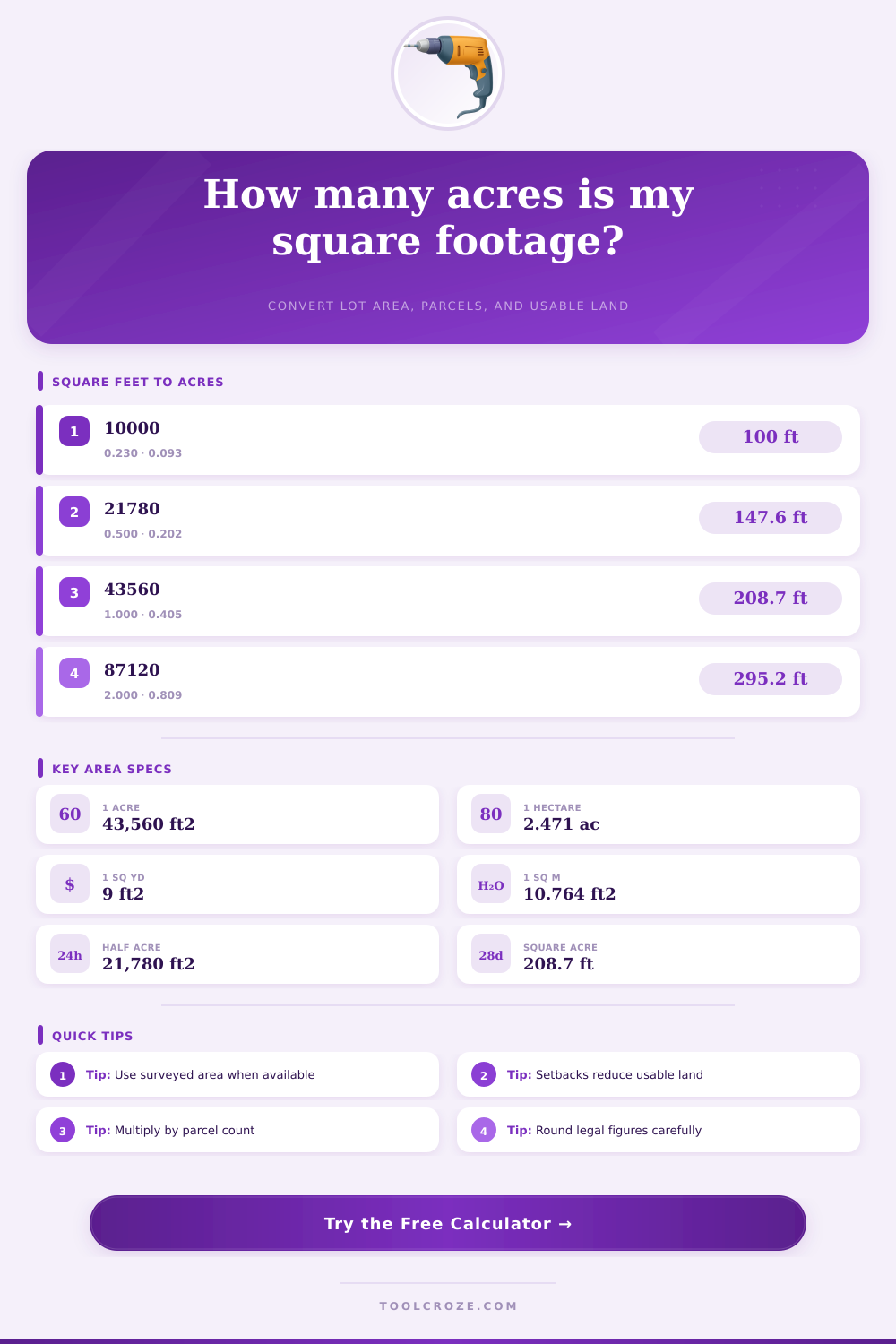
| 1,000 ft² | 0.02296 ac | 0.00929 ha | 31.62 ft x 31.62 ft |
| 5,000 ft² | 0.11478 ac | 0.04645 ha | 70.71 ft x 70.71 ft |
| 10,000 ft² | 0.22957 ac | 0.09290 ha | 100.00 ft x 100.00 ft |
| 21,780 ft² | 0.50000 ac | 0.20234 ha | 147.58 ft x 147.58 ft |
| 43,560 ft² | 1.00000 ac | 0.40469 ha | 208.71 ft x 208.71 ft |
| 87,120 ft² | 2.00000 ac | 0.80937 ha | 295.16 ft x 295.16 ft |
📏Common Lot and Field Sizes
| Land example | Typical dimensions | Square feet | Acreage |
|---|---|---|---|
| Narrow city lot | 40 ft x 100 ft | 4,000 ft² | 0.0918 ac |
| Standard city lot | 50 ft x 100 ft | 5,000 ft² | 0.1148 ac |
| Suburban lot | 80 ft x 125 ft | 10,000 ft² | 0.2296 ac |
| Quarter acre lot | About 104.4 ft square | 10,890 ft² | 0.2500 ac |
| Half acre parcel | About 147.6 ft square | 21,780 ft² | 0.5000 ac |
| One acre field | About 208.7 ft square | 43,560 ft² | 1.0000 ac |
🔢Acreage Fraction Reference
| Acre fraction | Square feet | Square yards | Square meters |
|---|---|---|---|
| 1/16 acre | 2,722.5 ft² | 302.5 yd² | 252.93 m² |
| 1/8 acre | 5,445 ft² | 605 yd² | 505.86 m² |
| 1/4 acre | 10,890 ft² | 1,210 yd² | 1,011.71 m² |
| 1/3 acre | 14,520 ft² | 1,613.33 yd² | 1,348.95 m² |
| 1/2 acre | 21,780 ft² | 2,420 yd² | 2,023.43 m² |
| 3/4 acre | 32,670 ft² | 3,630 yd² | 3,035.14 m² |
🗺Planning Reference Specs
| Reference type | Area benchmark | Typical use check | Calculator field to adjust |
|---|---|---|---|
| Urban residential lot | 5,000 ft² | Small single lot comparison | Frontage, setbacks, usable percent |
| Suburban residential lot | 10,000 ft² | Quarter-acre subdivision planning | Lot dimensions and parcel count |
| Rural homesite | 1 acre | House, yard, drive, reserve area | Usable percent and buffer width |
| Small farm tract | 5 acres | Crop, pasture, orchard, access | Known area and land-use reference |
| Commercial site | 43,560 ft² | Gross site area per acre | Frontage depth and usable percent |
| Conservation parcel | 10 acres | Trail, buffer, easement planning | Setback or buffer width |
💡Calculation Notes
The deed says your place is a certain size; that’s what you see in the figures. It appears exacting, yet doesn’t reflect how much amount of land you will be able to use. Why? Because difference between legal and practical space matters when it comes to conversions. Before you build, you have to know about how setbacks and easements limits your usable land.
The calculator computes the math for you, now you’ve got to know the reason behind the nice round numbers shrinking up close. A square acre has approximately 208.7-foot sides because there are 43,560-square feet in an acre. That’s not up for debate; it’s one acre. That is end of it. But this way of measuring area make more sense if you’re looking at large tracts of land.
Why Your Land Is Smaller Than You Think
If I have two lots, one is very wide and the other is very narrow. Both could be exactly the same size (in square footage) but have vastly different uses. For example, you could easily park a boat on the wide lot, but you will spend half your life maneuvering around mailboxes on a narrow one. Area gives you the foot space on the floor; the shape determine how usable that space will or won’t be for your everyday living.
Buffers are one of those things nobody thinks about until somebody doesn’t want to construct something within a certain distance of their property boundary. And setbacks can be a huge reduction in buildable area, particularly if your lot is small (every inch matter!). If you have a buffer requirement around the perimeter, that’s just dead overhead expense. You’ll never grow plants there, you won’t sit on a patio out there; it’s there so buildings don’t get too close to road or your neighbor’s fence.
To reflect this loss, the calculator allows you to specify buffer distances and enter a percentage of usable land. This makes it more of a planning tool that reflects real-world limitations different than mathematically perfect geometry. Similarly, breaking up land into several pieces also results in less usable area then you started with. Although it looks on paper as though dividing an acre lot into four quarter-acre lots is just basic math, it’s not quite that simple.
Each parcel will need its own access and setbacks. Together, these creates even more constraints and further reduce total amount of usable land. For example, having one big parcel may accommodate a long driveway, leaving most of the yard open for use. Subdividing it into four lots could require private driveways or a shared easement for access, which would slice up more of buildable portion. You can enter the parcel count and visualize the effect subdivision have on your final usable area before you make any plans to lay things out.
Many markets now see urban residential lot size shrinking towards 5,000 square feet. That’s tiny; if you’re building on such a small plot (which is becoming the norm), every inch counts, as a fifty-square-foot error could cost you half your driveway width, or require trimming ten inches off your backyard deck. On a larger rural parcel there’s much more wiggle room: no one notices if a fraction of an acre is suddenly wetland compared to hundreds of others.
But still, it’s important to get things right at any size. A wrong call of even just a few feet can sink a construction project, or launch an expensive and long legal battle that endures long after the house has been built. You should of make sure to check your calculations against proper survey data and get hard numbers from a survey before committing to anything financially.
When it comes to land planning, seeing the numbers is even more important than knowing them. Visualize the constraints of your landscape: how do those abstract numbers translate into real-world limitations on your home garden or business? The reference table above presents typical equivalents to help you bridge the gap between theoretical area and actual dimensions. Whether you’re looking at a large parcel of land as a potential rural retreat or a tiny urban infill property, keep in mind that square footage alone tells only half the story.
Value lies not just in the number, but in what’s left over after we cut away all the unusable bits, and what’s left for people to inhabit in real life. This understanding of gross acreage versus usable space protects your investments from rose-colored-glasses optimism, optimism that can’t be sustained in the field. It feels naturaly important to remember how much moddern land actually works.