Fire Pit Brick Calculator
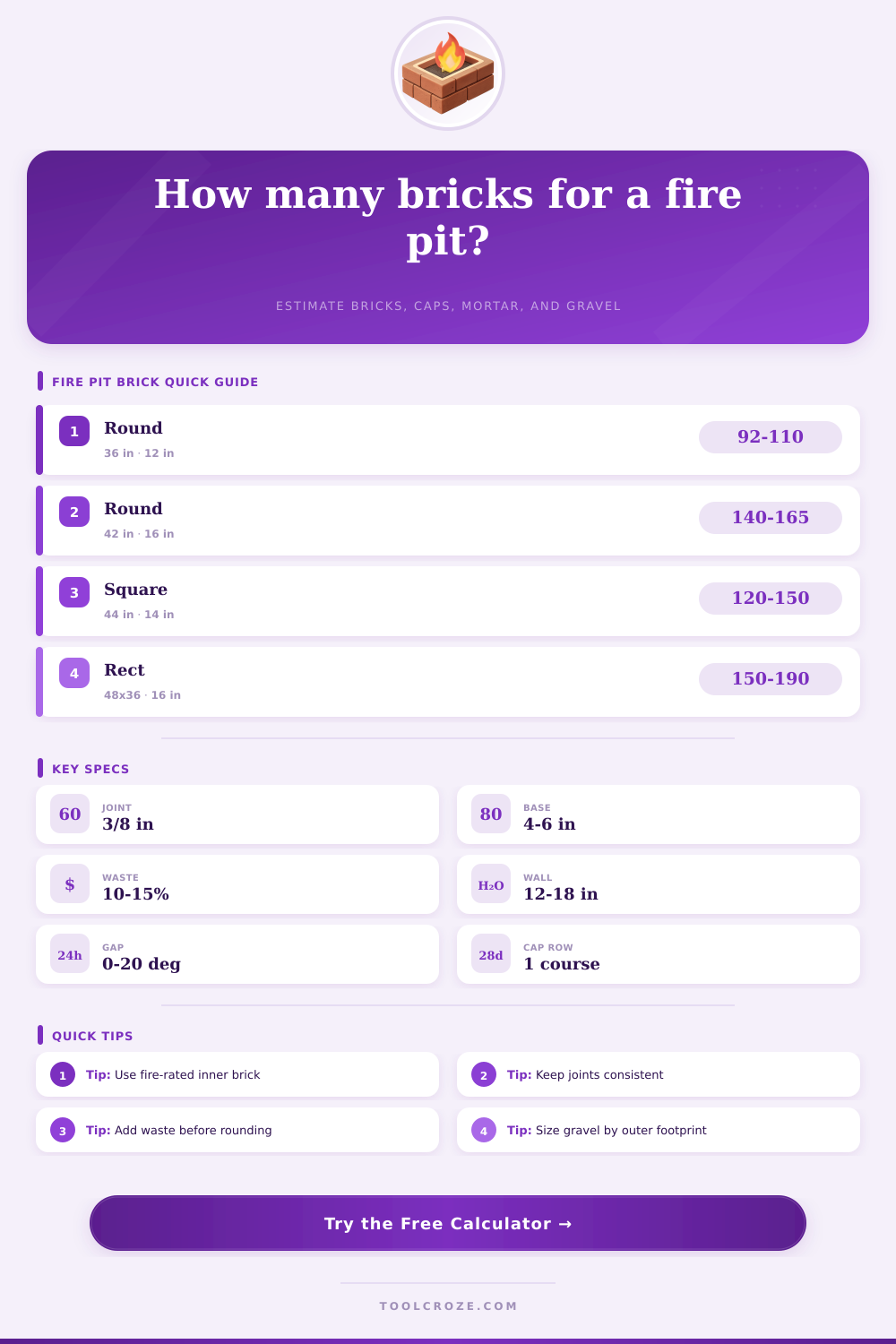
Estimate wall bricks, cap bricks, liner bricks, mortar bags, gravel base volume, courses, and waste for round, square, and rectangular fire pits.
Fire Pit Material Estimate
| Brick or Block | Nominal Face | Course Height | Common Use |
|---|---|---|---|
| Modular clay brick | 7.625 x 2.25 in | 2.625 in with joint | Outer veneer or small rings |
| Fire brick | 9 x 2.5 in | 2.875 in with joint | Heat-facing inner liner |
| Tumbled landscape block | 8 x 4 in | 4.375 in with joint | Dry-fit patio fire pits |
| Retaining wall block | 12 x 4 in | 4.375 in with joint | Larger straight or curved walls |
| Inside Opening | Typical Height | Best Shape | Planning Note |
|---|---|---|---|
| 30 to 36 in | 10 to 14 in | Round or square | Compact patios and small seating groups |
| 38 to 44 in | 12 to 18 in | Round | Common backyard gathering size |
| 48 to 54 in | 14 to 20 in | Round or rectangle | Large seating areas need wider clearance |
| Insert surround | Match insert | Round | Leave manufacturer clearance at rim |
| Item | Rule of Thumb | Calculator Use | Adjustment |
|---|---|---|---|
| Mortar bag | 25 to 35 bricks per 60 lb bag | Default 30 bricks per bag | Lower yield for wide joints |
| Gravel base | 4 to 6 in compacted | Outer footprint plus overhang | Use thicker base on soft soil |
| Waste factor | 10% normal layout | Applied before final rounding | Use 15% to 20% for curves |
| Cap course | One row around top rim | Perimeter divided by cap coverage | Soldier caps use short face |
| Shape | Perimeter Formula | Base Area Formula | Best For |
|---|---|---|---|
| Round ring | π x centerline diameter | π x radius² | Even heat and circular seating |
| Square pit | 4 x centerline width | outer width² | Modular paver patios |
| Rectangular pit | 2 x width + 2 x depth | outer width x outer depth | Linear seating walls |
| Vent gap | subtract gap arc length | unchanged footprint | Access gaps and insert handles |
Any backyard remodel will tell you: Before you buy your first brick, the price of materials is already apparent. Perhaps you have your heart set on a lovely fire pit… But what you actualy need is several interlocking clay piece that don’t need endless cutting and leave no open space. Basic geometry can be the difference between a clean, expertly done ring and an uneven rock circle. It is important to know if specific type of brick you have selected perform well in a curved structure.
After you plug in your measurements into the above calculator, it do the math for you so you don’t have to guess at conversions (how many bricks do I need to cut?). How many joints should be spaced out? And it doesn’t stop there, it does more than just count the bricks; it accounts for how these bricks will layer up to meet your required height.
How to Calculate Your Fire Pit Materials
Each type of modular clay brick come in a certain course height x face length ratio, which determines how many rows you’ll require to achieve the seat height you desire. For example: If you want a fire pit twelve inches high, you’re not just stacking four bricks because they look right; you are calculating based off the actual height of each unit plus the mortar joint between them. That fraction of an inch can add up fast enough to make you lose track of your overall dimension unless you think about it.
The second thing about waste and cutting: Shape makes more of a difference than you think. While a square pit has forgiving straight edges that need little trimming, a round pit adds the geometry of its centerline. It’s no longer just about measuring from the inner edge (where the fire burns) to the outer edge (where your foot sits). Now there’s some place in between. The tool takes that into account. Calculating based on the diameter of the centerline rather than the length of the inner or outer circumferences. That way, instead of having a perimeter much larger on the outside then inside, you don’t buy too few pieces. Then you’re not stranded halfway up your second course, with an uneven number of oddball scraps leftover.
And of course, there is the matter of what fills in between all those rings. When subjected to high flame temperatures, ordinary concrete blocks used as the interior lining will crack and flake off. So a good idea would of to plan on a fire brick liner, although this will add to your overall number of units. And the calculator lets you break out your refractory liner bricks from your structural wall bricks, so you’ll always know how many of each you want to order. It will also take into account a cap course. This helps protect the top layer of mortar from rainwater erosion and looks nice.
But first, let’s talk about what’s underneath our feet before we go laying anything down. Each time it heat up, thermal expansion puts stress on the structure. Because of this, a solid base is needed for stability. The volume of a gravel base are calculated in the estimate using the outer footprint with a slight overhang to allow for proper load spreading and drainage. Properly compacting this four to six inch layer keeps it from settling and ruining all of your straight lines months down the road. Digging now takes longer but fixing a sinking pit later is worse.
Every masonry project include one cost you can’t see: waste. No matter how perfectly you lay things out in theory, there are always going to be pieces broken in handling and pieces trimmed for fit along irregular edges. Ten to fifteen percent extra isn’t being pessimistic, it’s being practical. You don’t want to get halfway through your third course and find out you’re missing a cut piece that doesn’t match any of the rest. The tool automatically figures this into the total so you won’t find yourself at the supplier on an emergency run with fresh mortar still on your trowel.
Better to order a little more than you think you’ll use. When you plan things out carefully, even a weekend project becomes something to be proud of. Accounting for every single piece before it is even removed from the truck means you walk away feeling confident. You end up with a structure that was intentionaly built instead of one that feels slapped together. Knowing what you’ve got in your hands and how it’s going to fit together is a big part of that.