Concrete Slab Load Capacity Calculator
Estimate allowable point, wheel, rack-leg, and uniform loads using slab thickness, concrete strength, reinforcement, contact area, support condition, and safety factor.
Calculation Breakdown
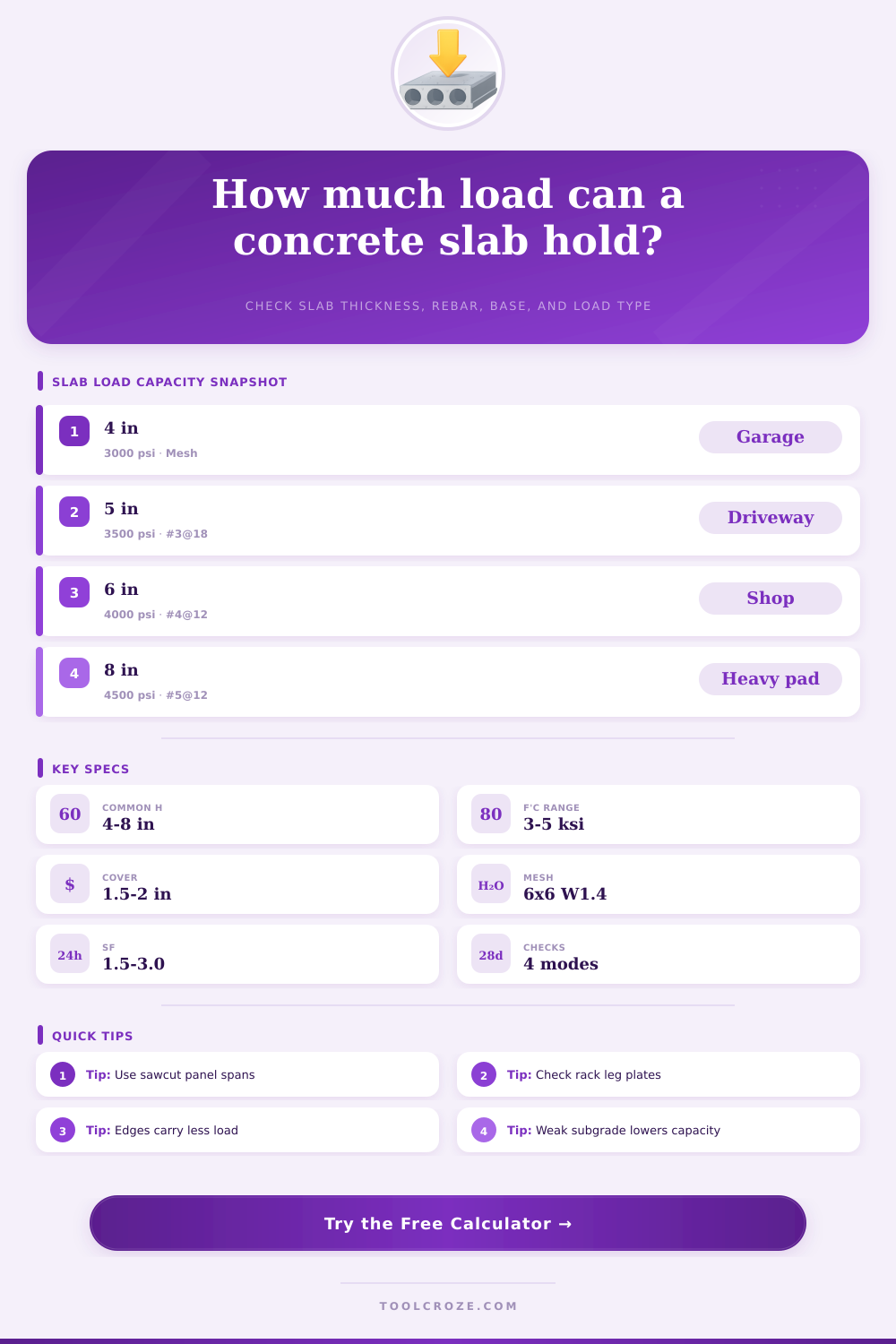
| Slab use | Typical thickness | Common concrete | Typical reinforcement |
|---|---|---|---|
| Residential patio or walk | 3.5 to 4 in | 3000 psi | Mesh or fiber for crack control |
| Garage floor | 4 to 5 in | 3500 psi | 6x6 mesh or #3 bars |
| Driveway or light truck | 5 to 6 in | 3500 to 4000 psi | #3 or #4 bars each way |
| Shop, rack, forklift aisle | 6 to 8 in | 4000 to 5000 psi | #4 or #5 bars each way |
| Reinforcement | Steel area per ft | Typical cover | Best use in this calculator |
|---|---|---|---|
| Plain concrete | 0.000 in²/ft | None | Low load slabs, crack limit only |
| 6x6 W1.4 mesh | 0.028 in²/ft | 1.5 in | Garage and patio crack control |
| #3 at 18 in | 0.073 in²/ft | 1.5 to 2 in | Driveway and light shop slabs |
| #4 at 12 in | 0.200 in²/ft | 1.5 to 2 in | Rack plates, wheels, heavier pads |
| Load contact | Typical patch | Capacity sensitivity | Input guidance |
|---|---|---|---|
| Car or pickup tire | 6x8 to 8x10 in | Moderate bearing, moderate flexure | Use one tire load or axle pair |
| Forklift tire | 5x7 to 8x10 in | High wheel concentration | Use loaded wheel or axle pair |
| Rack base plate | 4x4 to 8x8 in | High punching and bearing concern | Use service load per leg |
| Uniform storage | Whole bay area | Panel flexure controls | Enter psf or kPa load |
| Support condition | Calculator factor | Capacity effect | When to choose it |
|---|---|---|---|
| Weak subgrade | 0.75 | Reduces allowable load | Soft soil, poor compaction, wet base |
| Compacted gravel | 1.00 | Baseline slab-on-grade result | Typical residential and shop slabs |
| Engineered base | 1.18 | Raises working estimate | Verified base, thicker aggregate, good drainage |
| Edge or corner panel | 0.60 | Strong reduction for free edges | Wheel, post, or rack near slab edge |
Concrete slabs is not as sturdy as they appear; they’re like big pieces of glass and will break easy if you try to concentrate their weight on any one spot. Back up a vehicle onto one, and you’ll get a tiny cracking sound that makes your brain immediately wonder: Is this thing structurally sound? Humans have a tendency to think concrete can hold all the weight in the world; then we wonder if a hot tub will sink or stay put. Feed the correct variables to calculator, and it’ll do the work for you.
The reason for this is that concrete doesn’t tend to crush. It’s not designed to. Concrete fail by punching holes or cracking and bending where you have too much concentrated load. In those instances, thickness isn’t as important as reinforcement. Sometimes a four inch slab with rebar (welded wire mesh) will be superior to a six inch plain concrete slab.
Why Concrete Slabs Can Break
Why? Because of distribution of the load. The welded wire mesh doesn’t make the concrete any stronger in compression, it simply keeps cracks from splitting the slab open when it gets torn by tension. Think of it as a safety net for the brittle material.
Know what’s under there… Be honest. What’s under the concrete? That’s called subgrade. Many projects go bad because of something unseen: the subgrade condition. Did you pour a good slab only for it to sit on spongy, uncompacted dirt? You’ve got a boat on water not a floor.
Whether your subgrade is compacted engineered gravel or nothing but dirt determines the tool’s support factor which adjust for capacity. A soft subgrade means low capacity and random settlement, which can crack slab from below. Doesn’t care about math up top.
Where things get dicey for do-it-yourselfers (and their neighbors) is load concentration. Think about a forklift tire, it applies tremendous pressure to a very small area. To compute this, the calculator request your contact dimensions. Punching shear and bearing capacity are different than general failure mode calculations like general flexure.
You may be able to support 5k spread over the whole slab, but if you pile up everything onto a single square foot, you’re toast. That’s the distinction between having boxes in a room and parking a truck on it. As the reference table indicates, far more often, it is the rack leg that dictates design rather than total weight of stuff being stored.
Life isn’t perfect. There are safety factors. For example, every day for twenty years you’re not likely to load that slab precisely how you intended. There will be differences in materials, unforeseen loads and events, and normal wear-and-tear from the elements that degrade concrete over time. Failing to account for such factors could of cost less up front; however, this trade-off is certainty-for-risk. When you’re standing next to a structure on the verge of failure, it matters.
Before you build something new or repurpose a space, this will help you understand the forces at work that you can’t see. It turns confusing engineering terms like yield strength and effective depth into real-life numbers for your project.
That doesn’t mean you shouldn’t look out for tell-tale signs of a failing concrete slab, such as curling up of the edge or cracking that gets progressively wider over time. However, knowing more about what you’re dealing with allows you to prevent the shock of failure. Concrete’s tough, just not if you don’t give it what it needs.