Tank Volume Calculator
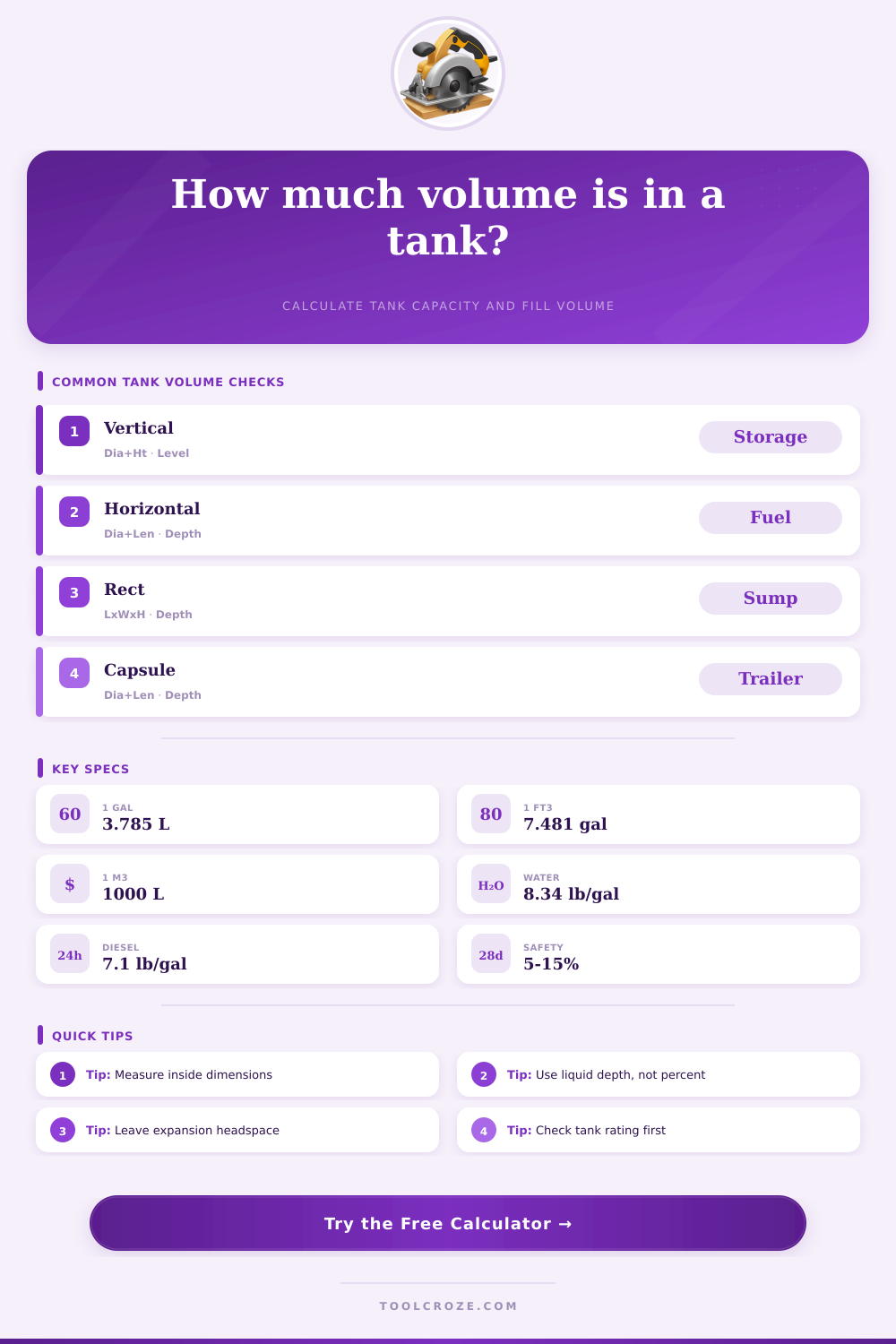
Estimate total tank capacity, filled volume, ullage, percent full, and liquid weight for vertical, horizontal, rectangular, capsule, elliptical, and cone-bottom tanks.
⚙Real Tank Presets
📏Tank Inputs
Straight shell length for cylinders and capsules.
For rectangular tanks, this is the total inside height.
Used by rectangular and elliptical tanks.
Measured vertically from the inside bottom.
Cone height for cone tanks; end head radius allowance for capsule tanks.
Subtracts liner, insulation, or wall thickness from inside volume.
Calculation Breakdown
🛢Material and Liquid Spec Grid
📊Tank Shape Formula Reference
| Tank Shape | Total Volume Formula | Partial Fill Method | Measure Carefully |
|---|---|---|---|
| Vertical cylinder | π × r² × height | Area × liquid depth | Inside diameter and straight height |
| Horizontal cylinder | π × r² × length | Circular segment area × length | Depth at the tank centerline |
| Rectangular tank | length × width × height | length × width × depth | Inside length, width, and height |
| Capsule tank | Cylinder plus sphere volume | Segment cylinder plus end fraction | Straight shell length between heads |
| Elliptical cylinder | π × a × b × length | Scaled circular segment | Major and minor inside diameters |
| Cone-bottom cylinder | Cylinder plus cone volume | Cone first, then cylinder fill | Cone depth and cylindrical height |
💧Liquid Density Reference
| Liquid | Approx Density | Metric Density | Use in Calculator |
|---|---|---|---|
| Water | 8.345 lb/gal | 1.000 kg/L | Potable tanks, process tanks, rain tanks |
| Diesel fuel | 7.100 lb/gal | 0.850 kg/L | Skid tanks, generator tanks, farm tanks |
| Gasoline | 6.100 lb/gal | 0.731 kg/L | Small fuel tanks and transfer tanks |
| Heating oil | 7.200 lb/gal | 0.862 kg/L | Residential horizontal oval tanks |
| Milk | 8.600 lb/gal | 1.030 kg/L | Dairy receivers and bulk tanks |
| Salt brine | 9.200 lb/gal | 1.102 kg/L | Water treatment and deicing tanks |
📐Common Tank Size Reference
| Tank Type | Typical Shape | Nominal Capacity | Common Measurement Check |
|---|---|---|---|
| Residential heating oil | Horizontal cylinder or oval | 275 gal | About 44 in wide and 60 in long |
| IBC tote | Rectangular tank | 275-330 gal | Inside cage dimensions vary by model |
| RV fresh water | Low rectangular tank | 30-100 gal | Low height makes level sensors sensitive |
| Farm sprayer | Elliptical or round | 200-1000 gal | Measure the actual molded tank profile |
| Aquarium | Rectangular glass tank | 10-300 gal | Subtract gravel, rock, and freeboard |
| Process cone tank | Cylinder with cone bottom | 50-5000 gal | Cone section fills before cylinder section |
⚖Conversion and Fill Gauge Reference
| Conversion | Exact or Practical Value | When It Matters | Calculator Use |
|---|---|---|---|
| Cubic inches to gallons | 1 gal = 231 in³ | Small and medium tanks | Imperial input basis |
| Cubic feet to gallons | 1 ft³ = 7.4805 gal | Large field measurements | Capacity cross-check |
| Liters to gallons | 1 gal = 3.78541 L | Metric drawings and imported tanks | Metric result display |
| Partial horizontal fill | Nonlinear by depth | Fuel, oil, and capsule tanks | Uses circular segment math |
| Expansion headspace | Commonly 5-15% | Temperature swing and foaming | Subtracts reserve from filled volume |
💡Practical Tank Measurement Tips
Without a good gauge, you can’t just look into a tank to know how full it is. This is especially true with a horizontal cylinder, since half the depth doesn’t always mean half the water. Guessing your inventory means either you’ll run dry (or overfill) your tank and guess what? That guesswork cost you money.
The calculator above will do the math for you if all you need is to get your depth readout and tank geometry entered. It’ll save you from having to solve complicated problems in bad weather while balancing precariously on a ladder.
Why Accurate Tank Measurements Matter
As water rises in a tank, its volume changes according to that tank’s shape. Volume is simple in rectangular tanks. These types of tanks fills out steadily, meaning that each additional inch of depth will add a predictable volume of capacity. Simple multiplication lets you estimate these volumes. Cylindrical tanks lying on their side are more complex because their bottom curve allows for slow growth initialy followed by acceleration in the middle and slowing toward the end. A 50% depth measurement isn’t equivalent to 50% of your liquid. It is far less until it crosses the centerline.
Getting the measurement right down to the millimeter isn’t as important as using the right geometry from the tool. Remember, a capsule tank isn’t just a cylinder; it have domed ends that trap a portion of the contents. Those heads hold real liquid. It counts towards your inventory. If you’re treating a capsule tank as a cylinder, you’ve made a mistake with your log books.
Is it a standard vertical drum or something more complex like an elliptical tank? Is it a standard vertical drum or something more complex like an ellipse? Find your shape in the table located on the same page as its corresponding formula.
The second reason this can throw things off is because different liquids has different weights. Diesel comes in at roughly 7.1 pounds of weight per gallon while water is closer to 8.34 pounds per gallon. So if you’re doing any calculations regarding load for something like an axle or floor joist, be sure not to use water as the density of your fuel since it will underestimate your weight. And that may just result in a blown tire down on the interstate versus a safe ride.
The tool factors in which liquid you choose and adjusts the output accordingly so that you understand how much weight and how much space is being taken up. For example, tank specs listed as 48″ wide may actualy be only 46″ wide on the inside because the exterior measurement includes insulation and wall thickness. Two inches doesn’t seem like much until you realize that’s the amount lost across the whole length of your vessel. This will account for a large reduction in overall capacity.
When possible, always use the interior wall to measure. If using plans, simply subtract twice the wall thickness.
When full, it will foam up and the liquid expand with heat. To avoid pressure building up in your reservoir and potentially spilling over (major cleanup), you need to make sure you have some headroom. Most people goes with a 5 to 15 percent buffer. You can adjust the calculator accordingly. The nice thing about it is that it adjusts your “usable” based off what’s real instead of what might be possible.
How to Calculate Tank Volume Without Guessing Once you know exactly how many gallons are in the tank, there’s no guesswork to what you’re doing. You won’t have to worry about running out of gas halfway through a job. You also won’t have to worry about overestimating the fill rate and ending up with a wet tank. That precision gives you control.
Knowing exactly how much your tank holds down to the gallon means you can guess less and plan more. That peace of mind would of saved you far more time than the few minutes it takes to go measure yourself.