
The hardware aisle has got you all confused. The bolts look the same but have different lengths and you have no plan for which to pick when assembling that new piece of furnitures or repairing that fence. Frustrating, I agree, and unsightly too. A poorly selected length simply do not catch enough threads in the nut; it compromises the joint, and looks bad!
To know what is correct, one needs to understand measurement standards behind various kinds of bolts. On this bolt size chart you can see how much bolt you’re going to get. So what we want to measure is the length of that bolt, but how do we know if we’re buying the right length bolt? The answer: don’t buy bolts longer than your measurement or they won’t fit!
How to Pick the Right Bolt
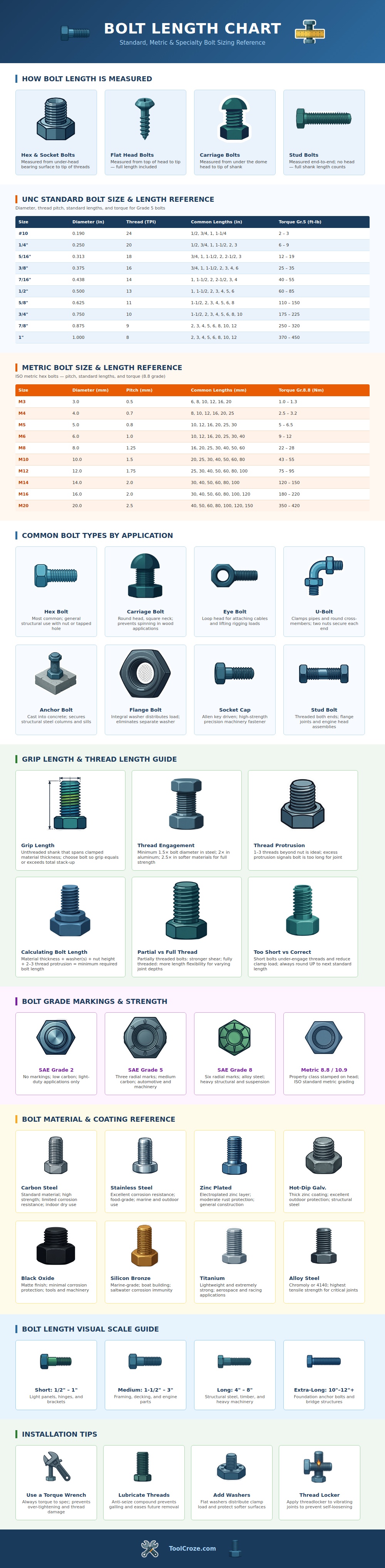
Follow these steps to know when to make your measurement. If you are using standard carriage bolts and hex bolts, then measure from beneath the head up to the end of the thread. Remember that these heads does not secure your material; they sit on top of it.
Flat head countersunk bolts should be measured from the top of the head to the point. Why? Because in any application where the bolt is flush with surface, each millimeter is important. If you attempt to use a ruler without knowing which rule to follow, you could end up wasting time and mony.
So now we know the length we need, what about engagement and grip of the joint? We want the grip (unthreaded shank) to cover thickness of material being clamped. So if threads come into this area, they won’t be able to seat against the surface. What we are looking for is a smooth shank drawing tight against rough material.
Now beyond that engagement point, the rest of the threads should has enough engagement to bear the load. As a general rule of thumb steel nuts need at least 1-1/2 times the bolt diameter in engagement. With softer materials such as aluminum, you need increased thread engagement as they strip out easy on soft metals. They typically double and even triple that engagement. This is the geometry that keeps them from failing under load.
To prolong life, choosing materials matters. Carbon steel is strong but not good outdoors where it will rust. Hot dip galvanization coats heavily and is great for really rough conditions. Zinc plating is a compromise between those two for general use outside. Stainless steel or even better silicon bronze are required if you’re working around salt water (higher cost, but worth it). Matching the environment to the bolt material matter as much as matching length to the hole.
Last but certainly not least, don’t neglect torque spec when installing. When torqued too hard, the bolt stretch past its limit and loses strength. This weakens the clamp force and could break fastener. Torquing with a wrench will deliver tension it was made for.
Including a washer spreads the load equally, guarding soft surfaces from indentations. A dab of lubricant helps reduce thread friction while tightening, making an accurate torque reading and easier future disassembly possible. This makes all the difference between amateur effort and a professional finish.
Now you have a checklist when choosing a fastener. You can choose the correct size by measuring according to style of head. You also learned the required amount of thread engagement for type of material being used. You chose the proper finish for environmental conditions. Now with these basic things checked off, selecting the proper bolt is more about verification then guess work.
Measuring twice thinking once leads to a better job holding together your next project.
