Drywall Primer Calculator
Estimate sealed surface area, primer volume, container count, coats, coverage loss, and drying window for new drywall, skim coat, repair, ceiling, and mixed-room work.
Drywall Primer Results
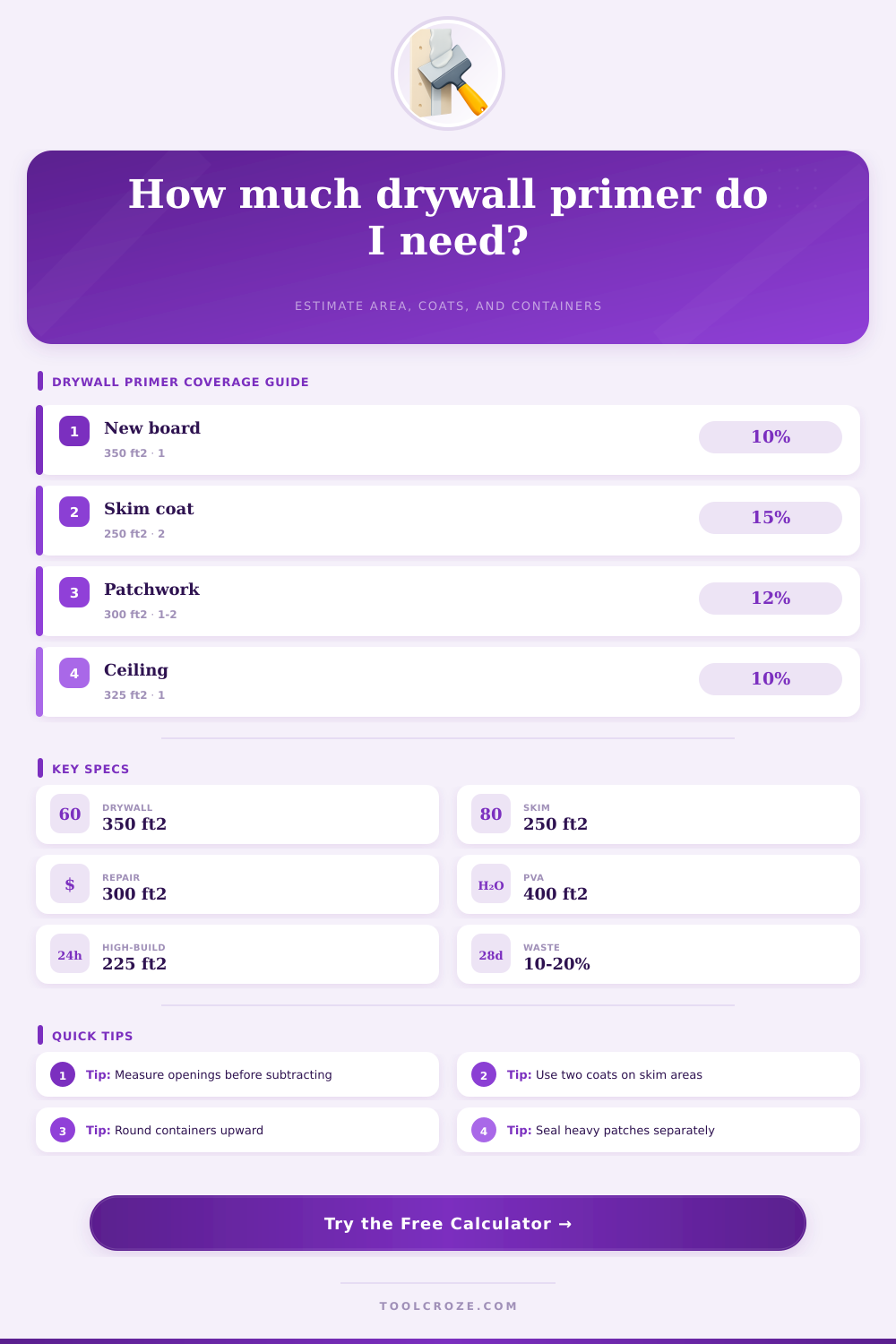
| Surface condition | Coverage baseline | Default coats | Allowance |
|---|---|---|---|
| New drywall board with taped joints | 350 ft²/gal, 8.6 m²/L | 1 coat | 10% for edges and compound bands |
| Fresh skim coat or Level 5 finish | 250 ft²/gal, 6.1 m²/L | 2 coats | 15% for high suction finish mud |
| Patchwork and spot repairs | 300 ft²/gal, 7.4 m²/L | 1-2 coats | 12% when patches are feathered wide |
| Previously painted drywall | 400 ft²/gal, 9.8 m²/L | 1 coat | 5% for normal roller loading |
| Stained or color-change areas | 275 ft²/gal, 6.7 m²/L | 2 coats | 15% for blocking and overlap |
| Textured ceiling drywall | 260 ft²/gal, 6.4 m²/L | 1-2 coats | 20% for profile depth |
| Primer type | Best drywall use | Coverage used | Topcoat timing |
|---|---|---|---|
| PVA drywall primer | New paper face and joint compound | 400 ft²/gal | 3-4 hours in normal conditions |
| All-purpose latex primer | Mixed new and previously painted drywall | 350 ft²/gal | 4 hours before finish paint |
| High-build surfacer primer | Minor sanding scratches and Level 5 work | 225 ft²/gal | 4-6 hours, longer if heavy |
| Stain-blocking primer | Water marks, smoke residue, marker bleed | 300 ft²/gal | 4-8 hours by label |
| Bonding primer | Slick painted drywall or glossy patches | 325 ft²/gal | 4 hours before finish coat |
| Moisture-barrier primer | Bathrooms, laundry rooms, damp utility walls | 275 ft²/gal | 6 hours in ventilated rooms |
| Application method | Transfer factor | Recommended nap or tip | Calculator effect |
|---|---|---|---|
| Roller, 3/8 in nap | 1.00 | 3/8 in microfiber or woven cover | Uses baseline coverage |
| Airless spray plus back roll | 1.08 | 515-517 tip for many primers | Adds overspray and hose loss |
| Brush and mini roller | 1.05 | 2-2.5 in sash brush, 4 in roller | Adds edge loading allowance |
| Thick nap roller for texture | 1.15 | 1/2 in to 3/4 in cover | Adds texture profile pickup |
| Common project | Typical dimensions | Suggested primer | Planning note |
|---|---|---|---|
| Small bedroom | 12 ft x 12 ft x 8 ft | PVA drywall primer | Usually one gallon when ceiling is included |
| New basement room | 28 ft x 18 ft x 8 ft | All-purpose or PVA primer | Five-gallon pail is often cleaner to stage |
| Level 5 media room | 16 ft x 14 ft x 9 ft | High-build surfacer primer | Two thinner coats reduce flashing risk |
| Bathroom drywall | 8 ft x 6 ft x 8 ft | Moisture-barrier primer | Ventilation matters during dry time |
| Garage drywall | 22 ft x 20 ft x 9 ft | PVA or all-purpose primer | Porous taped joints can raise usage |
Painting a wall is simple. Getting it ready to accept paint isn’t. Raw drywall is neither smooth nor sealed, so paint can’t covers it alone.
Guessing at quantity? Guessing about primer? Your painted walls won’t be even. You’ll waste top coat. You’ll have a mess. Enter the room dimensions in our calculator and it figure out everything else. How many gallons do I need? How much paint will I use? Does it matter if there are windows/door? What’s that absorption factor all about? The calculator knows all of this (and more).
How to Calculate Primer and Paint Needed
All drywall isn’t created equal and we see homeowners thinking it is. Joint compound sucks up moisture different than the paper face of fresh drywall. This means paint will be lighter or darker in those areas, forming what are called flash lines. Sealing the differences with primer ensure an even surface for topcoat. If using new drywall, the tool changes its output based on how much more absorbent it knows the wall to be. And if working over a skim coat, that layer is thirstier still so the tool changes again. Coverage go from three hundred fifty square feet per gallon on new board down to roughly two hundred fifty for fresh skim. It is not magic; physics meets porous gypsum.
Walls can actualy be tricky because raw drywall is porous and uneven. Ceilings, on the other hand, complicate things by being textured and harder to paint. Rolling upwards fight gravity. Plus, ceilings prime different from walls. Including (or excluding) the ceiling alters the overall area you’re working with.
For example: if we have a 12×12 room with an 8-foot ceiling, it’s not all contained within the four wall. Doors and windows will cut into that figure, something people tend to overlook. Removing square footage doesn’t seem right, yet unless doing a full trim job, it’s common not to paint behind any frames. By default, the tool figures in standard openings; odd architecture require tweaking.
The second thing is application method. Most folks don’t know how much this impact results. A roller is tight and slow. Spray gun is fast and wasteful. Overspray gets lost in the air and drifts around corners. Brush is… well, brush. To account for this, the calculator varies the transfer factor based off your chosen application tool: roller, spray gun, brush, etc. If you opt for airless spray, for example, it tacks on about eight percent of necessary volume to compensate for airborne waste and hose loss. It’s not a big deal. On a big basement reno, though, that amount equal one more quart to purchase.
Roller choice matters, too. For instance, if I pick a thick-nap roller, I’m putting up higher volumes of product per pass. Yes, it’s holding more…but laying on heavier coats, which take longer to cure. Another factor that isn’t immediately obvious is how long the drying takes. You can’t paint over primer until the primer dries, if it doesn’t dry correctly you’ll get bubbles or lift the primer underneath. In typical conditions most PVA primer takes 4 hours. If it’s humid (like bathroom) then it will take longer. The tool tells you how long it should of taken so you can plan out your timeline to match, you don’t want to rush it because that just makes your finish suck more than not doing it at all.
Primer is more of an art than a hard science. There’s no way to know exactly how much overspray you’ll create, nor how thirsty the drywall will be. But you do have some level of preparation. Running your number through a good estimator allows you to make sure you don’t run short mid-wall. It turns what would otherwise be a guessing game into something within reasonable bounds that has a known outcome.