
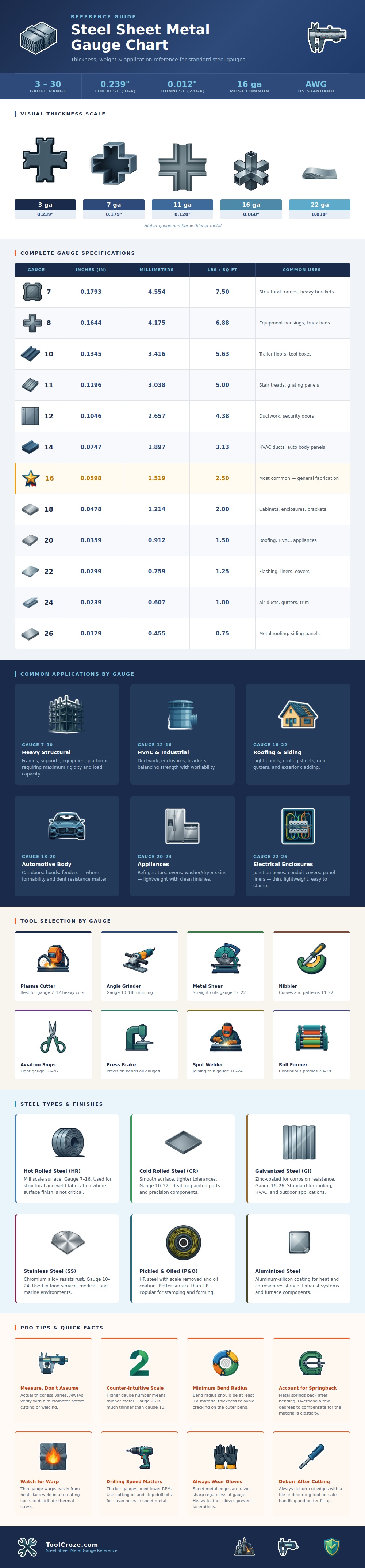
Confusion arises here because we’re looking at steel sheet metal, and gauge system is the opposite of what your gut might tell you. Bigger is not always better; instead of following our instincts, we need to change our expectations when shopping around. You’ll notice that chart (below) translates these arbitrary figures into real world measurements: how thick are they in inches or millimeters? It will also help make sense of why choosing correct spec affects both weight and price.
Sixteen-gauge is considered most general in terms of fabrication. This offer a compromise between workable material and durability. It’s thin enough to be cut by regular shop tools while being thick enough not to flap around. Seven- or eight-gauges will be used structurally when weight matter. You won’t be able to use snips on these heavier plates as they must be cut with saws or plasma cutters. The ability of tools to do their job hinges more on this criterion different than anything else at the shop. Gauges twenty-four or twenty-six is used for lightweight roofing and siding.
How to Choose Steel Thickness
Now it’s all about control of thermal stress with light material. Heat can wreak havoc on thin metal. Now it’s all about control of thermal stress with the light material. Heat can wreak havoc on thin metal. Beyond thickness, type of material also complicates things. Rougher hot-rolled steel is good for structural framing pieces where looks aren’t an issue. Cold rolled steel are smoother and great if you need a nice finished piece, like an enclosure, to paint since it applies coatings evenly. For outdoor uses like gutters, galvanized sheet metal use zinc to protect against corrosion, so this is the go-to option. Knowing about these finishes will prevent you from purchasing super-expensive stainless steel when galvanized would of be fine and save you much money in the process.
Knowledge of the numbers is only half of the equation. Equally important is practical fabrication tips. Because nominal gauge sizes vary between manufacturers, always use a micrometer to measure your stock. A slightly thinner sheet will weaken a weld or ruin a fit. When bending, you need to factor in metal’s spring back. Allow for a slight overbend past 90 degrees so the piece settle into the proper angle. To prevent cracking on the outside edge of the fold, use a bend radius that equals thickness of the material.
Attention to safety is paramount too, as even though higher gauge numbers means thinner material, their cut edges are still razor sharp. Be sure to handle with heavy leather gloves as cuts can occurs if you slip.
If you’re considering using steel sheet metal for a project, the first step is knowing the trade-offs: strength vs. Weight vs. It is easy to use. Know what you need to hold and choose lightest gauge (thinnest material) that will do the job. Saving money and reducing machinable parts time. Check the actual thickness prior to cut. Be mindful of tool limits as you work near either end of the range.
It seems random until you notice that this system lines up materials with their correct uses across various industries. From there, it’s all about experience and careful measuring (once you know what you have in hand), you won’t make expensive errors on the fly.
