
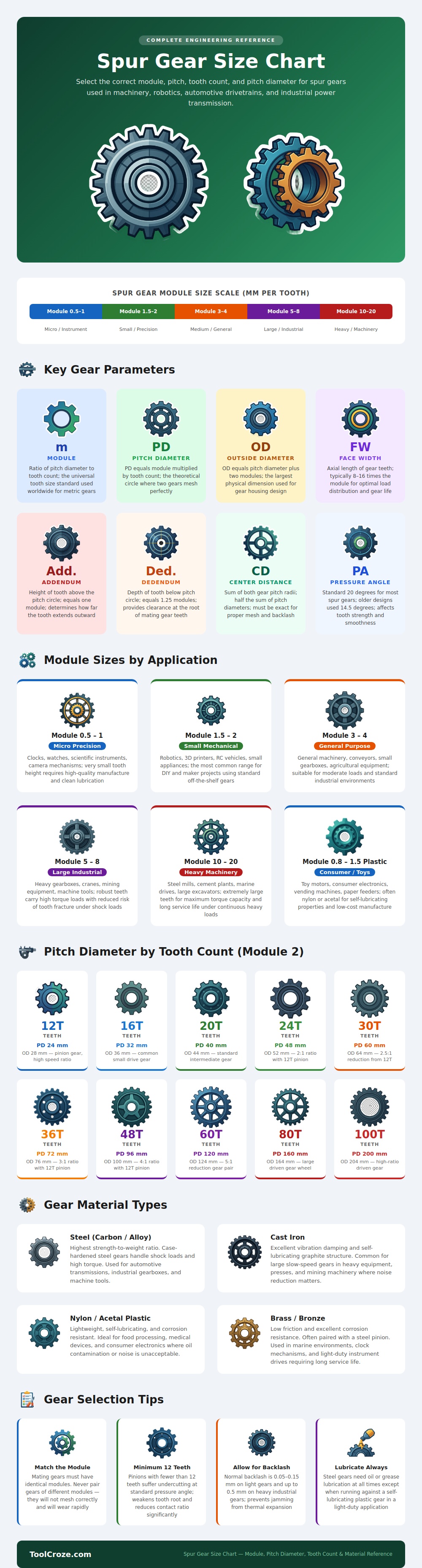
Gear Ratios The tooth count is right but the gears don’t mesh. Pressure angle’s good too, but still no go. What gives? Usually it’s because the designer forgot about “module” standard when they did the math. As the chart above shows, the module dictates not only the tooth strength, but also the “smoothness” or lack thereof, of the resulting meshing action. So in spite of being an obscure engineering number, the module make a real-world difference by saving you the expense of re-manufacturing something gone wrong.
Each tooth have a module as its blueprint. A module describes how many teeth are on an outer circle compared to it’s pitch diameter. That’s what everyone talks about when discussing metric gear. Module two doesn’t mesh well with module three, it’s like trying to fit a square peg in a round hole. To help organize this, the infographic categorizes various modules by range, corresponding to different industries.
How to Choose the Right Gears
On one end of the scale are tiny precision gears, ranging from zero point five to one. These tiny part might be found in cameras or watches. They need to be absolutely clean; any tiny speck of dust could gets caught in the teeth. At the opposite end are modules up to twenty, used in heavy machinery like mining equipment and steel mills. Their big teeth takes the shock load, and failure is not an option.
Knowing the pitch diameter will help with the spacing of your shafts as well. Pitch diameter is the theoretical circle where two gear mesh perfectly. To find the pitch diameter, multiply your tooth count by your module. This gives you the size of the theoretical circle formed when the two teeth meshing together. As you can see, using a standard two module and a twelve tooth pinion results in a pitch diameter of twenty four millimeters. Why does this matter? This is used to determine the center distance (axle to axle), which are important when designing your housings. If your center distance is off by even a fraction of a millimeter, then you’ll either bind or get some unwelcome backlash. A lot of folks neglect this fact because all they see is outside of their gear rather than what happens out of sight inside the middle contact circle.
Gears also vary by material selection. For example, steel gears are strong and can sustains very high torque loads. However, they require constant lubrication to avoid quick wear. Steel is common for car transmission system. On the other hand, cast iron have very good vibration dampening properties and is frequently used in slower speed/high load applications requiring minimal noise. In more quiet settings such as medical devices or food processing, nylon and acetal plastics would of been preferred; these materials is self-lubricating and will not corrode/rust but have a lower torque capacity than their metal counterparts. A compromise between the two would be brass and bronze which exhibit good marine corrosion resistance yet remain low-friction.
When choosing your gears, focus on their load requirement instead of their speed or appearance. Just because something fits doesn’t mean it won’t strip off its teeth if used to drive a massive conveyor belt. Likewise, don’t waste time and money using an oversize steel gear where a small plastic gear would do just fine. Provide for some minimal backlash in the design. This ensures the system doesn’t jam as components expands differently during operation. The seemingly odd “gap” between power-transferring pieces allow for smooth operation at varying temperatures.
Ultimately, selecting the proper spur gear size is less about memorizing complex equations and more about understanding how the different factors work together. Module determines the scale; pitch diameter determine the spacing, and material determines the limits. By staying aware of these relationships, you prevent wasteful cycles of trial and error that drain your budget and time. Begin with a suitable module for your load class, check your center distances against the pitch diameter and finaly choose your material according to your environment. Your mechanism will go where it’s supposed to go and the gears will mesh while transferring torque.
