
The clicking noise means that pneumatic nailer isn’t firing because there’s no more air coming from the compressor. What does that have to do with anything? It’s not a mechanical issue. The problem is not a mechanical failure or necessarily a tank capacity issue.
That’s where CFM (cubic feet per minute) come in. CFM is a measurement of volume, it is not pressure. That’s where CFM (cubic feet per minute) comes in. CFM is a measurement of volume. Not pressure.
Why CFM Is More Important Than PSI
When people start using pneumatics, they tend to get hung up on PSI. Why? It is because PSI reads a bigger number on the gauge, but PSI is just measuring force. CFM is measuring how much air goes through hose. Without sufficient volume, high pressure do nothing.
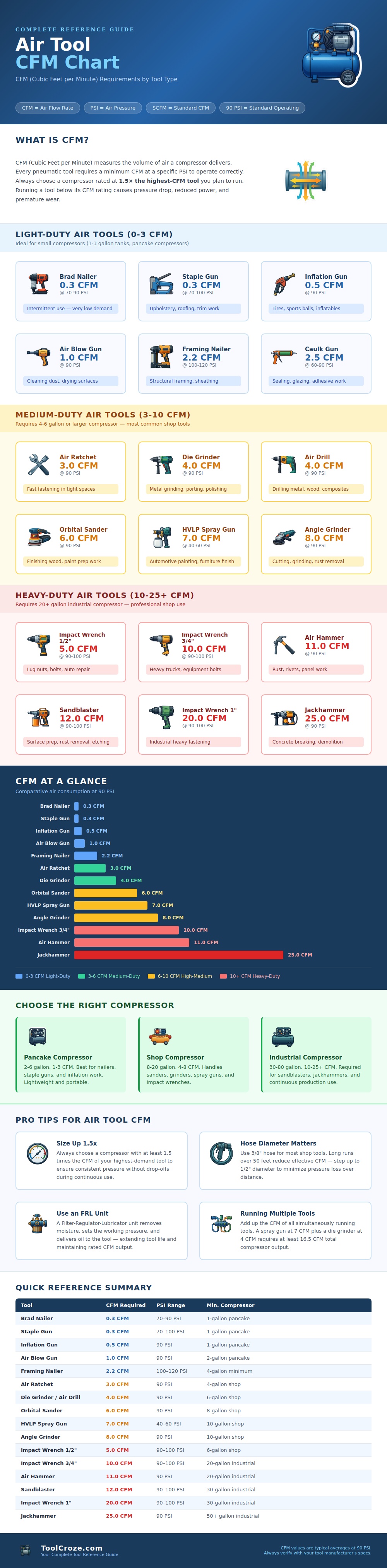
So the chart organizes tools based off their power requirements, light, medium and heavy duty. And it gives you an idea about whether your set-up will support whatever project you want to take on next. To use another analogy: Imagine that your garden hose has a small nozzle. It doesn’t matter how much you increase the pressure at the faucet; there’s never going to be enough water flowing. Pneumatic tools is the same way.
Some tools like a brad nailer or staple gun need very little air, less than a cubic foot per minute in many cases. With such low requirements, a small pancake compressor can feed them all day. However, something like an angle grinder or orbital sander use significantly more air. These are medium-duty tool that eat up air continuously instead of in bursts. If the compressor can’t refill its tank faster than the tool is draining it, then motor will cycle on constantly. This causes the motor to overheat while your tool lose power.
What happens to lots of people: They purchase a big tank but don’t pay attention to the CFM rating of the pump.
What? Continuous vs Intermittent: Although a specific CFM number sounds like a spec, it’s also important to know if your tool’s air use is continuous or intermittent. Moderate air volume goes into a framing nailer but you fire it fast then wait. Small compressors will refill during your pause and do fine. Heavy volumes drawn for a long time such as an impact wrench or die grinder requires something able to produce air at a similar rate or faster.
To help sort this out visually, the chart divides applications into colored areas. In the low light section would be a simple inflation gun while a sandblaster would be in the industrial heavy duty area. Because air volume isn’t adequate, running a sandblaster off of a standard shop compressor won’t work.
This gets practical when you apply the golden rule of sizing up: Match or exceed the maximum CFM demand of your most demanding tool by at least 1.5 times. If you’re using multiple tools simultaneously, add them all up first and then multiply. That gives you a little breathing room so there’s no drop in pressure that tears off a bolt head or messes with your finish.
Surprisingly, the size of your hoses will factor into this as well. Narrow diameter tubing will limit your flow, effectively reducing available CFM by the time it gets to the tool. Mysterious loss of power? A wide hose upgrade is a cheap solution.
Capacity matters, It’s tempting to go big or go home. But the best choice for your equipment is based on reality, not wishful thinking. For example, a small portable pancake unit will do just fine inflating tires and doing some trim work. If you’re using spray guns, grinders, and sanders, then a larger shop compressor can handles them with ease. Need something capable of constant, high-volume airflow? Then go industrial, with ample tank storage.
The message is to understand your tools’ needs before plugging anything in. When you have consistent, free-flowing air the job gets done quickly and lasts longer. Make sure your compressor doesn’t become a bottleneck slowing down your progress; make it a reliable partner.
