
In the toolbox of every mechanic is something called a feeler gauge. The feeler gauge tells you whether your engine will run smooth or tear itself apart within fifty miles. If it doesn’t, it won’t go 50 miles before it dies. A thousandth of an inch can make the difference between success and failure. But a thousandth of an inch is nothing you can SEE. You have to feel it.
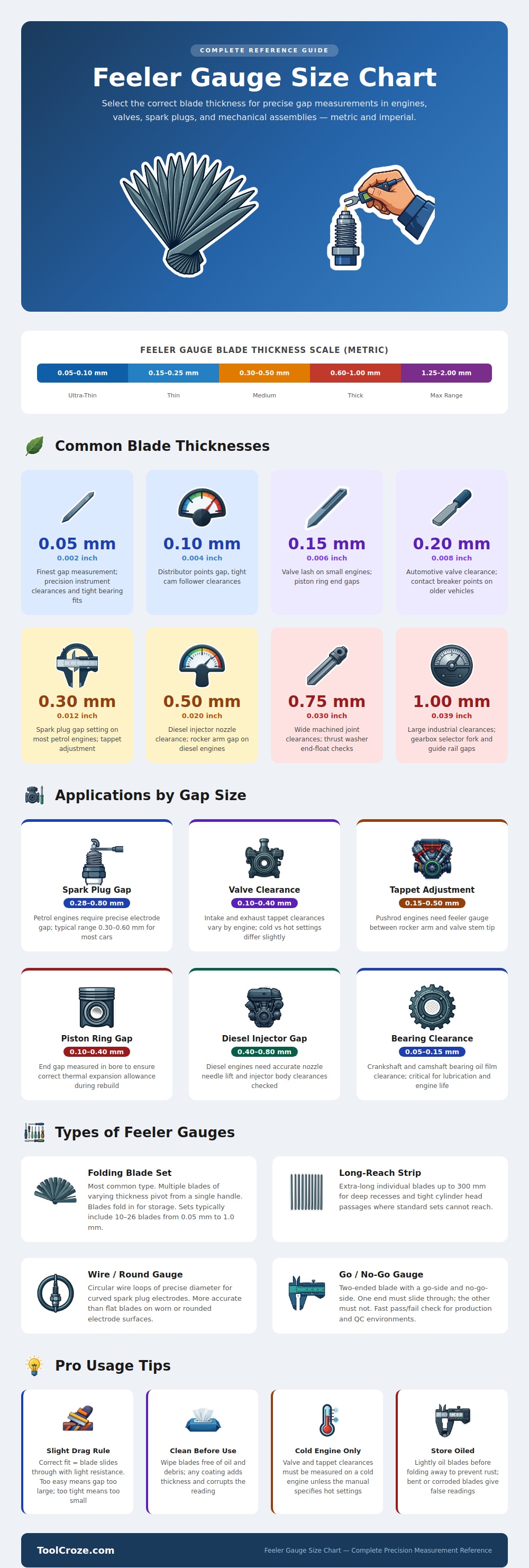
This is where we see standard blade thicknesses broken out (above). These range from super thin slivers to solid strips for industrial duty clearances. We break them out into their own category on this visual guide so you know at a glance what range it is in without having to look through every leaf to figure it out.
How to Use a Feeler Gauge
Ultra-thin blades are for really tight bearing fits and precision instrument clearances, where literally fractions of a millimeter makes a difference. Any thicker and you’ll be reading off by too much and can actualy physically mess up a soft surface with the blade. You could of kill the part while doing that.
When adjusting valve lash or spark plugs, most of us go directly for our feeler gauge. They’re typically in the medium to thin range. If you’re using European manuals and has American tools, chart above shows millimeters in both cases. It also shows corresponding imperial measures. So what? Well, sometimes you’ll find an adjustment mentioned in one set of terms versus another, which makes using your tool difficult without the conversion. It’s easy enough, but use it with caution. Too large a spark plug gap will result in poor firing on high compression; too small a gap may lead to misfiring on heavy loads and premature electrode wear. Correct here means complete fuel burn and good air flow through engine.
It is important to get both the proper thickness and the right style of gauge. As the infographic shows, there are four popular styles, each with its own special solution to an access issue. For everyday applications, a standard set of folding gauges will suffice. But what if you’re attempting to fit one into a deeply recessed injector nozzle or working under a deep valve cover? A standard-blade gauge may not reach far enough. Forcing the tool in at an odd angle runs the risk of bending those fragile edges.
Enter: Long reach strips. With these, you can poke deep down inside a cylinder head and still avoid forcing the tool in at a bad angle. Another option for rounded surfaces is wire gauges. These give you better contact against rounded spark plug electrodes different than a flat sheet of steel can.
And that leads me to another point: technique. One of the biggest rookie mistakes I see is when people gets the blade into position and just let go and say “ah, there we go.” Wrong. When done right, you’ll be able to slide your blade through the gap and the blade will resist slightly. Pulling back on it, you want to feel some give but nothing like bending or sticking. Too loose and the gap is bigger than you think. Too snug and it’s smaller. That’s the actual art to this thing, how do you know? You know by how it feels. It is not what it says on the back.
Accuracy is another element where maintenance plays a part. The blades are made from thin spring steel which will bend, and especially rust if not cared for. Keeping the blades lightly oiled when stored and wiping them down between uses avoids any corrosion that might cause minute amounts of material to be added each time it’s measured. A rusty blade measures larger than it actually is, causing you to adjust it and resulting in overly tight parts.
In the end, however, this isn’t so much about perfecting something for the sake of being perfect. This is about repeatable accuracy, whether you are setting tappet clearances on an old-timey pushrod motor or measuring piston ring end gap during a rebuild. Factory specs don’t lie, and when you nail down that pesky drag test and make the proper selection for blade choice, you’re not just filling up some empty space with metal. You’re making sure the thing works reliably. And when that bit of resistance clicks into place, you know you got it right.
