
When your chisel goes haywire in the middle of a woodworking task it’s not always your bad luck, it’s geometry. In other words, you’re attempting to shave off a little something-something from a joint, yet instead of slicing through cleanly, the tool catch and tears the grain. That’s when blade angle is all wrong. How much of a bite a chisel has are determined by its blade’s angle relative to the wood, and if that angle is incorrect, then you’re fighting physics.
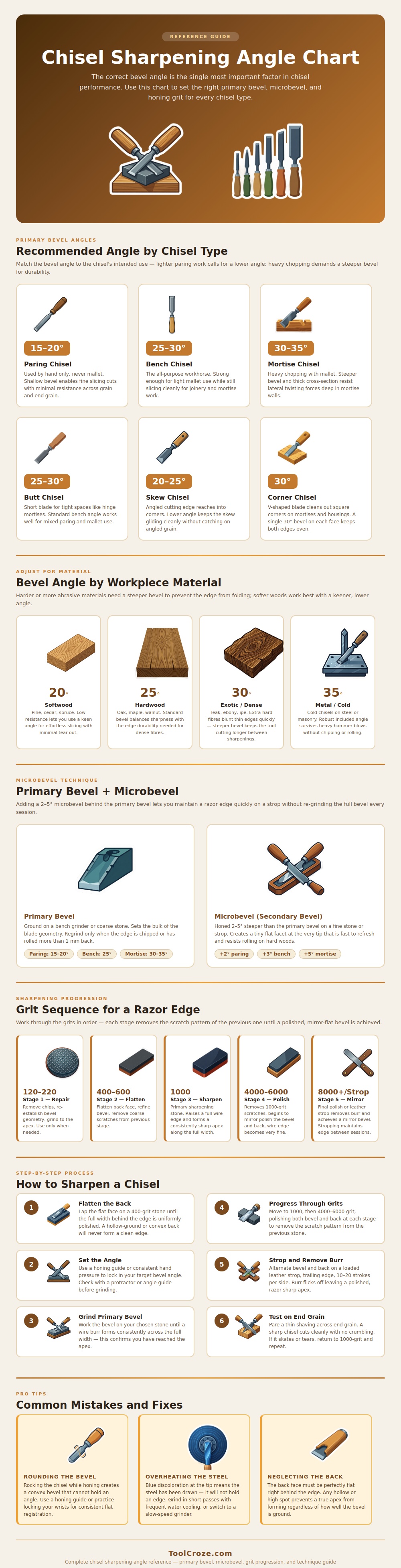
To eliminate guesswork, the infographic links workload to angle. Because you’ll only apply hand pressure on paring chisel, bevel should range from fifteen to twenty degrees, shallow. The low angle produce a very sharp edge capable of quickly slicing through fibers without much resistance. On the other end of spectrum, a mortise chisel take heavy mallet strikes; it therefore demands a steeper bevel ranging from thirty to thirty-five degrees. The increased amount of steel behind the edge keep it from rolling up or chipping under impact. It’s a matter of sacrificing cutting speed in favor of structural strength; something the chart illustrates quite well.
How to Choose the Right Chisel Angle
The proper angle also depend on the material’s hardness. For example, softwoods such as pine take to a shallow twenty degree angle and shave off easy. On the other hand, hardwoods and denser exotic woods will quickly dull these delicate cutting edges. The visual guide show that a thirty-degree angle is better for tough materials. Cut ebony at a twenty degree bevel and within seconds, you’ll have nothing but folded-over wood. Then you’re fighting a blunt wedge different than trying to make accurate cuts.
The microbevel is an effective component of your sharpening regimen, though most woodworkers ignore it. In the drawing, it’s the small, increasingly acute angle you hone on top of main bevel. Two to five degrees on a strop or fine stone create a strong tip that lasts longer before needing a full-blade-face grind. Less sharpening mean more woodworking; it’s a small time investment with a big improvement in cutting efficiency.
The angle is important, but so is grit progression. To fix damage, you begin on the coarse side at roughly a hundred twenty grit. Then, heavy lifting occurs in the four hundred to a thousand grit range. A lot of folks quit here leaving them with scratches which dull an edge prematurey. From there, moving up into the four thousand to six thousand grit area will polish your bevel until it’s reflective as glass. The mirror finish not only makes it look good, but it cuts down on friction as it glides across wood fibers.
One oversight leading to common errors involve forgetting that back of the chisel is flat. Directly behind the cutting edge, the back needs to be perfectly flat. If you rock your wrist when you hone it, the edge will round itself off and the angle won’t matter. You should of keep things in line and use a guide. Make sure they intersect at a sharp 90-degree angle on both planes.
If the geometry is correct, a sharp chisel respond. It fits naturaly into your hand, producing nothing but clean cuts and smooth shavings. If you want to be a woodworker, that kind of control begin by getting your angle right before you sharpen it on the stone.
