Type S Mortar Calculator
Estimate Type S mortar volume, preblended bags, field-mix cement, lime, sand, water allowance, and masonry unit coverage for brick, block, stone, and repointing work.
Full calculation breakdown
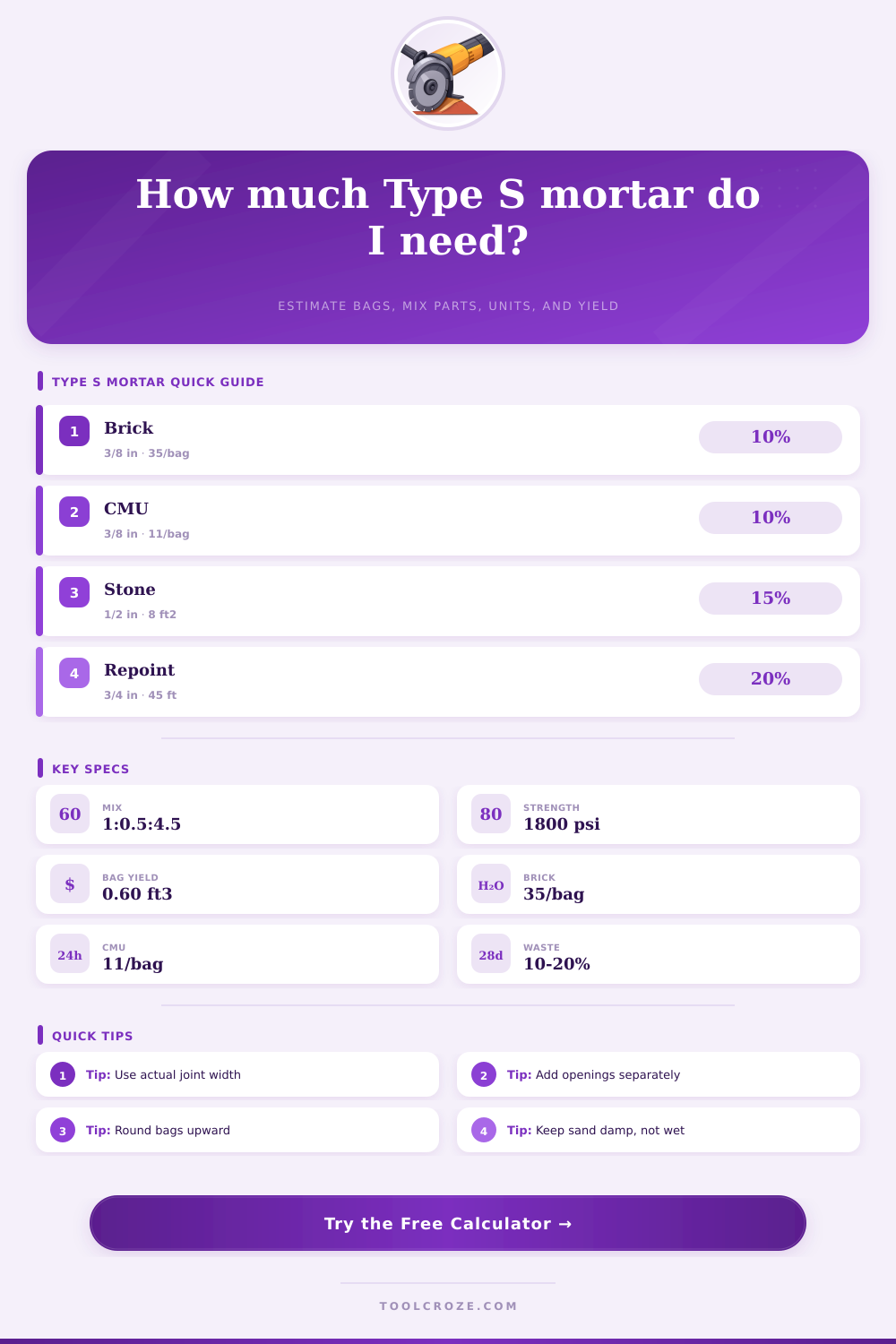
| Masonry work | Typical joint | Approx coverage per 80 lb bag | Calculator basis |
|---|---|---|---|
| Modular or standard brick | 3/8 in bed and head joints | 35 to 40 brick | Unit count plus joint adjustment |
| 8x8x16 concrete block | 3/8 in face-shell bedding | 10 to 12 block | Block count plus bed-depth factor |
| Thin stone veneer | 1/2 in setting bed | 7 to 10 ft² | Area times bed thickness |
| Brick repointing | 3/8 in wide, 3/4 in deep | 40 to 55 linear ft | Joint length times width and depth |
| Component | Common proportion | Volume share | Estimator conversion |
|---|---|---|---|
| Portland cement | 1 part | 16.7% of dry blend | 1 ft³ per 94 lb bag |
| Hydrated lime | 1/2 part | 8.3% of dry blend | About 1.25 ft³ per 50 lb bag |
| Masonry sand | 4-1/2 parts | 75.0% of dry blend | 27 ft³ per yd³ |
| Water | Adjust for workable mix | Not fixed by proportion | Estimated by gal per wet ft³ |
| Unit type | Face size | Nominal joint | Typical use |
|---|---|---|---|
| Modular brick | 7-5/8 x 2-1/4 in | 3/8 in | Veneer and walls |
| Queen brick | 7-5/8 x 2-3/4 in | 3/8 in | Residential veneer |
| 8 in CMU | 15-5/8 x 7-5/8 in | 3/8 in | Foundation and site walls |
| Thin stone | Variable pieces | 1/2 in bed | Veneer bedding |
| Project | Suggested waste | Bag yield check | Notes for takeoff |
|---|---|---|---|
| Straight brick wall | 10% | 35 to 40 brick per bag | Subtract windows and gates |
| CMU foundation wall | 10% to 15% | 10 to 12 block per bag | Use face-shell bed depth |
| Stone veneer | 15% to 20% | 7 to 10 ft² per bag | Irregular backs need more |
| Repointing | 15% to 20% | Depends on rake depth | Measure joint depth after removal |
You know that feeling: You’re halfway up a wall and discover you can’t finish it. You only has mortar to lay three more bricks. Uh-oh! You either estimated incorrect on how thick to make the joints, or you miscalculated the amount of material required for stone veneer (which require more mortar than brick). The calculator does the math for you, but knowing why those numbers affects the calculation helps your wallet.
Type S mortar is the classic masonry mix. It are a high-strength blend with 1800 psi compressive strength. That’s strong enough to support soil pressure and resist lateral loads, which makes it the go-to for retaining walls and foundations. But that strength also mean rigidity, which is why precision matters. Overorder it, and you’ll lug home more weight then needed. Undermix it, and you’ve got a weak wall.
How to Estimate Mortar for Your Wall
Joint width is the first input that lead to trouble. Most folks think they’re supposed to use a width of 3/8 of an inch. That’s right if your material is brickwork, but stone veneers and repointed old chimney typically have half-inch joints or wider rakes. That additional sixteenth of an inch doesn’t sound like much… But times it by a hundred square feet of surface, then multiply… Small increases in depth quickly lead to large increase in volume. As the joint width go up, the coverage area goes down (you can see this in the reference table on the page).
An 80-pound bag will get roughly ten or twelve concrete block, but about 35 modular bricks. Blocks seem oddly more wasteful than bricks, yet the blocks are taller, and need fatter bed joints because they weighs more.
Another decision is whether to mix on site or buy premixed bags. Premixed bags are consistent, handy, but also more expensive per cubic foot. If you’re mixing on site, you can control workability (see below) and use a mix of 1 part cement, 0.5 parts lime, and 4.5 parts sand. To get this right, use same bucket for all scoops and remember: The ratio is strict, by volume. Keep those proportions strict by volume to ensure you get it right. If you have sandy soil, be aware that dry sand occupy more space than damp sand. Likewise, a bucketful weigh more when wet, yet less when dry. So the experienced mason notes the behavior of his sand on any given day.
Waste factors is always tricky when estimating. In theory, 5 to 10 percent excess material should of be all that’s required for a simple straight wall with no corners. With a rough stone face or a curving garden wall, however, you could be looking at 20 percent or even more. Mortar gets spilled…on the trowel, in the wheelbarrow, and simply by slipping away. Good idea: This lets you tweak this slider in the tool. Better to end up with a couple of surplus bags than to find yourself out of luck partway through the shift. Extra bag stay in the shed until your next little repair project.
The last variable is water. You want enough water in type S mortar so that it’s workable, but not so much that it’s soupy (and weaken the bond). The estimator will give you an approximate amount in gallons based off volume, but go by the consistency every time: On the trowel, it shouldn’t slide right off the brick; it should keep some kind of shape. If there’s too much water, it’ll increase your shrinkage cracks when it dries. Not enough, and the joints can never be toled well.
Math is not so important as understanding the volume of what you are working with. Be careful measuring your units. Consider that you must subtract doors and windows before totaling up. Ensure that your sand is not too wet or too dry. After tweaking these variables, it all make sense. And you’ll have a few bags left over and a straight wall, but no empty wallet.