
Have you ever attempted to sharpen a blunt kitchen knife? Did you spend 20 minutes stroking it back-and-forth across a stone with no noticeable difference in sharpness? It’s not usually your fault, it’s nearly always your angle. We treat sharpening as if it were polishing, when realy it’s all about geometry. If your angle is too flat, you’re simply smoothing out what’s already there without adding any fresh edge. Too steep and you’re shaving off more metal than you can compensate for.
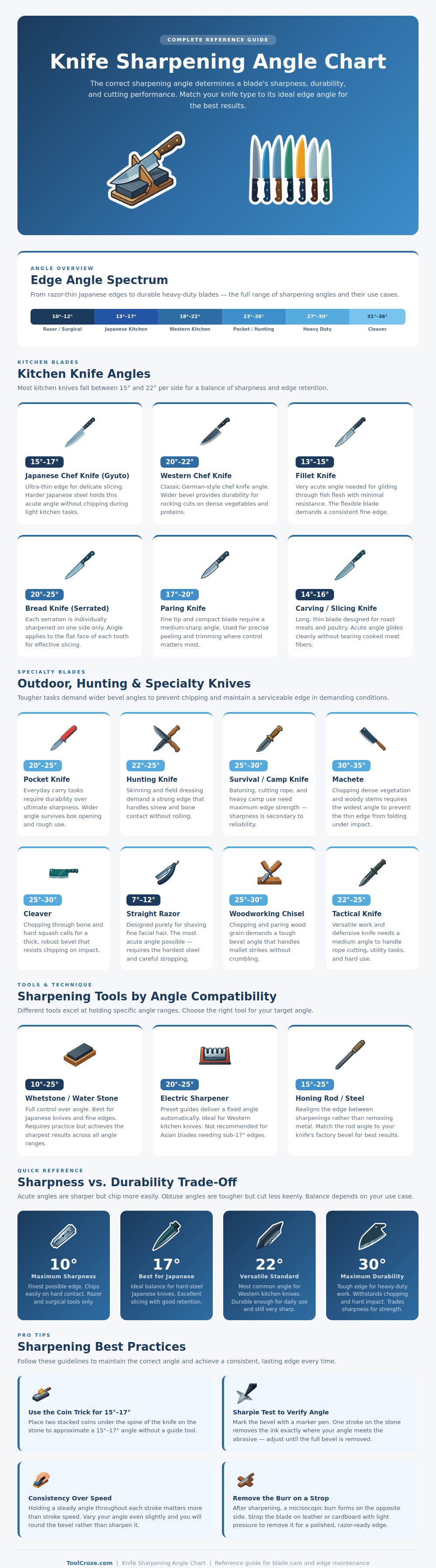
As the graphic up top explains, there’s a precise angle that works for each type of knife, and this makes sharpening a vague art form into something you can measure. There’s always a trade off between durable and sharp. A sharper blade has a more acute angle, which give it a finer cutting edge that effortlessly slivers through paper. But the fine cutting edge is brittle. For example, a Japanese chef knife would have a thinner wedge of steel.
Why Knife Angle Is Important for Sharpening
A wider angle make for a thicker bevel. It can withstand repeated abuse on a piece of wood or bone. But you’ll never experience the razor-sharp nature of a thinner bevel. In the end, it’s a blade that’s trying to balance survival with precision. If you were to pick up a Japanese chef knife… Meant to slice through softer ingredients with delicate cuts… You’d see a lower angle in the range of fifteen to seventeen degrees per side. This geometry help the blade separate fibers instead of crushing them apart.
On the other hand, a German-style Western knife coming right out of the box might feature a steeper bevel of around twenty degrees. This is due to its ability to rock back and forth on thick vegetable tasks while occasionally getting knocked into a harder surface without any fear of chipping. Get away from the kitchen, though, and the figures change radically: these are harsher chores. A fine hair-shaving edge isn’t what you’re after on a hunting knife or something you hope will be able to pry open crates or beat wood.
Tactical implements and even basic pocket knives fall right in the sweet spot of twenty- to twenty-five-degrees, as indicated on the chart. That gives them plenty of punch to stand up to digging the end into a crate without rolling over but enough bite for everyday use. If we’re splitting bones with a cleaver or lopping off branches with a machete, we go higher up to perhaps thirty degrees or beyond. Then it’s not about sharpness anymore so much as retaining an edge against impact forces that will shatter more delicate blade immediately.
Choosing the right angle is just as important as the tool you use to do it. The ease of electric sharpeners is that they force you to use a certain angle (typically twenty degrees). This is great if you’re trying to put an edge on your everyday Western kitchen knives, but it is a nightmare when it comes to specialised Asian knives which has thin cutting edges. For maximum flexibility, go for whetstones, but accept the greater learning curve. They will let you set whatever angle you need, from super sharp for fillet knife-like work to beefy bevels for chisel-type tools.
The secret is consistency. When starting out most people wobble the hand back and forth as they move the blade across the stone; this means the edge won’t be sharp, instead of a clean cut you’ll get a rounded, ineffectve edge. Before you start to sharpen, draw a mark along the bevel with a marker pen so that, as you go, you can clearly see where the stone is touching the steel. That way you know that you’re truly engaging with the metal, not just glancing off it.
After grinding out the edge you’ll notice there’s still a small wire burr running the other direction across the blade. That’s some folded over metal you need to clean up with your sharpening stone in order to get it done. Using something like heavy cardboard or leather, stropping your knife lines those micro-teeth back up again and makes it extra sharp. Gives you a nice shine too. You can sharpen to perfection and leave that little burr there, so now you’ve got something that’s technically sharp as all hell but feels dull because of this burr thing. Getting the angle right is only half the fight. The actual satisfaction comes from getting that edge cleaned up.
Now that you understand the angles, your knives take on new meaning. They’re not just tools that go dull; they become engineered systems designed to perform in certain ways. Once you have one in your hand, sharpened correctly to the right angle, you’ll know the difference instantly. It cuts like butter, needing little effort and providing greater control. Your work becomes effortless, using your equipment rather than struggling against it.
Next time your knife seems to be lagging behind, look at your angle first. Everything else falls into place after that.
