
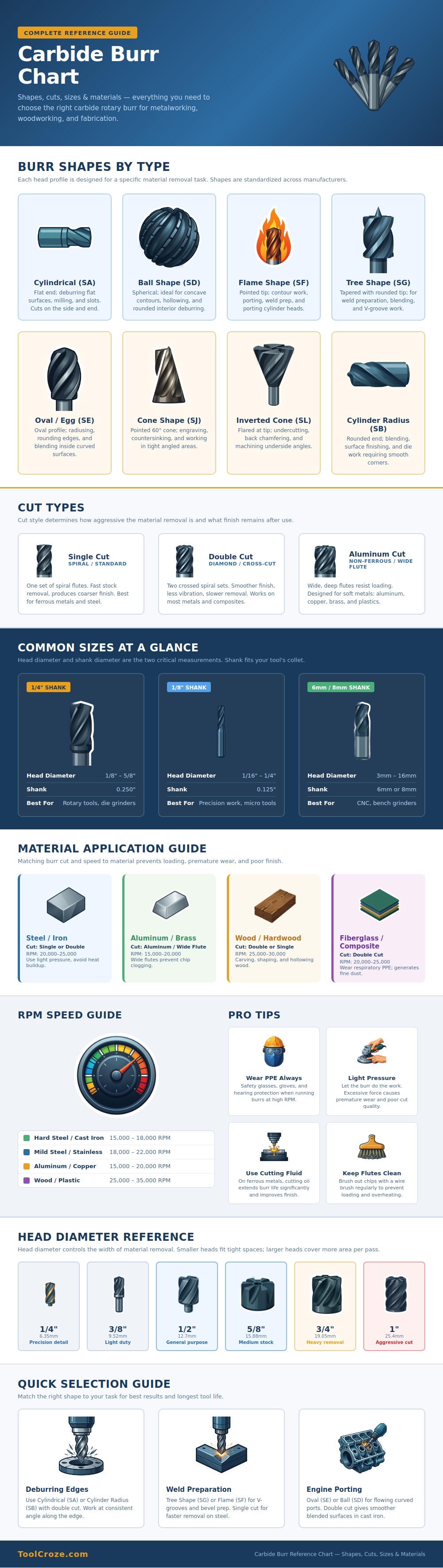
The burrs are set up right if metal doesn’t chatter when scraped across something. This requires patience, metallurgy, and some geometry. Most folks take what they find that has a shiny bit on it and spin it real fast until it’s a hot mess on there workpiece.
Certain head shapes make all the difference (see chart above). A cylindrical profile will produce a flat deburr, while a rounder ball type will be really good at removing material around a concave contour. It’s kind of like using the right sized drill bit for drilling holes, each shape is designed for one function and will perform differant if forced into another role.
How to Choose and Use Carbide Burrs
Single cut burrs has one spiral set of flutes. Because of this, it is an aggressive cutter and removes more stock in less time, leaving a coarser finish then the double cut options. However, these are also very good at removing metal such as iron and steel, where both the cut pattern and physical shape matter just as much.
Two cuts is essentially two sets of flutes that intersect to create a sort of diamond pattern, which is why it’s called a double cut burr. It’s a little more gentle on materials that tend to load into the flutes like aluminum and brass, and would of basically clog your tool in no time if you used a single cut on something softer. You may notice with a harder steel that a double cut feel somewhat slow and creates too much heat. In those cases, a wide flute are designed for non-ferrous materials to keep chips moving away from cutting edge.
The next piece of the puzzle is size selection. If your shank is too big for your machine, you can’t fit it in there. A precise micro tool uses an eighth inch shank, while a handheld die grinder use a quarter inch shank. After that, you’ll want to consider head diameter; bigger heads cut away material faster, but won’t fit into tight spaces as well. Small heads will let you get into detailed areas, but will take you longer to cover large areas, so it’s a bit of a trade-off between speed/precision. For general fabrication tasks, try the medium stock removal size first. They’re quicker than fiddling around with one small burr on a whole big project. Downsize from there as needed for finishing details, according to reference guide.
The majority of novices’ mistakes occur with regard to speed; if you’re running a burr too slowly, you’re going to generate heat and in the end glaze over the carbide surface (i.e., essentially ruining its cutting edge). Conversely, if you run a burr too quickly, it can spit some bad stuff at you and fly out of your hands. The speed guide suggests that softer materials such as plastics and certain woods can be cut with much higher RPMs without any danger, while harder materials such as cast iron require slower speeds in the range of about fifteen to eighteen thousand. For tool life, matching the hardness of the material to the rotational speed is not negotiable, and you’ll have a lot longer with your expensive carbide inserts if you follow these limits.
The emphasis in the pro tips section is on light pressure, letting the carbide do the work, and that’s where technique makes all the difference. High pressure either dulls the teeth from friction heat or cause them to snap off. A little water, or better yet, some kind of cutting fluid on ferrous metals help cool the bit and clear away the chips. The flutes also need regular cleaning with a wire brush to keep any built-up material from acting as a brake on your tool. But just as importantly, eye protection is not optional; a high-speed shard of metal does not play well when it come into contact with unprotected eyeballs.
When you find the right cut, shape, speed, and gentle touch, those carbide burrs becomes extremely precise extensions of your own hand. The satisfying hum returns clean and consistent every single time you pick it up.
