
The same goes for all those rotary tools. You pay your hard-earned money thinking you have purchase a do-everything machine. The sales pitch worked. And for the initial 10 minutes of use, it does seem like one do-it-all device. Drill a few small hole in some plastic. Cut through a wire. Use it to smooth down an edge. It looks easy, right?
Well then try polishing up some jewelry or grinding through a thick weld. Too much vibration. Lots of smoke. It just doesn’t work right.
How to Choose the Right Bit for Your Rotary Tool
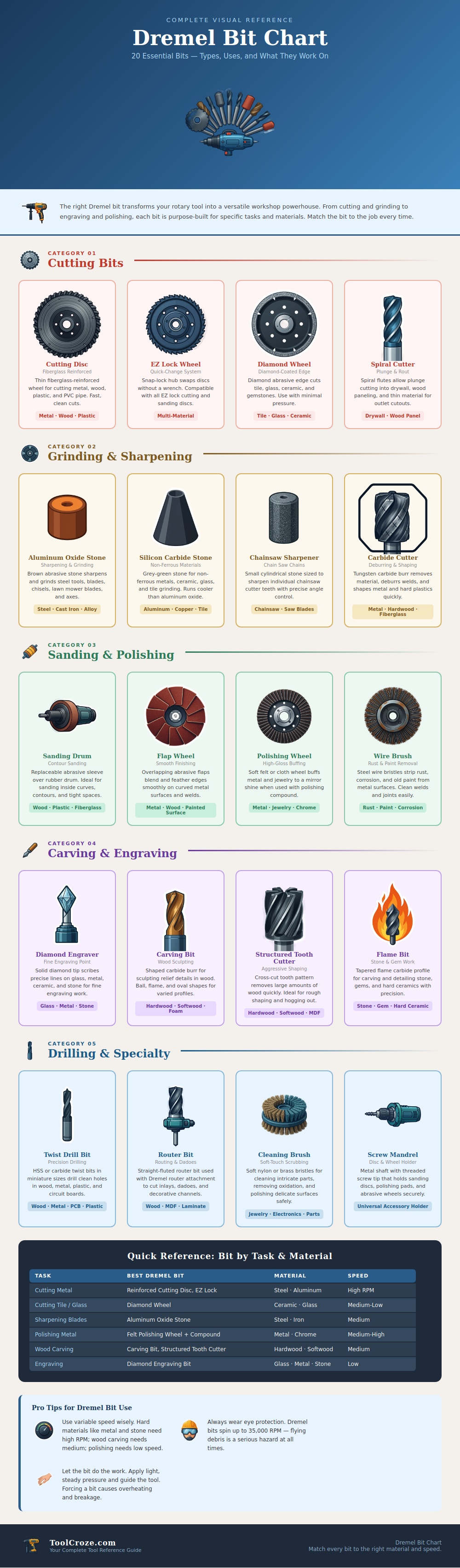
What gives? It’s often not that the motor isn’t strong enough. Rather, you are trying to use a fiberglass disc on something glass-like or a diamond wheel on something made out of wood. Match the bit to the medium, and then let the handheld power station help you instead of fight you.
But there are different types of accessories within each family depending not only on what they do but also how they gets the job done: some accessories spin and remove material (cutting) while others spin and grind down material (grinding). The difference might sound minor, but it can be critical to safety as well as outcome.
A cutting bit with a reinforced disk will slice through plastic, wood or metal, relying on a strong form of thin friction. Run it against something you want ground down instead and it’ll crumble like a waffle cone. On the other hand, a carbide burr will bite off tiny pieces of material in controlled increments. Use a carbide burr to shape hardwood or deburr a weld; don’t expect it to cut through pipe. But if you need edges cleaned up, its perfect.
Knowing this avoids the most frequent misstep with a rotary tool… Using the wrong accessory for a heavy duty job. Different kinds of abrasive stones are made differently, and knowing which you’re working with will help you protect whatever project you’re trying to do.
A brown aluminum oxide stone is a general grinder that is good for metals containing iron, such as steel and iron, but it runs hot. Use it to sharpen a lawn mower blade or chisel. A grey-green silicon carbide stone is softer to the touch, runs cooler, and is good for tile and glass and non-ferrous metals, such as copper and aluminum. Using a hard stone on soft metal creates friction heat that ruins bit and burns your workpiece. Many people think all grinding stones appear so alike they can be used interchangeably, this is a mistake.
Refinement replaces removal as the focus of finishing jobs. Drum sander is used in small areas such as contours and tight curves that flat sandpaper cannot reach. In detailed woodwork or inside corners, they gets it all smoothed up.
A flap wheel offers a different feel because it has overlapping strips of abrasive material. On round surfaces they smooth edges while blending them nicely, without leaving hard scratch lines. A flap wheel is commonly used heavily before paint on metal fabrication projects. But once you desire the mirror shine, abrasives step aside and polishing compounds take over.
Buffing with felt or cloth buffs loaded with compound brings out the gloss on your jewelry and chrome. The grinding stops. Now, friction creates heat that melts micro scratches away, making everything smooth again.
When cutting or grinding, you’re fighting the material. When carving, you’re actualy steering the material away. With diamond engraving tools, the harder diamond tip makes fine line marks on hard surfaces such as stone or glass. Carbide is used for carving bits with a toothy structure that cut through wood fast for rough shape work. Flame shaped burs can be used for more detailed relief work.
The speed control are important here. High RPMs are usually best for hard materials like stone and metal where you want the cutting edges to remain efficient. For carving wood, typically low RPMs is desired (you don’t want to scorch the grain and lose control over the detail). Very little pressure should of been applied; let the bit do the work.
How do you hold them? For best performance, it’s not just about what type of bits you get, but also how they mount. Sanding drums, wheels and flat discs attaches to standard screw mandrels with a threaded end. Some quick-change systems snap bits on tool-free, quicker, but potentially less secure when heavily loaded. Understanding your accessory mounting type (threaded or quick change) eliminates the heartache of getting a bit that won’t fit in any holder. It’s a practical matter that determines how organized you are.
Always use eye protection with this tool. No matter how careful you think you are, at those RPMs, anything turns to shrapnel. Use light, steady pressure. If you try to force a little more, it will overheat, wear out faster and sometimes snap off. It’s largely a mind game. Try not to have it scream but instead make it work quietly.
When you choose the exact right bit for the exact type of texture and quit trying to muscle it along, what was once a vibrating nuisance in your hand will change again into the versatile powerhouse you purchased it as.
