Floor Weight Capacity Calculator
Estimate floor live-load capacity, heavy-item point load, joist utilization, and deflection using common span, spacing, material, and load assumptions.
📌Real Floor Load Presets
📐Floor System Inputs
🧱Selected Material / Spec Grid
📊Floor Load Reference Table
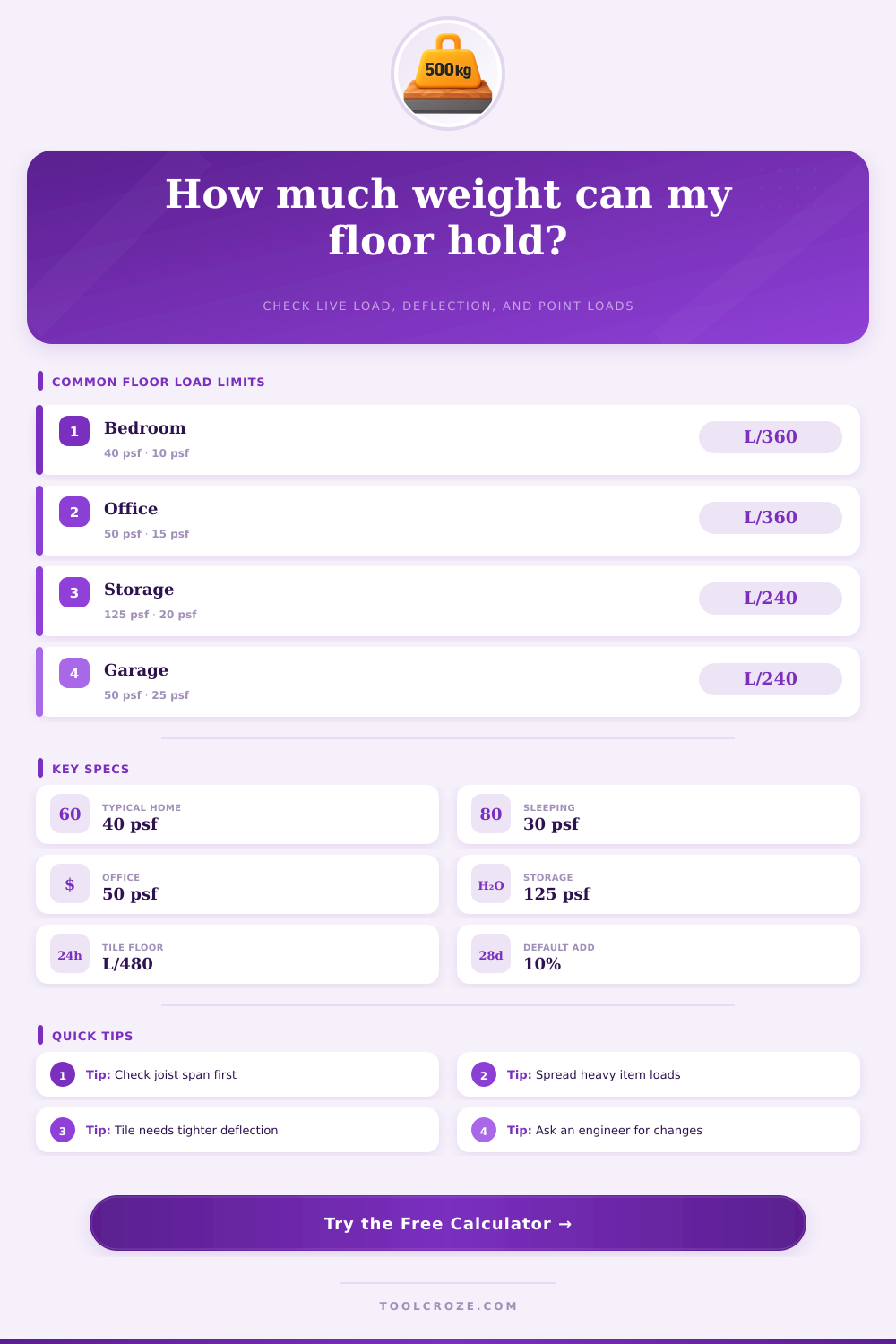
| Use or occupancy | Common live load | Typical dead load | Common deflection check |
|---|---|---|---|
| Sleeping room | 30 psf | 10 psf | L/360 |
| Living area | 40 psf | 10 to 15 psf | L/360 |
| Private office | 50 psf | 15 psf | L/360 |
| Light storage | 125 psf | 15 to 20 psf | L/240 |
| Garage floor | 50 psf or wheel load | 20 to 25 psf | L/240 |
| Tile or stone finish | Use room load | Add mortar and board | L/480 or stricter |
📏Member Property Reference
| Floor member | Depth | Section modulus | Moment of inertia |
|---|---|---|---|
| 2x8 SPF No.2 | 7.25 in | 13.1 in³ | 47.6 in⁴ |
| 2x10 SPF No.2 | 9.25 in | 21.4 in³ | 98.9 in⁴ |
| 2x12 SPF No.2 | 11.25 in | 31.6 in³ | 177.9 in⁴ |
| 11 7/8 in I-joist | 11.875 in | 48.0 in³ | 285 in⁴ |
| C8 steel channel | 8 in | 13.8 in³ | 55.1 in⁴ |
| 6 in slab strip | 6 in | 72.0 in³ | 216 in⁴ |
🏋Heavy Item Footprint Reference
| Item | Typical total weight | Suggested footprint | Calculation note |
|---|---|---|---|
| Upright piano | 300 to 500 lb | 5 ft by 2 ft | Often spans several joists |
| 120 gal aquarium | 1,200 to 1,500 lb | 5 ft by 2 ft | Place near bearing when possible |
| Power rack and plates | 800 to 1,500 lb | 8 ft by 6 ft | Use platform to spread load |
| Bookcase wall | 60 to 180 plf | Line load | Check joists parallel to wall |
| Large safe | 600 to 1,200 lb | 3 ft by 3 ft | Small footprint can govern |
⚙Formula Breakdown Reference
| Check | Formula used | What controls | Output impact |
|---|---|---|---|
| Uniform bending | M = wL² / 8 | Fiber stress Fb | Maximum total psf |
| Uniform deflection | Δ = 5wL⁴ / 384EI | L/limit stiffness | Comfort and finishes |
| Center point bending | M = PL / 4 | Shared joist load | Max item weight |
| Center point deflection | Δ = PL³ / 48EI | Footprint width | Point-load warning |
💡Calculation Tips
There’s that corner of your basement where you’ll be putting a big aquarium or a heavy power rack. It has carried the load of boxes and laundry machine over the years, so the floor seems stable enough. But supporting a few hundred pounds throughout the room is not the same as putting fifteen hundred pounds on a two-foot footprint. That needs some math; so take measurements of those joists before placing anything heavy.
Living spaces are designed for 40# per sq ft and bedrooms 30#. This is an average applied to a whole floor space. This doesn’t mean that someone standing on one foot applies 40# per sq foot… they’re pressing several hundred pounds down on a tiny part of the deck. Why? Even though there is high localized pressure, the overall load is low so the house can bear it. Large items depends on certain beams to take more than their fair share of the weight instead of spreading it out evenly.
How Much Weight Can Your Floor Hold?
Now the calculator does all that math for you, but it’s good to know what goes into it so you don’t make incorrect assumptions. The biggest one is span length. You think, oh, I have a twelve-foot span. That’s nothing, right? Wrong. Because longer spans has more bending moment: the bigger your span, the stronger the beam must be in order to allow only a certain amount of sag. For example, doubling the span means quadrupling the stiffness required to allow the same sag limit.
This is why an old house, even though it may well be structurally sound, can feel bouncy. It’s physics, and it’s often due to long spans. And that’s just flexible, which isn’t necessarily dangerous. But when you add dead weight, such as a safe, that flexibility becomes a problem. While pure strength isn’t the end all, be all for a lot of today’s finishes, deflection is what they really care about. Tile doesn’t like movement at all and it gets brittle too, so typically they ask for a deflection limit of L/480 rather than L/360. That means floor has to be much stiffer or the tile will crack the grout. It makes a huge difference in how long it lasts.
You can set the deflection criterion for your finish material with the tool. Fail to do that and you may pass the strength check but fail the durability and comfort test. Another hidden variable is material properties. All wood isn’t created equal. Bending strength and stiffness are different than wood species, meaning that a typical 2×8 Southern Pine joist will support much more load than a 2×8 of Spruce-Pine-Fir. These outcomes are driven by the moment of inertia (I) and section modulus (Z), as seen in the reference table on the page.
Unless you’re sure what type of wood you have, assume it’s lower grade. Better to err on the side of less capacity rather than risk having something structurally fail. Load spreading works for heavy stuff as well. A point load‘s weight can presses down on only a few joists at a time when there’s a small footprint. By adding a plywood platform we spread out that load onto three or four members and that dramatically reduces the demand placed on any one beam. That’s cheap insurance. Floors is designed to handle distributed loads better than point loads.
Keep in mind: Conditions deteriorate. A joist may have been reduced by 20 percent or more due to poor drilling (e.g., for wiring), moisture damage or simply notches cut into it. That’s why there is a condition factor on the tool. It requires that you recognize the history of your house. And that it isn’t necessarily pristine, like brand-new construction. Before taking the numbers at face value, check out what’s in the framing.
So here’s the thing: There isn’t one magical number that tells us how much weight our floors will hold. The question has more to do with the connection between load, material and span. In other words: it should of had to do with recognizing the physical laws at work below your feet. If you approach your floor structure this way, you’ll sleep soundly regardless of what heavy things you decide to install upstairs.