S S Plate Weight Calculator
Estimate stainless steel plate weight from grade density, plate shape, dimensions, thickness, holes, quantity, and fabrication allowance.
⚙Stainless Plate Presets
📏Plate Details
Full Calculation Breakdown
🧪Selected Material Snapshot
📊Stainless Steel Grade Density Reference
| Grade | Density kg/m³ | Density lb/ft³ | Common plate use |
|---|---|---|---|
| 201 | 7850 | 490.1 | General sheet, trays, light panels |
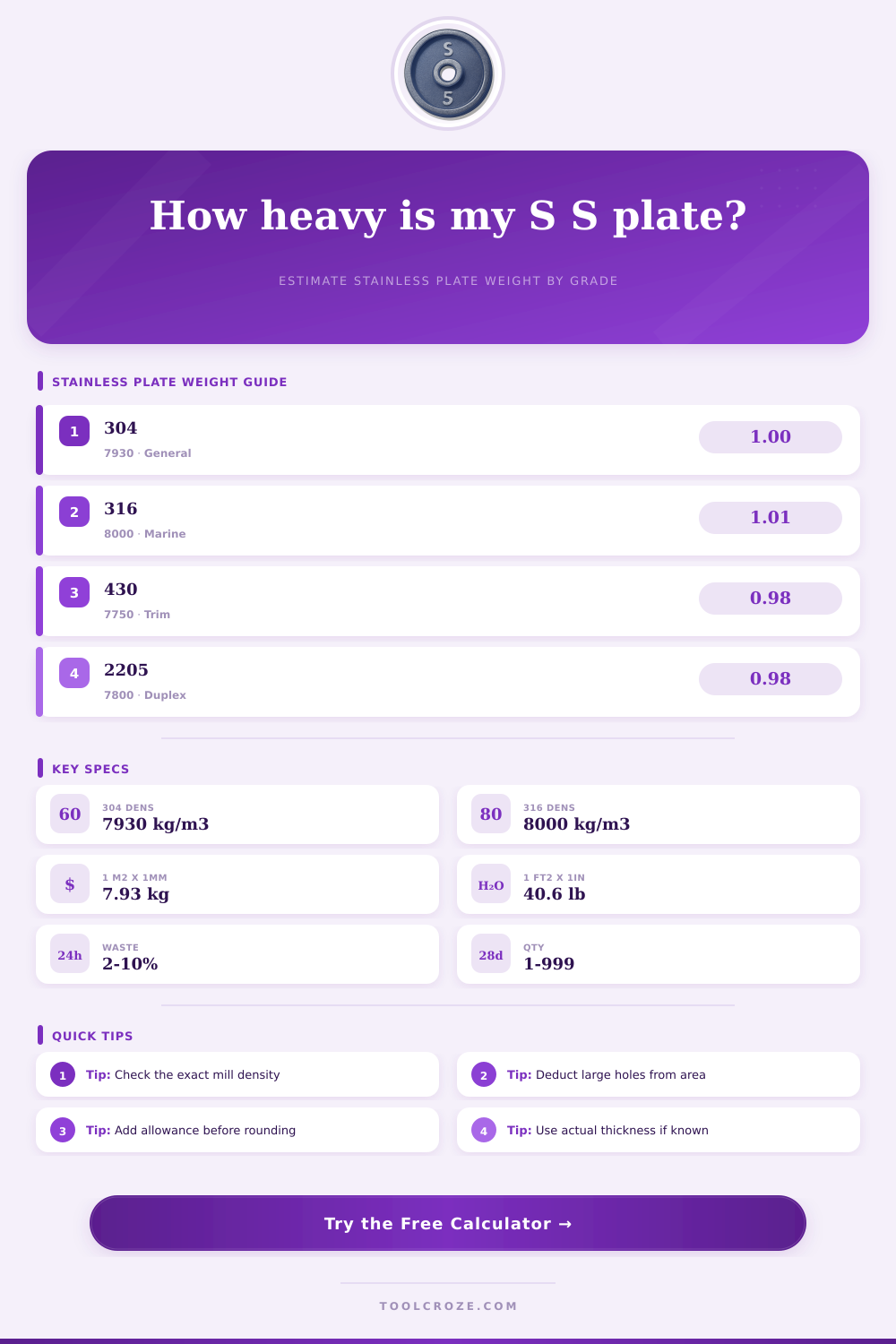
| 304 / 304L | 7930 | 495.1 | General fabrication, food equipment, tanks |
| 316 / 316L | 8000 | 499.4 | Marine, chemical, outdoor corrosion service |
| 321 | 8020 | 500.7 | Heat service and welded hot assemblies |
| 410 | 7750 | 483.8 | Wear plates, blades, hardened components |
| 430 | 7750 | 483.8 | Appliance trim, decorative ferritic plate |
| 2205 duplex | 7800 | 486.9 | High strength corrosion resistant plate |
| 17-4 PH | 7800 | 486.9 | Tooling, shafts, high strength parts |
📐304 Stainless Plate Weight per Square Area
| Thickness | Weight kg/m² | Weight lb/ft² | Typical handling note |
|---|---|---|---|
| 1.5 mm / 0.059 in | 11.90 | 2.44 | Light sheet, hand carried in small panels |
| 3 mm / 0.118 in | 23.79 | 4.87 | Common sheet and cover plate thickness |
| 6 mm / 0.236 in | 47.58 | 9.75 | Panel, tray, guard, and bracket stock |
| 10 mm / 0.394 in | 79.30 | 16.25 | Machine base and structural plate |
| 12 mm / 0.472 in | 95.16 | 19.49 | Heavy base plate or equipment mount |
| 20 mm / 0.787 in | 158.60 | 32.48 | Heavy tooling and support plate |
| 25 mm / 0.984 in | 198.25 | 40.60 | Forklift or hoist planning recommended |
🔧Shape Formula Reference
| Plate shape | Area formula | Best input use | Cutout treatment |
|---|---|---|---|
| Rectangle or sheet | Length × width | Standard plate, panel, cover sheet | Subtract holes and cutout area |
| Long strip | Length × strip width | Kick plate, bar plate, trim strip | Subtract repeated fastener holes |
| Round disc | π × diameter² / 4 | Round blank, turntable, cap plate | Subtract holes or center bore |
| Ring washer | π × (OD² - ID²) / 4 | Flange ring, gasket support, washer | Use width field as inside diameter |
📋Common Stainless Plate Scenarios
| Scenario | Typical grade | Common size | Allowance to consider |
|---|---|---|---|
| Commercial kitchen splash panel | 304 | 1200 x 2400 x 1.5 mm | 2% for edge trim |
| Marine equipment base | 316 | 900 x 600 x 6 mm | 5% for holes and dressing |
| Machine mounting plate | 304 or 17-4 | 1000 x 500 x 12 mm | 5% to 8% for machining stock |
| Decorative kick plate | 430 | 36 x 8 x 0.06 in | 2% for trimming |
| Round flange blank | 316 | OD 18 in, ID 8 in, 0.5 in | 8% if rough cut from plate |
| Heat shield plate | 321 | 600 x 450 x 2 mm | 3% tolerance check |
💡Calculation Tips
Stainless steel is heavy; if you’ve picked up a sheet, you know how fast it makes your back hurt. Stainless steel has a sleek and thin look that make many people think they are choosing mild steel. The density of stainless steel is high. In fact, it almost weighs as much than eight thousand kilograms per cubic meter. Be sure to add up the weight before placing an order for plate material for any project. Failing to do so will result in high shipping costs or poorly planned lifts. More importantly, get mass correct rather than the color correct.
After you put in size of your sheet and the grade, the calculator does the rest of math. First, it will ask for shape. Any given thickness of plate is going to weigh same whether it’s a square or something else. The real variable are the alloy. For most projects common grade 304 is fine. At around 7930 kilograms/cubic meter, this density isn’t so bad. Grade 316 is heavier to resist salt water. It’s only an extra ~70 kg/cubic meter but that becomes significant if you’re multiplying by ten sheet.
Why You Should Calculate Steel Weight
A common mistake people make is assuming that all stainless steel weigh the same. They miss the slight but significant shift between austenitic and ferritic grades. Now there is another variable in thickness. You say the part is three millimeters thick. But how much is three? Mill tolerances will alter that thickness a bit and you may want to account for it in your weight estimate. The tool allows you to add a tolerance factor so that what you calculate is more realistic. Five percent underestimating can make or break your center of gravity calculations when you’re talking about a machine base.
Mounting holes cut out some of the material fast. The calculator accounts for these areas automatically based off the number of holes entered. No need to do any circle geometry at the end of a long shift. In theory, handling allowances aren’t really necessary but in practice, they’re very important. You can cut it right down to the dot. However, you’ll still trim off edges and leave some stock to make weld bevels. This will adds extra weight. A five to ten percent buffer accounts for the fabrication process. Cutting shops waste material. The scrap weighs something and goes into dumpster. If you don’t account for that loss, you could end up buying short of the actual amount needed. You might get delayed as you wait for another shipment. Better to show up with more than what’s needed then chasing the delivery truck.
Safety comes first. Physics does not care about your calculations. If it’s a heavy plate being dropped from a crane, it doesn’t care. Knowing the true weight allows you to select proper slings and make sure your overhead hoist will support the load. When precision is required, check the mill certificate. Otherwise, this method provides a good starting point for planning. Now, instead of guessing at weight, you’ll have a known quantity. Your budget stays honest and your back stays safe. Knowing exactly how much something weighs allow you to treat the sheet with care.