Stainless Steel Plate Weight Calculator
Estimate stainless plate weight from grade, thickness, length, width, quantity, hole deductions, cutouts, and handling allowance.
Calculated Stainless Plate Load
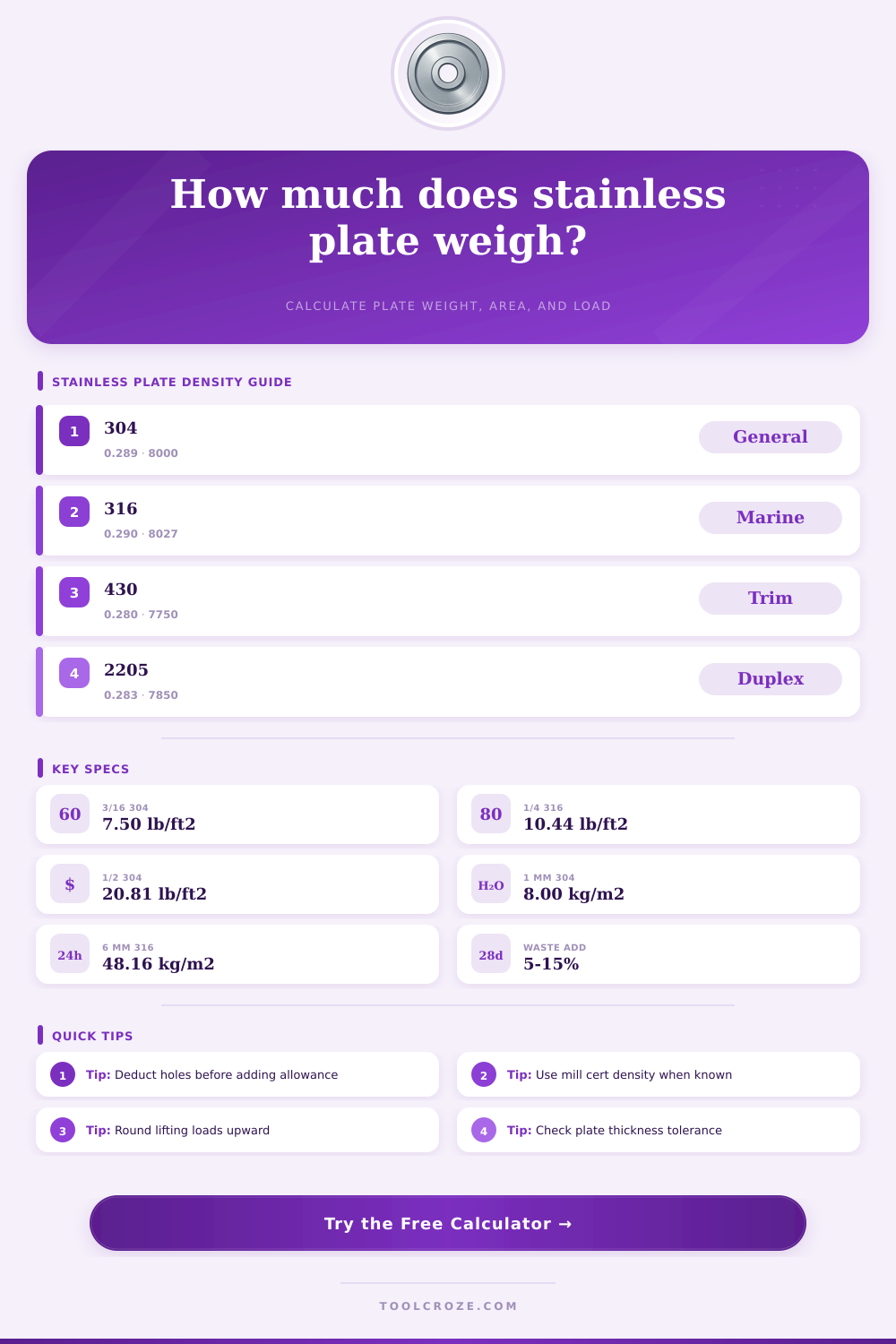
| Stainless grade | Density lb/in³ | Density kg/m³ | Typical plate use |
|---|---|---|---|
| 304 / 304L | 0.289 | 8000 | Food equipment, covers, shop plates |
| 316 / 316L | 0.290 | 8027 | Marine brackets, chemical splash zones |
| 430 | 0.280 | 7750 | Trim, appliance panels, magnetic covers |
| 2205 duplex | 0.283 | 7850 | Tanks, structural corrosion service |
| 310 | 0.287 | 7940 | Heat shields and furnace plates |
| 303 | 0.289 | 8000 | Machined fixture plates |
| Nominal thickness | Decimal inch | Metric equivalent | 304 weight per area |
|---|---|---|---|
| 14 ga sheet | 0.075 in | 1.90 mm | 3.12 lb/ft² |
| 1/8 plate | 0.125 in | 3.18 mm | 5.20 lb/ft² |
| 3/16 plate | 0.188 in | 4.76 mm | 7.82 lb/ft² |
| 1/4 plate | 0.250 in | 6.35 mm | 10.40 lb/ft² |
| 3/8 plate | 0.375 in | 9.53 mm | 15.61 lb/ft² |
| 1/2 plate | 0.500 in | 12.70 mm | 20.81 lb/ft² |
| Common plate size | Area | 1/4 in 304 weight | Shop handling note |
|---|---|---|---|
| 24 in x 24 in | 4 ft² | 41.6 lb | Bench lift with care |
| 36 in x 48 in | 12 ft² | 124.8 lb | Two-person or hoist |
| 48 in x 96 in | 32 ft² | 333 lb | Forklift or overhead lift |
| 60 in x 120 in | 50 ft² | 520 lb | Plan rigging points |
| 1500 mm x 3000 mm | 4.5 m² | 288 kg at 8 mm | Use certified slings |
| Specification | Scope | Thickness tolerance clue | Calculator use |
|---|---|---|---|
| ASTM A240 | Chromium and chromium-nickel plate | Mill tolerance varies by width | Use for most plate entries |
| ASTM A480 | General flat rolled requirements | Sheet and strip references | Useful for thin stainless |
| ASME SA-240 | Pressure equipment plate | Project spec governs | Use measured certified data |
| EN 10088 | European stainless steels | EN thickness classes apply | Use metric units directly |
Stainless steel plates is heavy. You think it through, you get out the tape measure and mark it off on the ground. You know there’s no way this sheet won’t fit so you call over two guy. You grab a corner. DENSITY doesn’t give a crap about confidence. A fraction of an inch thick can make all the difference between a sheet fitting in a glove box and needing a forklift. Multiply that small amount by big surfaces and it adds up fastly.
You don’t need to guess whether your crane can handles this load. This calculator does math for you. The calculator considers volume being lifted and adjusts for holes/cut outs that reduce the amount of material you’re lifting. Then it adds a bit more to account for handling. If you’ve ever been on a job where you overbought steel because you didn’t realize how much empty space was inside the plate or underestimated the load being rigged, then you know what I mean.
Why You Need to Weigh Your Steel
Small details like deducting round bolt holes before using a waste allowance matter when you’re dealing with high grade (expensive) duplex. Stainless grades may appear exacty alike to the unaided eye, but not all stainlesses is created equal. Grade 304 is workhorse of general fabrication because it combines corrosion resistance with an affordable price tag. It’s your go-to material for indoor enclosures and food tables where chloride isn’t a concern.
When going outdoors or working around chemicals, you’ll use 316 because its molybdenum content resist acid and salt pitting. The added protection comes with a slight increase in cost and a little more density which will prevent having to replace brackets down the road. If working in a high heat application such as inside a furnace, maybe consider grade 310 which withstand thermal stress better. It’s not so much a matter of lowest cost off the shelf, but rather selecting the correct grade based on the application.
There is also an element of thickness tolerance that impact your overall weight guess. Nominal thicknesses are provided in the mill certificate. However, due to the manufacturing method and width, plates may actualy be plus or minus some amount. So a quarter inch plate could actually be 1mm less or more. The tool recognizes this and allows you to input values based on what you measure vs just using catalog numbers. For certified vessels it’s always best to pull the actual measured weight from the mill cert since the engineering tolerances is tighter and the liability is greater.
The way shops approach handling allowances varies. For simple trim cuts and basic shop handling, five percent is usually enough to cover it. For more complicated jobs where you’re nesting multiple parts with substantial offcuts, kick it up to ten or fifteen percent so you don’t run out of material mid-job. Having a bit of extra steel sitting in the scrap bin is preferable to finding out at the last minute that your primary plate are three inches too short.
There’s a table on the page indicating change in weight-per-square-foot by thickness. For instance, a half-inch plate will weigh about 20 pounds per square foot. So a typical four-by-eight sheet weighs more then six-hundred pounds. This is not something you would of want to keep in mind while trying to feed the slings underneath a heavy load. When working with heavy stuff around the shop floor, you need to plan out rigging points, check sling angles, but you really don’t have time to rush things. A strong man can’t go where a prepared one won’t.
The stainless plate edges can be sharp. When worn they are slick as snot on a doorknob. Good gloves and eye protection is non-negotiable. You also need a way to confirm that your lift points can handles the weight. The calculator provides those numbers. Then you look at the actual piece of steel and say hmmmm… I think I got this.
No more guessing about how much material to order. No more straining your team unnecessarily. It turns a potential accident into a simple logistical step. Measure once; lift with confidence. Do it right the first time.