
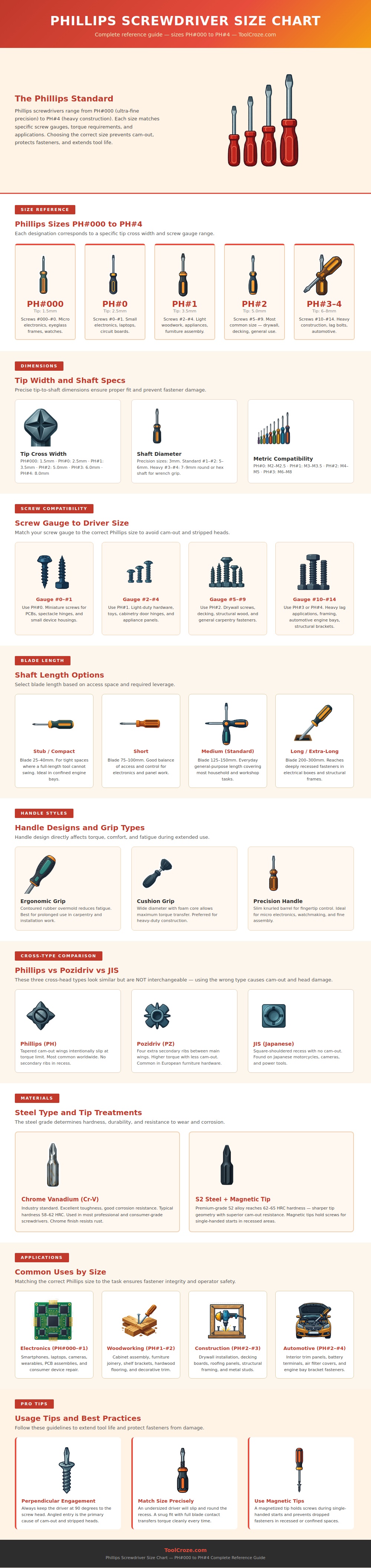
How often has a Phillips head screw driven you crazy? You mash it down and twist, then…clack! Driver falls out of recess. It’s happened to most of us. But it is not usualy for some mysterious reason. It’s nearly always because the fastener in front of you don’t match up with the tool in your hand.
Most of us think of screwdrivers as sticks with grips on them… They’re all basically the same, right? Wrong. There’s much greater precision involved here and the chart above spells it out: a direct link exists between screw size (gauge) and driver tip width. Next time you dig around your toolbox looking for something, guesswork will be eliminated.
How to Pick the Right Screwdriver
A lot of folks don’t realize that the Phillips system has a built-in safety feature baked right into its design. When it’s tightened beyond a certain amount of torque, the cross are designed to widen so the driver can slips out. In other words, it doesn’t strip itself in mass production because it can’t be screwed down past a reasonable amount of tightness.
But that same design also renders the fit extremely important. If your tip is just barely too small, it won’t grip onto the full area of the screwhead. Instead, you will put pressure on tiny points different than spreading the force evenly along the whole recess. And that’s how you turn a viable fastener into a rounded-off disaster needing drill bits or pliers to extract.
Where should you begin? First of all, know thyself. The graphic shows the spectrum from heavy duty construction drivers to ultra-fine precision tools… Although you’re not likely to want them all as part of your main set.
The number two driver will be your main tool for most household jobs. Because it fits most common gauges of screws used in building materials, it covers deck boards, dry wall and other general carpentry fasteners.
Go smaller if you’re working on something more delicate, like assembling furnitures or an electronic device. Narrow drivers fits snugly into recesses, whereas a bigger one might wobble around and scratch the adjacent surfaces.
Go big if you’re doing some heavy framing or automotive work where the bigger sizes can take greater amounts of torque before the shaft bends.
The quality of materials used also plays a role in their effectiveness. For instance, you don’t want to buy a cheap steel-tipped screwdriver that bend out of shape as soon as you apply pressure, especially if you are using it on metal or very hard wood. Chrome vanadium steel blends corrosion resistance and toughness well enough. And if you’re up against some really tenacious fasteners and/or if you’re going pro, then check out the S2 alloy, it’s super hard and holds its edges better.
Another thing to consider that might not seem like much are magnetic tips. That can be useful in tight places like behind paneling or engine bays where keeping both hands free (one on the screw, one on the driver) is a bit of a juggling act. Seems small, but it makes all the difference when working back there.
We tend to focus on grip design only when our hands start hurting halfway through a long task. A good grip distribute pressure more evenly so you can use steady force and not slip. A wide cushion grip handles leverage better for heavy duty projects. A narrow barrel is better for precision work where brute strength doesn’t help but fingertip control does. When done right, the handle becomes an extension of your arm instead of another item you’re fighting to control.
One more thing: Although Phillips-head looks like some other cross-point heads out there, they aren’t interchangeable. Pozidriv screws has extra lines running outward from their main arms. JIS (Japanese Industrial Standard) screws don’t taper into pointed ends but instead have flat shoulders. You can bet your butt that if you try to drive one of those with a Phillips screwdriver, it’ll cause cam-out; unless, that is, you check the head first before applying any force. It’s a little habit that saves a lot of time and aggravation.
You should of checked the head first. If you pick the right sized screw, align the driver perpendicularly with the screw head and use quality materials, there is no slip and slide routine at all. The next time you grab a screwdriver, spend a few seconds verifying the fit. It should engage tightly and turn smoothly. That is what we all want when we finally get around to fixing that thing.
